



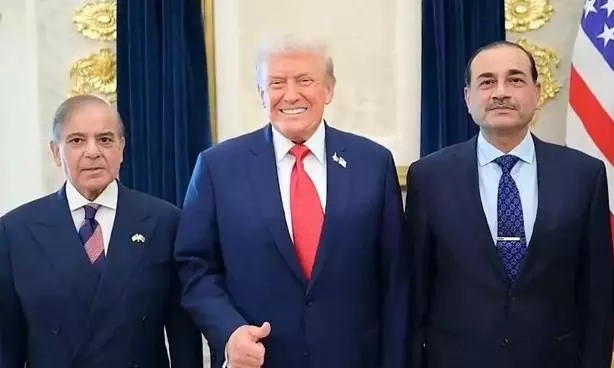
White House approved Pak PM's appeal to Donald Trump on Iran ceasefire: Report
A report claims the White House reviewed and approved Shehbaz Sharif’s public appeal to Trump on Iran, raising questions about diplomatic messaging independence

The White House had reportedly cleared Pakistan Prime Minister Shehbaz Sharif’s public appeal to US President Donald Trump to extend his deadline for Iran.
Report points to prior approval
The revelation that Sharif’s statement had the prior approval of the Trump administration has come to light in a report by The New York Times.
The Pakistani Prime Minister, on Tuesday night (April 7), prior to Trump’s announcement of the two-week ceasefire with Iran, called for a ceasefire to ensure that there is time for diplomacy to take place.
Also Read: Worried by rising oil prices, US pushed Pakistan to broker truce with Iran: Report
He also urged Iran to reopen the Strait of Hormuz during the ceasefire as a gesture of goodwill.
"Behind the scenes, the White House had already reviewed and approved the statement before Sharif posted it," stated the report, quoting sources.
Denial and draft scrutiny
The White House rejected suggestions that Trump personally authored the message, even as renewed attention focused on the post’s edit history and the sequence in which it appeared to have been prepared.
Also Read: Trump-Iran ceasefire raises doubts despite talks of peace in region | AI With Sanket
Screenshots that circulated widely online seemed to show an earlier version labelled “Draft - Pakistan’s PM Message on X.” While their origin has not been formally verified, they were enough to draw scrutiny toward the drafting process rather than the substance of the statement itself.
Questions over messaging independence
The draft version contained references to continued diplomatic engagement in the Middle East and called for a pause in measures linked to the Iran standoff. The inclusion of that language, and its subsequent revision, raised questions about whether the message had been shaped in advance.
Also Read: Pakistan's Vishwaguru moment? It's a narrow escape, not ceasefire
Online discussion has since broadened, with some commentators questioning how independently Shehbaz Sharif frames official communication and whether external influence plays a role behind closed doors.
Sharif’s final message struck a firmer tone, stating diplomatic efforts were “progressing steadily, strongly and powerfully,” and urging restraint to “allow diplomacy to achieve conclusive termination of war.”