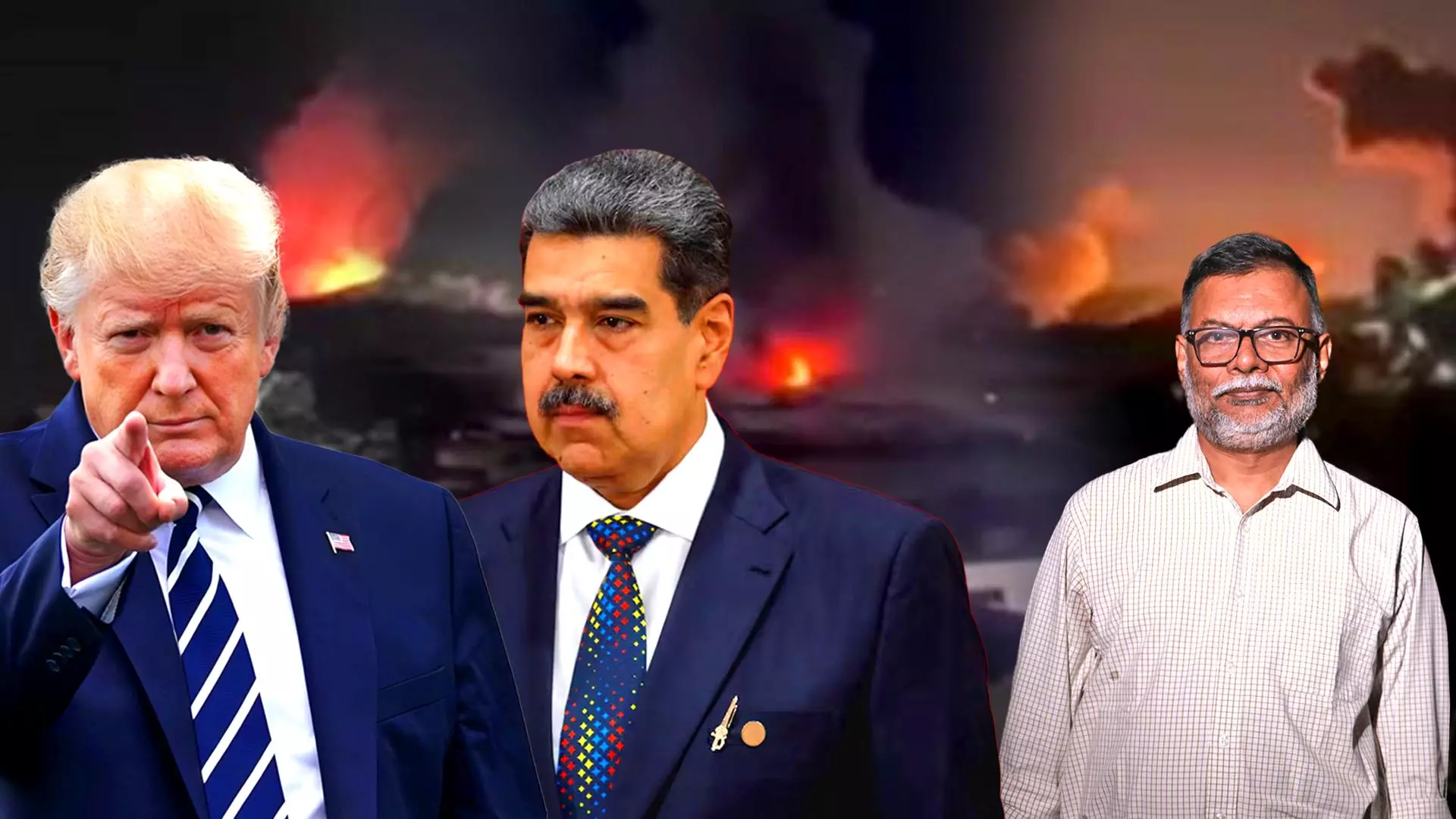
US claim of capturing Venezuela's Maduro signals dangerous return to regime-change politics
The Federal’s consulting editor KS Dakshina Murthy explains why Washington’s latest move against Caracas exposes the limits of international law

A dramatic announcement by US President Donald Trump on social media on Saturday (January 3) claiming that American forces have captured his Venezuelan counterpart Nicolás Maduro and his wife, First Lady Cilia Flores, has sparked outrage and concern across Latin America.
The move marks a sharp escalation in Washington’s long-running confrontation with Caracas and raises fundamental questions about sovereignty, international law, and the future of the US's interventionist policy in the region.
The Federal’s consulting editor KS Dakshina Murthy explains why Washington’s latest move against Caracas exposes the limits of international law.
How do you see today’s escalation, with the US claiming it has captured Venezuelan President Nicolás Maduro?
First of all, the very use of the word “capture” is highly contentious. Venezuela is a sovereign nation, and no other country, including the United States, has the right to capture its president. Nicolás Maduro is a legitimate, elected president. He is not a criminal who can simply be captured. So, the usage of this term itself is deeply problematic.
Also read: Explained: Why did US attack Venezuela?
Many countries in Latin America have objected to this action. What we are seeing is the US playing out its traditional role in Latin America, where it brooks no resistance. This entire Venezuela issue goes back a long time.
Since the time of Hugo Chávez, who was Maduro’s predecessor, the US has been desperately trying to effect regime change in Venezuela. It has failed every time. What we are seeing now is probably the most brazen attempt in this long series to change the government in Venezuela and make it more pro-US.
For the last 25 years, from the time Chávez became president, Venezuela has opposed US hegemony in the region and tried to carve out an independent path. What Donald Trump has done today is not unprecedented in US behaviour. No international power, including the United Nations, can stop the US, and Trump has done something that no other country in the world would be allowed to do.
Was drug trafficking really the trigger for the US action?
The drug trafficking issue was only an excuse, a way to create some kind of legitimacy for regime change. The US was looking for a justification. In fact, if you look at developments over the past few weeks, the leading opposition figure in Venezuela, Ms. (Maria Corina) Machado, was recently awarded the Nobel Peace Prize.
Also read: Russia, Iran condemn as EU, Ukraine back US strikes on Venezuela
All of this was part of a broader process of building momentum towards removing Maduro. In the last couple of days, it appeared that Maduro may have received information that the US was preparing to move decisively. He even offered to hold talks and was on record saying that Trump had recognised him as president and that he was willing to sit down and negotiate.
But the issues are far deeper than that. This is definitely not about drugs alone. Drug trafficking is not new to Latin America. Cartels have been operating for decades. That does not justify one country attacking another.
What the US has effectively done is attack Venezuela and depose a legitimately elected president. The drug issue is simply a cover; it does not explain or justify such an action.
Given all these factors, was this US action expected?
The US has a long history of interventions in Latin America because it considers the region its backyard. There are many examples. One of the most important was Chile, where Salvador Allende was deposed in a coup in 1973 and replaced by Augusto Pinochet. A democratic regime was replaced by a military dictatorship.
Also read: Emergency in Venezuela after Caracas blasts; Maduro blames US ‘military aggression’
Across Latin America and the Caribbean, the US footprint is very obvious. It has intervened repeatedly. There are hardly any exceptions. The only country where the US has not really been successful is Cuba, which has resisted US pressure for decades.
The intervention in Venezuela is simply the latest example. For a long time now, the US has avoided direct military interventions. The last major one that immediately comes to mind is the invasion of Grenada under Ronald Reagan.
After that, the US relied more on coercion and indirect methods, such as encouraging forces to fight the Sandinista government in Nicaragua during the 1980s. But this kind of direct attack — bombing, reaching the capital, and then claiming to capture the president — is something we have not seen in a very long time.
What this shows is that US policy towards Latin America has not fundamentally changed. Trump, despite his claims of being a peacemaker, has shown his true colours. There is no other way to look at this intervention.
What happens next, and what can be expected?
This invasion, or attack on Venezuela, shows that the United Nations is completely powerless. The Security Council is effectively irrelevant in such situations. The US does not care about international law or the legitimacy of its actions.
Also read: Trump reacts to Nobel Peace Prize snub; says Machado accepted award 'in his honour'
More worrying is that the US is already threatening similar action elsewhere, including Iran. Iran is facing internal turmoil over rising prices and economic stagnation, and Trump has warned that the US will not hesitate to intervene there.
This reinforces the idea that the US sees itself as an international policeman, willing to move anywhere and do whatever it wants, regardless of international law. Venezuela is simply the latest example.
As far as the European Union (EU) is concerned, the US’s most important allies are in Europe, and they broadly back what Washington is saying. While the EU may claim it is examining the situation, this is largely meaningless. The EU has no real power to stop or significantly influence US actions, and it is broadly in favour of the US position.
Also read: María Corina Machado: The face of Venezuela’s fight for democracy
Even the Nobel Prize being awarded to the leading Venezuelan opposition figure fits into this broader pattern. It raises questions about what exactly was done to merit such an award and how it aligns with the larger geopolitical context.
The ramifications are clear. Latin America is once again under a form of siege. This US administration has demonstrated that it will continue to push its agenda aggressively. Developments will continue to unfold, and they will need to be followed closely.
The content above has been transcribed from video using a fine-tuned AI model. To ensure accuracy, quality, and editorial integrity, we employ a Human-In-The-Loop (HITL) process. While AI assists in creating the initial draft, our experienced editorial team carefully reviews, edits, and refines the content before publication. At The Federal, we combine the efficiency of AI with the expertise of human editors to deliver reliable and insightful journalism.