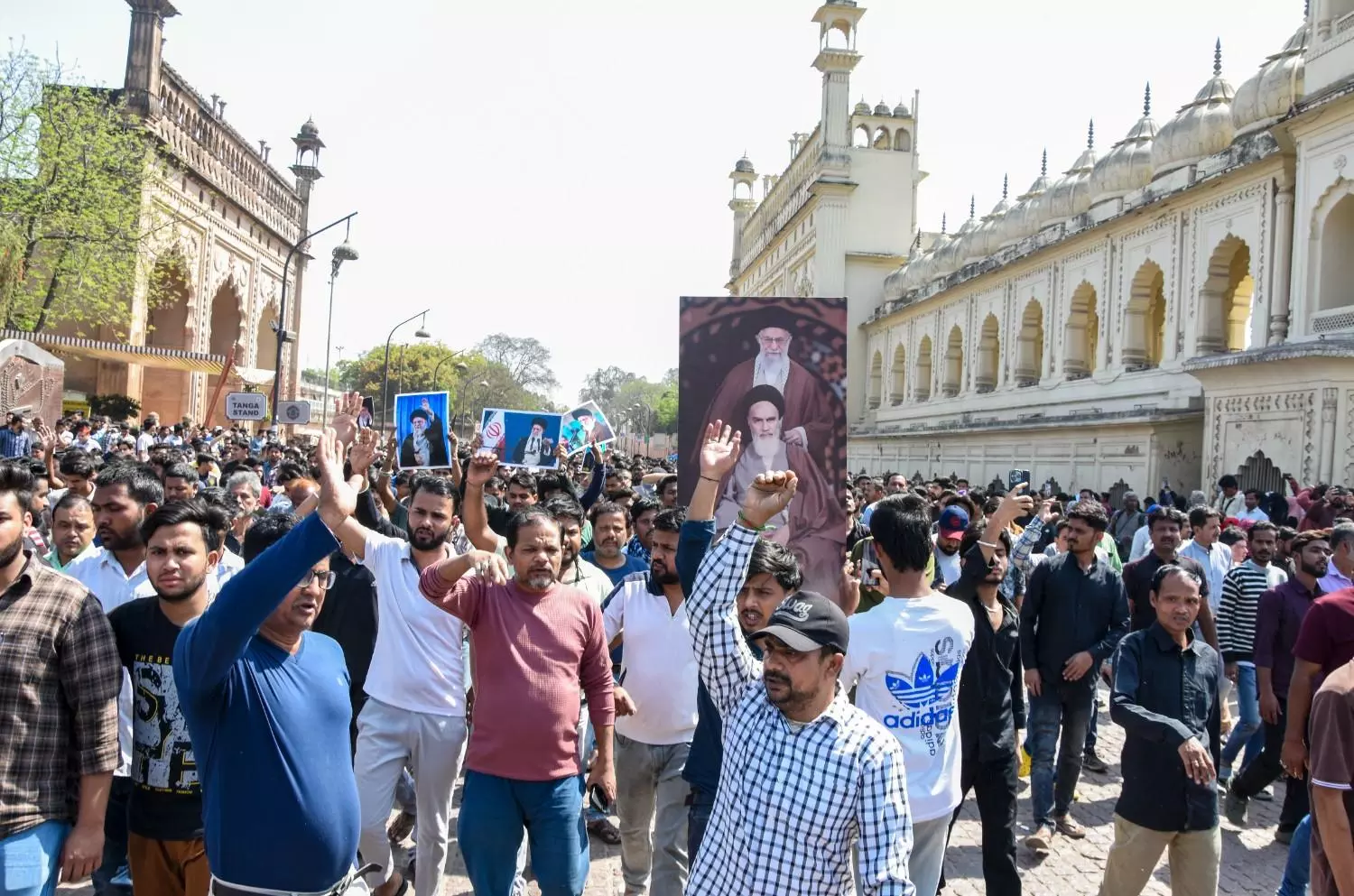
People from the Shia Muslim community shout slogans during a protest against the killing of Iranian Supreme Leader Ayatollah Ali Khamenei near Bara Imambara, in Lucknow, Uttar Pradesh, on March 1, 2026. Photo: PTI
Mourning Khamenei: Lucknow’s ties with Iran run deeper than geopolitics
With historical roots tracing back to the 18th century, the city's Shia community views the loss of Iran's leadership through a lens of religious and emotional kinship

As the Israel-US war against Iran continued in the Middle East, posing serious global economic threats, one cannot overlook the cultural and religious consequences that the conflict has left across the world. India has been no exception either, with Shia Muslims vehemently protesting against Israel and the US over the killing of Iran’s Supreme Leader Ayatollah Ali Khamenei by an Israeli missile on February 28, the very first day of the conflagration.
Follow Live updates on Iran war here
Such protests have been found in various cities and states of the country, including Lucknow, which has strong religious and cultural links with Iran, which today occupies the historically popular region called Persia in West Asia.
Awadh Nawabs' links with Iran
The capital city of Uttar Pradesh is even called “Mini Iran” by many owing to the fact that it is a major Shia cultural centre, thanks to the deep historical, cultural and architectural connections with Persia (and now Iran) that were established during the times of the Nawabs of Awadh. Lucknow served as a key centre and later became the capital of the Kingdom of Awadh that existed between 1722 and 1856 when the British annexed it.
Also read: This is the real Gulf War, and the world is paying the price
It is not surprising that the grim mood that prevails in the city in the wake of Khamenei’s elimination is profound. While protests over his death have occurred in other parts of India, too, the strong public display of grief in Lucknow is unique. While several by-lanes in the ‘City of Nawabs’ have worn a deserted look, black flags were found flying on houses in areas of Old Lucknow that are mostly occupied by Shias.
A photo of slain Iranian Supreme Leader Ayatollah Ali Khamenei hung on one of Lucknow's architectural marvels to protest his death in Israel-US attacks on February 28, 2026.
Posters featuring Ali Khamenei’s images and slogans against Israel and the US were seen on buildings dating back to the era of the Nawabs. Lucknow even saw a three-day mourning after Khamenei was killed, and the Nawab-era buildings remained shut during that time, developments that caught much public attention. The mournful ambience has continued even a week after the supreme leader died, along with many of his family members and top Iranian officials.
First Nawab of Awadh was from Iran
Explaining the impact that the Iranian culture had on Lucknow, senior journalist Syed Husain Afsar, who hails from the city, told The Federal, “The Nawabs of Awadh were associated with the historic Iranian city of Nishapur or Neyshabur (located in the Razavi Khorasan province). It was they who brought Iranian culture, poetry, worship practices, and building styles to Lucknow. It all began in 1722 when Nawab Saadat Ali Khan I of Iranian descent laid the Awadh kingdom’s foundation here and introduced all the things that were done in Iran, thus making Lucknow a stronghold of the West Asian nation’s culture.” It is also because of this reason that Lucknow earned the nickname of “Mini Iran”, he added.
A little history
Saadat’s rise as the founder of the kingdom was not an easy journey. Born Mir Muhammad Amin in the then Persia, he had arrived in India around 1708 and served in the court of the Mughals, who were in decline then, in various capacities for more than 12 years. He grew in ranks under various Mughal rulers in Delhi before being appointed as the governor of Awadh in 1722. He was also conferred the title of ‘Burhan-ul-Mulk’ by one of the Mughal emperors. He ruled till 1739 when he died. This is when the Persian or Iranian influence vividly entered Awadh, in terms of culture, architecture and even cuisine.
Also read: Did India provide intelligence inputs on Iranian warship to US?
The historic ties become evident when one sees the food habits, lifestyle and way of worshipping by the city’s Shia community today. The Nawabs of Awad had constructed many places of worship and buildings in Lucknow on the lines of those found in Iran and Iraq. The influence of the Iranian tradition can be spotted in many parts of the old city during the solemn observance of Muharram. However, the Nawabs also ensured a cultural fusion, blending the Iranian traditions with the local Hindu ones to begin a new ‘Ganga Jamuni Tehzeeb’ (Ganga-Jamuni culture).
Lucknow's Shias bring 'kafan' from Iran
To give another example to show how close Iran is to the heart of Lucknow’s Shias — people from the community bring their own ‘kafan’ (the shroud or cloth or an enveloping garment in which a dead person is wrapped during burial) from the West Asian nation. They consider it auspicious to bring it from Iran or Iraq whenever they go to those countries for pilgrimage.
Speaking on the faith, Afsar said people bring the shroud from Iran after touching it to Iran’s sacred 'Tazia' (the ornate replica of the tomb of Imam Hussain, the grandson of Prophet Muhammad) for they believe that by wearing the shroud brought from Iraq or Iran, all their sins would be pardoned. “People even tell people who go there to bring shrouds for them as gifts,” he told this publication.
'Their protest is not political, but emotional'
While the protests in India over Ali Khamenei’s death have resulted in debates and criticism, Afsar said the issue is a religious and emotional one, not a political one for the Shias.
“Shiites have religious ties with Iran. If this protest remains peaceful and no violence takes place, it is not a bad thing. No person, institution, or system in India is being targeted; people are simply expressing their own grief and anger,” he said.
Also read: What is Blue Sparrow, the missile that 'came from space' to kill Khamenei?
There are also links between Lucknow and Iran in matters of education and employment. People go to the Iranian city of Qom, which is a premier centre for Shia Islamic studies, to study Shia theology. Many youth from Lucknow are among them. Many are also doing jobs in cities such as Iran and others. Those families are also concerned about the safety of their loved ones amid the war.
What are the Shias in Lucknow thinking about Iran’s situation after Ali Khamenei’s death? To this, Afsar said the people of Iran have been facing challenges for a long time, in the form of sanctions. “They own oil, but they are subject to several sanctions, such as financial. They have fought them, too. But the current crisis is taking a wide form, and what lies ahead cannot be said at this moment,” he told The Federal.
The article was originally published in The Federal Desh.