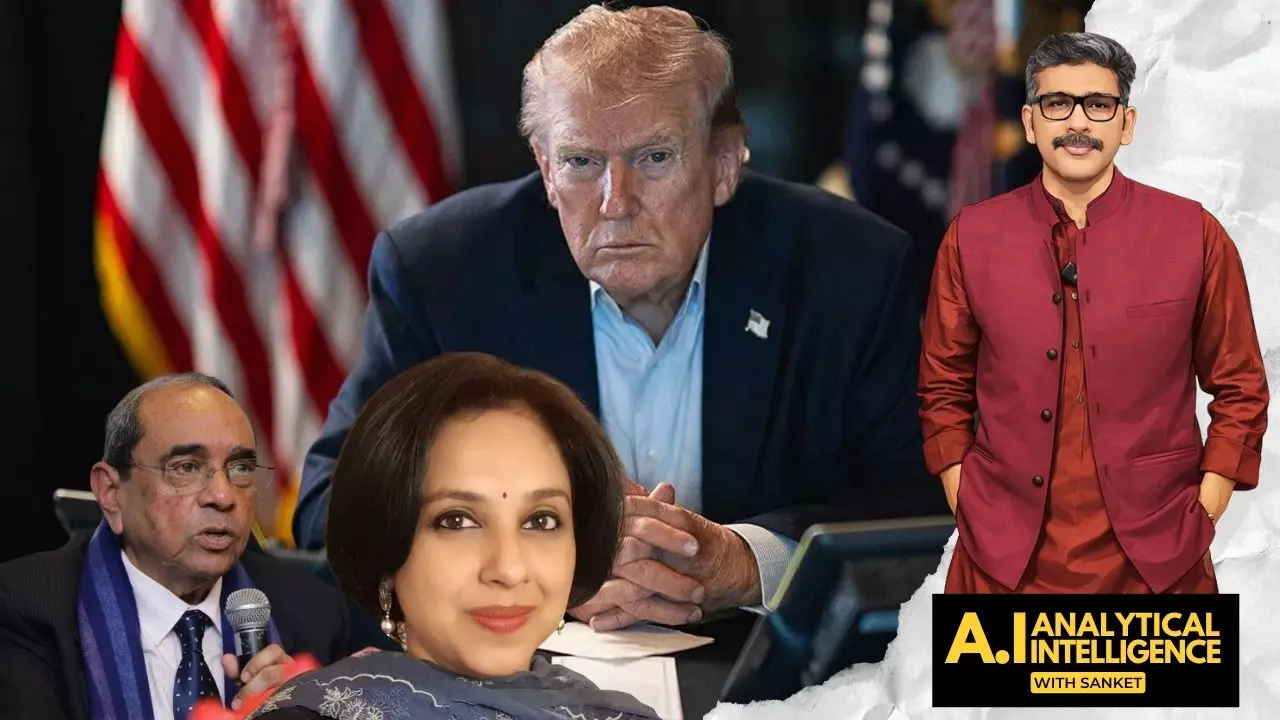
Trump’s Iran profanity: Desperation or dangerous escalation? | AI With Sanket
Panel warns of risky escalation as Donald Trump’s language and strategy in Iran conflict signal unpredictability and growing global concern

US President Donald Trump’s increasingly aggressive rhetoric, including the use of profanity in public messaging, reflects a worrying mix of unpredictability and desperation, experts warn. As the conflict involving Iran intensifies, concerns are growing over whether the United States could escalate further in pursuit of a “victory narrative.”
The Federal spoke to former Foreign Secretary Shashank and senior journalist Suhasini Haidar, who analysed the implications of Trump’s communication style, strategic decisions, and the broader risks of the ongoing conflict.
Unfiltered messaging
The discussion began with a striking question: has any global leader, particularly the US President, ever used such language publicly? Shashank pointed out that while American presidents traditionally relied on carefully prepared briefs, Trump has increasingly inserted his own voice into official communication.
According to him, this reflects a leadership style driven by a desire to shape a legacy as one of the “best presidents” in US history. However, this has also meant sidelining institutional checks, with Cabinet members often reduced to “yes men” who avoid contradicting the president.
Also Read: Live! Iran warns of 'devastating retaliation' after Trump's threats
Haidar added that Trump’s messaging marks a significant departure from diplomatic norms. “Presidential communication has never been so direct,” she noted, pointing out that such language indicates the messages are coming directly from Trump himself rather than being filtered through official channels.
Diplomacy shift
Haidar argued that while such blunt rhetoric may seem shocking, it also exposes what has historically remained behind closed doors. She recalled past instances of aggressive US language, including remarks attributed to American officials after 9/11, but emphasised that those were never publicly articulated in this manner.
What makes the current situation different is the transparency of that aggression. Trump’s use of social media to communicate directly bypasses traditional diplomatic filters, making the rhetoric more immediate—and potentially more dangerous.
She also pointed out that the inconsistency in Trump’s messaging—shifting deadlines, changing narratives—suggests that the situation is not unfolding according to plan. This unpredictability, she said, adds to global uncertainty.
War trajectory
As the conversation moved to the broader conflict, Shashank highlighted a historical pattern in US foreign policy. He argued that successive American administrations—regardless of political affiliation—have sought to control strategic regions, often leading to prolonged conflicts.
Drawing from personal experience in Vietnam and Libya, he described how local populations resisted foreign intervention, leading to drawn-out wars and eventual US withdrawal. He suggested that similar dynamics could play out again.
Also Read: ‘Hell will rain down’: Trump reminds Iran that 48 hours remain of Hormuz deadline
Haidar reinforced this concern, warning that the real danger lies not in initial threats but in escalation. “Wars don’t begin with the intention of going to the extreme,” she said, but the pressure to secure a victory often pushes leaders further than intended.
Escalation fears
The panel raised serious concerns about the possibility of escalation beyond conventional warfare. The discussion referenced historical precedents, including the use of nuclear weapons, to underline the risks.
Haidar cautioned against dismissing Trump’s threats as mere rhetoric. While some may view his statements as theatrical, she stressed that decisions at the executive level in the US can have immediate and far-reaching consequences.
She also questioned the absence of effective “guard rails” in the current scenario. With allies expressing reservations and limited internal resistance within the US administration, the decision-making process appears increasingly centralised.
Global stakes
Shashank identified two potential stabilising factors: Iran’s strategic restraint and pressure from regional players. He noted that Iran’s actions—such as allowing the safe return of US personnel—could be interpreted as signals aimed at de-escalation.
At the same time, he pointed out that regional dynamics, including concerns among Arab nations about environmental and humanitarian fallout, could influence the course of the conflict.
However, both panelists agreed that the situation remains fragile. The lack of a clear diplomatic pathway, combined with competing narratives of victory, complicates efforts to bring the conflict to an end.
Exit strategy
On the question of how the war might conclude, Haidar suggested that any resolution would require a credible “off-ramp” for all parties involved. This could involve ceasefire agreements, non-aggression pacts, or negotiated commitments.
Also Read: Lost jet, destroyed planes, daring rescue: How US airman was pulled out of Iran
However, she emphasised that the US would need to construct a convincing narrative of success to justify withdrawal—something that has historically prolonged conflicts.
Referencing Afghanistan, she noted how the US remained engaged for two decades before ultimately withdrawing without achieving its original objectives. This pattern, she warned, could repeat itself.
Uncertain future
The discussion concluded with a sobering assessment: the current trajectory of the conflict is deeply uncertain and potentially dangerous. Trump’s rhetoric, combined with shifting strategies and limited institutional checks, has created a volatile situation.
Both experts stressed that while diplomacy remains the only viable path forward, the conditions for meaningful negotiations are not yet in place.
As Haidar put it, the key question is not whether escalation is possible—but how far it might go before restraint prevails.
(The content above has been transcribed from video using a fine-tuned AI model. To ensure accuracy, quality, and editorial integrity, we employ a Human-In-The-Loop (HITL) process. While AI assists in creating the initial draft, our experienced editorial team carefully reviews, edits, and refines the content before publication. At The Federal, we combine the efficiency of AI with the expertise of human editors to deliver reliable and insightful journalism.)