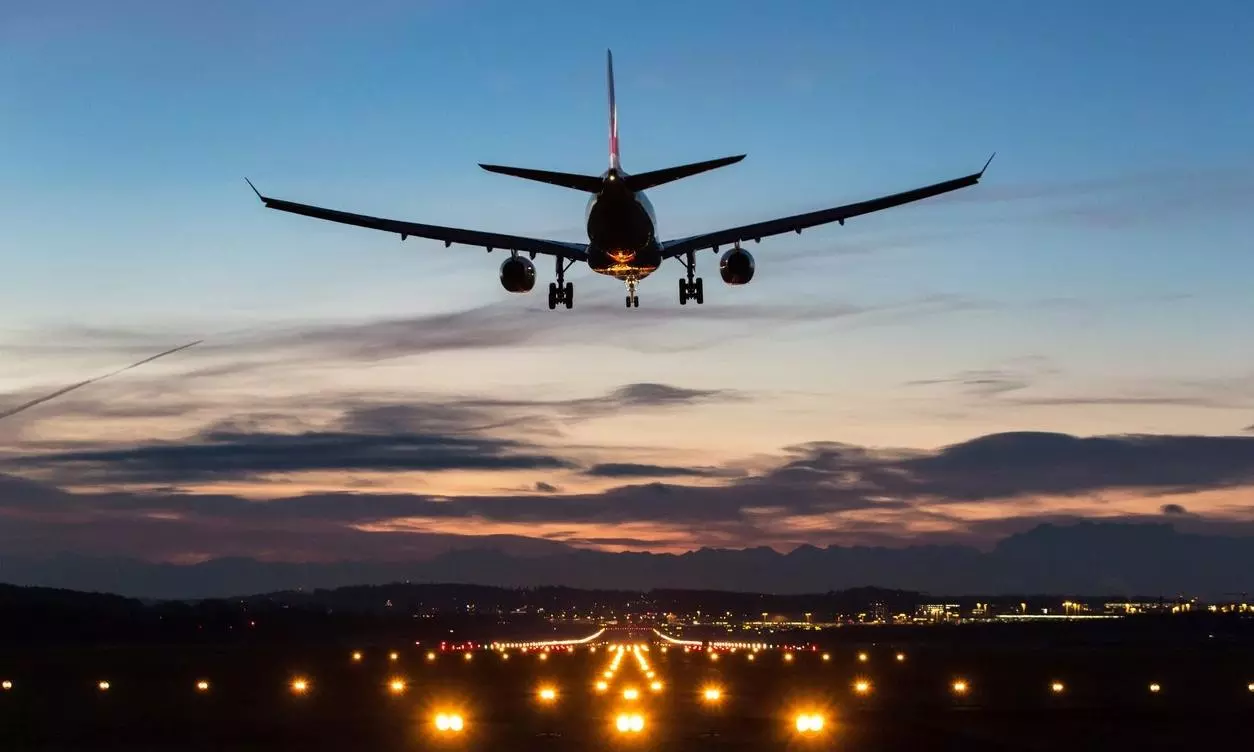
The global aviation sector has been hit by the ongoing crisis in West Asia. Photo: iStock
No Gulf hubs, no cheap tickets: How Iran war grounded low-cost air travel
Rerouted flights, jet fuel price hikes, India's percentage-based ATF tax structure combine to push some long-haul fares past Rs 2 lakh, with no relief in sight

For the global aviation industry, the worst is coming true. With the Israel-US war on Iran completing two weeks, air carriers across the world are feeling the bite, thanks to the sharp spike in prices of jet fuel as a consequence of the war.
Airlines worldwide and in India have been raising fares and adding new fuel surcharges on a range of domestic and international routes. Tickets that once cost Rs 45,000–1,00,000 are now selling for Rs 1.3–2.25 lakh on certain India-US flights, a result of soaring fuel prices and costlier reroutes avoiding the conflict zone. Other routes too have seen a big spike.
How airfares have jumped
♦ Bengaluru-London: from Rs 80k to Rs 120k
♦ Bengaluru-New York: from Rs 1L to Rs 2L
♦ Bengaluru-Frankfurt: from Rs 80k to Rs 1.9L
♦ Bengaluru-Dubai: from Rs 12k-15k to Rs 22k
♦ Bengaluru-Singapore: from Rs 20k to Rs 40k
♦ Bengaluru-Malaysia: from Rs 20k to Rs 30k
♦ Hyderabad-Muscat up to Rs 40k
♦ Hyderabad-Dubai from Rs 8k-15k to Rs 40k-50k
Airlines, understandably, are passing the costs on to passengers through higher base fares and fuel surcharges.
ATF prices hit the skies
In India, state‑owned oil marketing companies (OMCs) raised domestic aviation turbine fuel (ATF) prices at the start of March, by 5-6 per cent, pushing Delhi ATF rates into the mid-Rs 90,000/kl range.
Executives and industry groups note that ATF pricing in India is based on import‑parity formulas linked to international benchmarks, such as the Mean of Platts Arab Gulf (MoPAG) assessments for jet-fuel cargoes. Since the Indian ATF is benchmarked to Gulf jet fuel prices rather than purely to domestic refinery costs, war‑driven spikes in regional jet fuel benchmarks are quickly transmitted into Indian fuel invoices.
Also read: West Asia conflict paralyses South India’s granite exports
Analysis by commodity and aviation specialists highlights that output issues and logistics constraints at large export hubs in Saudi Arabia, the UAE, Kuwait and Bahrain have tightened jet fuel supply, helping to drive global jet cracks to unprecedented levels.
Tax structure at play, too
On top of the benchmark effect, India’s tax structure further amplifies the impact of higher fuel prices. Central excise duty and state‑level value‑added tax are levied as a percentage of the ATF base price, and VAT (Value Added Tax) rates in major hubs such as Delhi are often in the 20-25 per cent range.
As a result, when international benchmarks rise, the absolute tax burden on each kilolitre of ATF increases, compounding the cost pressure faced by airlines.
Against this backdrop, Indian carriers have moved quickly to introduce fuel surcharges on new bookings. Air India has implemented a new surcharge framework from Thursday (March 12), adding Rs 399 per ticket on domestic and SAARC (South Asian Association for Regional Cooperation) routes and introducing additional surcharges of around $10 on West Asia routes, with higher dollar surcharges on longer‑haul international flights.
Also read: Sensex, Nifty drop nearly 1 pc as West Asia conflict, surging oil prices rattle stock markets
Public statements and media reports indicate that surcharges on Southeast Asia services have been lifted to up to $60, while Africa routes are seeing surcharges of up to $90 per ticket. From March 18, surcharges on European sectors are set to rise into the $125 range, and those on North American and Australian routes to around $200, implemented in phases across the network.
IndiGo's fuel surcharge
IndiGo, India’s largest carrier by market share and also a budget one, has likewise announced a fuel surcharge effective Saturday (March 14).
According to the airline’s disclosures, surcharges range from Rs 425 on domestic and short‑haul flights within the Indian subcontinent to as much as Rs 2,300 on longer‑haul routes to Europe, with intermediate bands (for example, around Rs 1,800) applied to services to Southeast Asia, China and parts of Africa.
Akasa Air has followed suit, stating that from Sunday (March 15), it will levy fuel surcharges ranging from Rs 199 to Rs 1,300 per ticket on domestic and international routes, with the exact amount determined by flight duration and sector length.
Rerouting pains
In parallel, several carriers are avoiding parts of the West Asian airspace, lengthening flight paths and driving up fuel burn and operating costs, thereby reinforcing pressure on fares.
On North American routes linking Indian hubs such as Delhi and Mumbai with American cities such as New York and Newark, booking data and travel agents’ quotes show that one‑way economy fares on certain dates are now trading at roughly double, and in some cases more than double, their typical levels.
Tickets that might normally be available in a Rs 45,000 to Rs 1,00,000 range are, on some high‑demand and constrained flights, are being sold in the Rs 1.3 lakh to Rs 2.25 lakh range. This reflects both the fuel spike and rerouting around restricted West Asian airspace, which lengthens flight times and pushes up operating costs.
Foreign airlines' actions
European and Asian network carriers are also adjusting their pricing. Air France-KLM has announced increases in long‑haul ticket prices from Thursday (March 11), citing the surge in jet fuel costs linked to the Iran conflict; typical economy‑class long‑haul fares are expected to rise by around 50 euros — roughly $55-$60, or close to Rs 4,800 at current exchange rates.
Also read: Current West Asia conflict lacks a roadmap, says geopolitical expert: 'A pointless war'
Thai Airways, meanwhile, according to reports, has said it is raising international fares by about 10-15 per cent to reflect higher fuel costs, using its existing surcharge and pricing mechanisms to recover some of the additional expenses.
The situation has been affected in Delhi, Mumbai, Chennai, Bengaluru and Hyderabad, among India’s major economic hubs that are closely connected with international business hubs.
Due to changes in air routes, fuel shortages and price hikes, there has been a sudden and huge increase in ticket prices for international and domestic flights departing from Bengaluru’s Kempegowda International Airport , one of the busiest in the country.
Travel to Middle East falls
In the wake of the war, the number of people travelling to the Middle Eastern countries has completely decreased due to security concerns. Giving information about this, S Mahalingaiah, director of the city-based Skyway International Travels, told The Federal, “Flight on the Middle East route has been completely disrupted, and flight services to Dubai have almost stopped. Due to the lack of service from Middle Eastern flights, European airlines have monopolised and increased ticket prices drastically.”
According to him, the fares for international flights (economy class) are as follows: The fare between Bengaluru-London, which was earlier Rs 80,000, has now increased to Rs 1,20,000. The ticket price between Bengaluru and New York, which was Rs 1 lakh, has now doubled to Rs 2 lakh. The fare between Bengaluru and Frankfurt which was Rs 80,000, has become Rs 1,90,000.
Also read: Beyond oil and LPG: How Iran conflict is wrecking multiple sectors
The war-related traffic has also seriously affected the business of air travel agencies. Tickets are being cancelled in large numbers, and ticket prices for most routes have doubled.
Big hit for travel agents
Vineet Kumar V, manager at Bengaluru’s Richvi Rich Holidays Travels, said, “Air travel has become very expensive due to the Israel-Iran war. Due to the lack of flights from Dubai airport, the layover time for passengers is increasing drastically.”
He added that the fare between Bengaluru and Dubai, which was earlier Rs 12,000 to Rs 15,000, is now Rs 22,000 (flights on this route are currently cancelled). The fare between Bengaluru and Singapore, which was Rs 20,000, is now Rs 40,000. The fare between Bengaluru and Malaysia has increased from Rs 20,000 to Rs 30,000.
In particular, passengers going to the US have to rely on Singapore airport instead of Dubai, where they have to wait for a layover for more than 10 hours.
The fare from Bengaluru to Munich has gone up six times, according to a passenger who arrived in India with a pre-war ticket. While normal pre-war fare doesn’t exceed Rs 50,000 to 60,000, it costs now Rs lakh to 3.5 lakh, he told The Federal. The surge is due to a circuitous route taken to avoid the disturbed Gulf zone.
Flight cancellations
In Hyderabad, as many as 29 flights connecting the city with Gulf countries stood cancelled as of Saturday, including 13 arrivals and 16 departures. IndiGo alone cancelled 19 services between Hyderabad and multiple Gulf destinations, further disrupting travel plans. Hyderabad-Dubai remained the most affected route.
Also read: As Iran war hurts international trade, inflation looms large for the common man
The cancellation of flights and reduced operations has also led to a sharp increase in airfares in all sectors by three or four times.
Direct tickets from Dubai to Hyderabad are currently priced between Rs 40,000 and Rs 50,000, compared to the usual pre-war fares of Rs 8,000 to Rs 15,000.
Similarly, the fares from Muscat to Hyderabad have surged to Rs 30,000-Rs 40,000, as against the pre-war fare of Rs 7,000 to Rs 15,000.
(With inputs from The Federal Karnataka and The Federal Telangana.)