



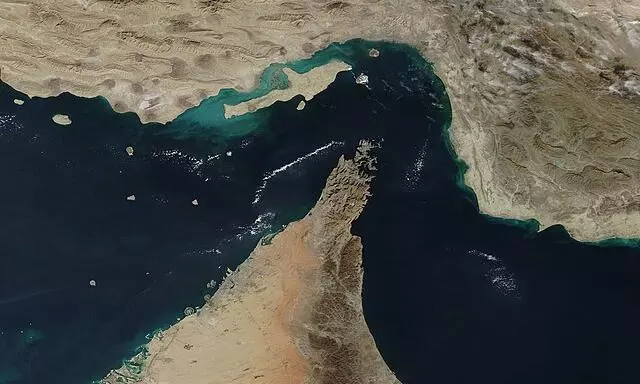
The blocking of the strategic Strait of Hormuz has disrupted around 86 per cent of the usual east-west crude oil traffic, rattling the energy markets. File photo: Wikimedia commons
Strait of Hormuz gridlock: India braces for energy shock as global oil flows freeze
As 700 tankers idle at Strait of Hormuz and Gulf oil flows collapse by 86pc, New Delhi triggers emergency protocols to prevent a domestic LPG and fuel crisis

Strategic crude transit through the Strait of Hormuz has come to a near-total halt with daily traffic plummeting by a staggering 86 per cent over the last 48 hours pushing energy markets to the brink.
Roughly 706 non‑Iranian tankers are now stacked on both sides of the strait: 334 crude carriers, 109 dirty product tankers and 263 clean product vessels.
Clearly, while the waterway remains technically open, maritime data from Windward and Kpler reveals a different scenario.
On March 1, only three tankers carrying a mere 2.8 million barrels crossed Hormuz — a fraction of the 19.8 million barrel average seen earlier in 2026—leaving global markets teetering on the edge of a supply catastrophe. By the morning of March 2, activity had dwindled further to just two small vessels, one small tanker and one small cargo ship, moving through the lanes.
Several ships are idling in the Gulf of Oman, signalling deepening uncertainty in one of the world’s most critical oil transit corridors.
Also read: Iran blocks Strait of Hormuz traffic, India issues urgent advisory for seafarers
Notably, more than 14 million barrels per day flowed through the Strait in 2025, or a third of the world’s total seaborne crude exports, according to data from Kpler. Roughly three-quarters of those shipments were destined for China, India, Japan and South Korea.
Also read: Explained: How closure of Strait of Hormuz impacts India
Oil markets react
Brent crude jumped to USD 80 per barrel, rising nearly 10 per cent, while European gas jumped more than 40 per cent after Saudi Arabia's Ras Tanura refinery and a Qatari LNG plant was attacked by Iran.
But, if the route is disrupted or blocked, what happens to global energy markets and it’s impact on India?
If the disruption continues, the delivery schedules will be impacted as war‑risk insurance has already tightened sharply for Gulf waters. With freight charges increasing, the fuel prices are impacted.
Why India should worry?
Industry estimates that about one-third of its petrol and nearly a quarter of its diesel production is exported. Liquefied petroleum gas (LPG), however, remains a critical weak spot. The country relies on imports for nearly 80–85 per cent of its LPG requirement, most of it sourced from Gulf suppliers through the Strait of Hormuz.
According to industry assessments, existing inventories could last for less than a fortnight if incoming shipments are disrupted.
Also read: As West Asia flares up, what's in store for India's energy security?
Indian Oil, HPCL and BPCL have started ramping up LPG production at select plants to cushion supplies. Oil Minister Hardeep Singh Puri has said that India’s combined crude and petroleum product stocks — spread across strategic reserves, refineries, ports and floating storage — are sufficient to meet about 74 days of demand.
Within this, industry estimates suggest that dedicated crude storage in strategic caverns accounts for roughly 17–18 days, refined fuel inventories for about 20–21 days, and LNG storage for around 10–12 days of consumption.
New Delhi’s plan of action
India procures nearly 55 per cent of its crude imports from the Middle East, amounting to roughly 2.7 million barrels per day. With this temporary blockage, officials in New Delhi are weighing emergency steps.
Reports suggest India may scale back petrol and diesel exports to safeguard domestic supplies, while stepping up crude imports from Russia. The government is also mulling demand-side measures, including possible LPG rationing, if disruptions continue.
Also read: Iran-Israel conflict marks return of Western power politics
"We are continuously monitoring the evolving situation, and all necessary steps will be taken in order to ensure availability and affordability of major petroleum products in the country," the oil ministry said on X after Oil Minister Hardeep Puri reviewed supplies.