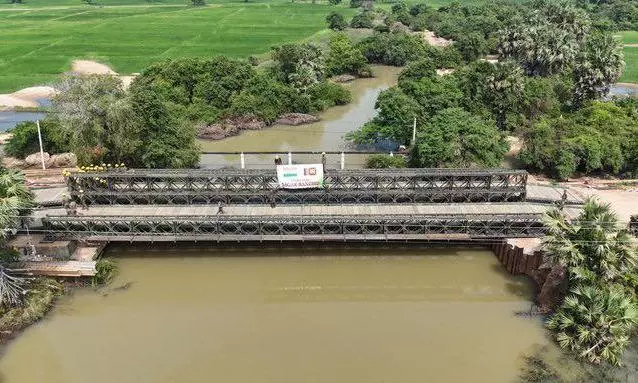
The 120-foot dual carriageway Bailey Bridge in the Kilinochchi District of Northern Province, one of the areas severely affected by Cyclone Ditwah. Photo: Facebook/S Jaishankar
India-built Bailey bridge in Sri Lanka under strain; Tamils seek permanent structure
Restrictions on heavy vehicles along the Kilinochchi–Mullaitivu link spark calls for New Delhi to fund a concrete bridge using part of its post-cyclone assistance

India is under scrutiny after a Bailey bridge it built in Sri Lanka’s most impoverished region began showing strain just two months after completion, prompting usage restrictions and calls from Tamil communities for a more permanent replacement.
Also read: EAM Jaishankar meets Lanka PM Amarasuriya, assures India's commitment to rebuilding
Tamil residents in Kilinochchi and Mullaitivu said India has the financial muscle to quickly construct a lasting bridge on the vital A035 road link that connects the two districts in the island nation’s north.
Excess use of temporary bridge
A cross-section of Tamils interviewed over the telephone said the 120-feet dual carriage Bailey bridge, opened formally on December 23 last year, has suffered damage apparently due to unexpected load and constant use.
They said that though the bridge set up by the Indian Army was a temporary solution after the original bridge on a seasonal canal collapsed in the devastating cyclone of November 2025, no one expected it to get damaged so soon.
This has sparked appeals from Tamils in the two districts that India must use a small part of its USD 450 million post-cyclone assistance to Sri Lanka to rapidly provide a lasting concrete bridge.
Economic strain, traffic curbs
They said the Sri Lankan government is in too much financial distress to build a new bridge, leaving Tamils in the sprawling region to suffer as restrictions bar heavy vehicles weighing over 110 tonnes from using the Bailey bridge.
Also read: Sri Lanka placing roadblocks on Tamil refugees’ return from India
At present, heavy vehicles and trucks must take a long detour, while bus passengers have to disembark, walk across the bridge, and reboard after the buses cross with only the crew. There are no restrictions on light vehicles. Motorists say they hear metallic sounds, as if something is shaking, while driving over the Bailey bridge.
“Sri Lanka is not economically sound. In any case, the government has other priorities dealing with the south and central hills,” two-time former MP Murugesu Chandrakumar said.
Call for permanent structure
“If the Indian government can build a concrete bridge there, our people will be very grateful,” said the 61-year-old former Tamil militant who is now a leader of the Equality Party.
Velayutham Karikalan, chairman of the Pradeshiya Sabha at Puthukkudiyiruppu in Mullaitivu district, said the affected road was a vital surface link and played an immensely important role in the region’s economy. “People badly need a new bridge,” he said in an interview. “If the government uses IMF money it has to build the bridge, it will be good. But in view of Sri Lanka’s financial crisis, it will be ideal if India constructs a new bridge at the earliest.”
Indian diplomats have reportedly told the Tamil media that they would be open to building a new bridge if Colombo requested.
However, a Mullaitivu resident said India must be proactive on the issue and tell Sri Lanka that it wants to build a concrete bridge. “It is a matter of India’s self-respect. They should not see this from a narrow procedural point of view,” said the resident who did not want to be named. “Already some YouTubers are making fun of India over the bridge, disregarding how useful it was when it came up.”
Also read: Sri Lanka’s ‘Indian Tamils’ allege racial bias, seek justice and dignity
For two full weeks following the cyclone, which killed hundreds across Sri Lanka and caused widespread destruction to infrastructure, the main arterial road to Mullaitivu from Kilinochchi remained cut off, causing immense distress to tens of thousands of people, including traders and businesses.
Bridge damage raises alarm
A Bailey bridge, normally erected by Army engineers, is a temporary measure. If it is constantly subjected to overloading, it will show signs of distress and damage earlier than expected.
A Jaffna resident who frequently travels to Mullaitivu said one reason the Bailey bridge was damaged was that oversized trucks repeatedly used it to ferry heavy construction material for a nearby bridge that has been under construction for years. “I saw these huge trucks myself,” he said.
“If India had not helped after the cyclone, we would still be suffering,” added Kilinochchi-based journalist M Thamilselvan (45). “If the Indian government is ready to construct a new bridge in the area, people will certainly welcome it.”
Also read: Amid India-China aid race in Lanka, Tamils seek a diplomatic ‘help’ from Modi
Chandrakumar added, “Had India not erected the Bailey bridge, the road would have remained cut off as it was for a fortnight after the cyclone. Everyone suffered very badly then.”
A Mullaitivu Tamil resident, who also wished to remain anonymous, said: “We are told that Bailey bridges are temporary solutions. Most people don’t know this. If that is true, why was there such a high-profile inauguration of the bridge?”
He referred to a December 23 event in Colombo when Indian Foreign Minister S. Jaishankar formally opened a Kilinochchi Bailey bridge along with senior Sri Lankan minister Vijitha Herath, with President Anura Dissanayake watching.
Emergency relief after cyclone
India came out with emergency assistance of USD 450 million after the November cyclone, one of the worst to ravage Sri Lanka.
Kilinochchi and Mullaitivu, two of the five districts that make up the Northern Province, are economically the most backward among all 25 districts in the country.
These two districts also suffered the highest human fatalities and property destruction when the Sri Lankan military crushed the Tamil Tigers in 2009. The rebels had for long held sway over Kilinochchi and Mullaitivu.
Also read: India proposes USD 450 million aid for Sri Lanka after Cyclone Ditwah
Tamil residents said the choice of the Bailey bridge on the key road connecting the two districts was the most appropriate decision considering the immediate need after the natural disaster. The alternative to the Kilinochchi-Mullaitivu road are non-surfaced rural lanes that are both difficult to drive on and involve winding detour, costing both energy and money.
This month, 10 additional Bailey bridges arrived in Colombo from Visakhapatnam, India, and were formally handed over to the Sri Lankan government. The Indian High Commission said these would be installed at various locations across the country in close coordination with the Sri Lankan Army and the Road Development Authority.
India had earlier provided four Bailey bridges. Two of them were installed in Kilinochchi district and two on the Kandy-Ragala Road. These have played a key role in restoring connectivity in difficult terrains.