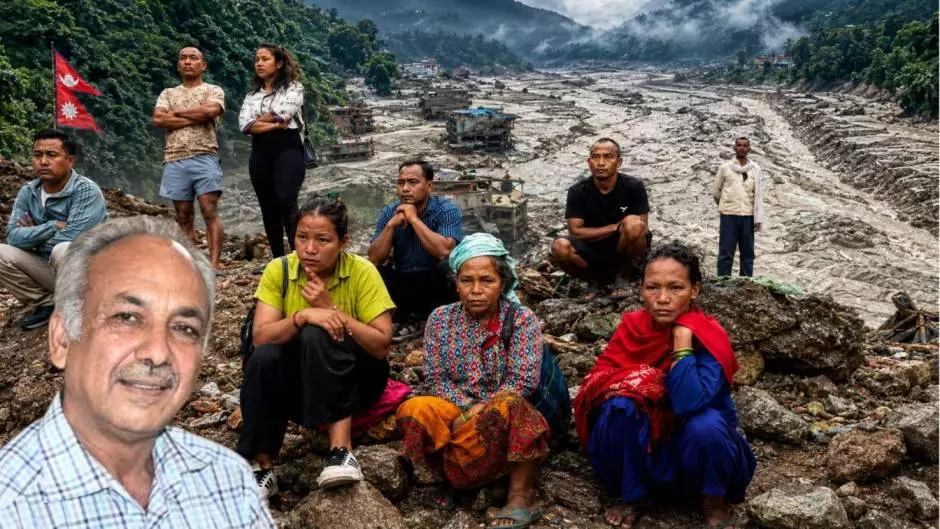
China warns of second flood; is Nepal prepared? | Yubaraj Ghimire Exclusive
Senior journalist Yubaraj Ghimire speaks on the scale of the devastation and whether Nepal is prepared for another flood

A fresh warning from China about a barrier lake near the Nepal border has raised fears that the country could face another devastating wave of flooding even as rescue and relief operations continue after the first disaster.
Follow live updates of Nepal floods
The lake already holds about 2 million cubic metres of water, with another 3 million cubic metres potentially accumulating in the next three days, raising concerns about water gushing downstream into Nepal.
Also read: Killer floods: Is Nepal underprepared for natural disasters? Yubaraj Ghimire exclusive
The Federal spoke to senior journalist Yubaraj Ghimire, who has covered Nepal’s politics, constitutional crises and development challenges for three decades, about the threat, the scale of the devastation and whether Nepal is prepared for another flood.
How serious is the warning about a possible second disaster?
Well, yes, that is a warning sign because there was, even in this kind of crisis and tragedy, some kind of consolation that the flood situation was improving and relief and rescue, basically the search-and-rescue works, were being carried out satisfactorily.
But at the same time, Chinese and Nepalese authorities have also increased their interaction level. The Chinese government has informed the Ministry of Foreign Affairs in Nepal that the water deposit has already reached 2 million cubic metres and getting another 3 million cubic metres might lead to water gushing out to Nepal downstream. So obviously, that will cause havoc.
So the government of Nepal has already issued a warning and is helping local people move to safety areas in case that happens. But it may also depend on whether there will be excessive rains and whether the water deposit will increase and all that. That is conditional.
So let us see and hope for the best. The government of Nepal, led by its security agencies, especially the Nepal Army, is carrying out the search-and-rescue operation, and people are also being rehabilitated. So there is worry, there is an increased level of worry, but they are also preparing to meet the worst situation if it comes.
Also read: Nepal tragedy | Registration, insurance, monitoring: Checklist for high-risk travel
How reliable are the death and missing-person figures at this stage?
As of now, the centralised information that we have got from the centre, as of 5 pm Nepali time, which would be quarter to five Indian Standard Time (IST), is that the total confirmed death toll is 359, with about 1,000 missing.
But government agencies are normally hesitant to reveal the missing figure unless they have very confirmed sources.
We journalists, do gather information from eyewitnesses and different channels of recorded information. So in Rasuwa, where hydel projects abound, it looks like at one of the hydel projects, Trishuli 3A, which is being jointly operated by Korean and Nepalese interests, around 400 people are missing. It is a 216-megawatt project, which has been shut down in the sense that it is not generating any power at the moment.
Around 400 people are missing from there. They had been at the project site, and people are fearing the worst. There are also about a dozen other hydel project areas where people were working. There were labourers, engineers, mechanics and others.
I think from there, only around 1,000 people are missing. That is just one site in Rasuwa, which is the worst-affected area. It is also a densely populated area, and the river has swept away many localities and houses.
Unfortunately, this is also the area that was worst hit by the earthquake in April 2010. The same area has been hit by the flood this time. So the area itself is a little sensitive to natural disasters.
It looks like it is a disaster-prone area. Unfortunately, it has faced this kind of calamity twice in the past 11 years.
Also read: Nepal floods: 80 from Isha Foundation missing; Vijay calls emergency meeting
What would a second flood mean for Nepal, given the damage already caused?
Definitely, it has been rendered fragile by the first round of flooding. Another round of flooding, maybe more intense in theory, or even less intense in theory, would mean more calamities. That would be the worst case.
But let us hope, because the Chinese and Nepalese authorities are also cooperating with each other in reducing the possible damage. We do not have the whole details, but it looks like they are coordinating and cooperating with each other.
Is Nepal in a position to prepare for another wave, or is it still overwhelmed by the first one?
It is difficult to compare. But in any case, if, in such quick succession, another round of fast flooding engulfs Nepal, the damage would certainly be much more.
But because the government has alerted the people and they have been asked to move to safety and take utmost precaution, I think human casualties would be less.
But the other damage to the crops and to the houses along the course of the river would definitely be bigger.
Can the barrier lake be controlled before it breaches?
Yesterday, the former king, Gyanendra Shah, issued an appeal to different agencies involved in the search-and-rescue operation and to the government to carry on those kinds of operations.
At the same time, he also suggested that there should be a tripartite mechanism developed to reduce or contain the possible damage in future. When he said tripartite, it meant that China, Nepal and India should form a tripartite mechanism.
Today, two leaders, Rabi Lamichhane, chairman of the ruling Rastriya Swatantra Party, and Gagan Thapa, chairman of the Nepali Congress, which is the main Opposition party, spoke in a forum and made separate statements with a similar suggestion.
I think the government of Nepal may take such an initiative, approaching China and India because, after all, these three countries form the riparian course. Depending on which way it flows, the damage would affect all these three countries.
So it is very likely that they will take the initiative, and maybe these three countries will take some joint measures to reduce the effects of global warming, climate change and all that. And that also includes reducing the damage caused by floods.
What are the latest relief measures on the ground, and are they reaching people?
The most important task at the moment is definitely search and rescue. Around 1,000 people, 60 per cent of them from Rasuwa district alone, have been rescued and moved to safety. The Prime Minister today held a series of discussions with government authorities.
His instruction was that they should be rescued and moved to safety. They should be rehabilitated in safer places with all the possible basic amenities.
So I think it is a major priority of the government at the moment. Let us hope that the government is serious about doing what it has set as its goal.
Are Indian nationals receiving focused attention amid the wider disaster?
India has come forward. India's External Affairs Minister, S. Jaishankar, is taking personal interest. The government of India sent some emergency equipment, medicines, tents and all that. China has also sent equipment needed for rehabilitating people and providing them shelter. Canada and other countries have also come forward.
I think there is international solidarity and support, and they are implementing it in any way that is possible in this hard and very difficult situation.
I think Nepal definitely enjoys a lot of goodwill from its friendly countries, including its neighbours.
Does the disaster pattern point to a need for a different approach to early warnings with China?
From what Nepal experienced yesterday, it looks like the early-warning system in Nepal is technically poor. But it also looks like it is not in a very advanced condition in that region, Tibet, in the Jelong part of Tibet or China. So that definitely needs to be upgraded.
The government of Nepal has its own department, the Flood Forecasting Division. I think it needs to be well equipped, modernised and made more effective. They are the challenge and they will be increased, they will increase. But it looks like they were not adequately functional on both sides.