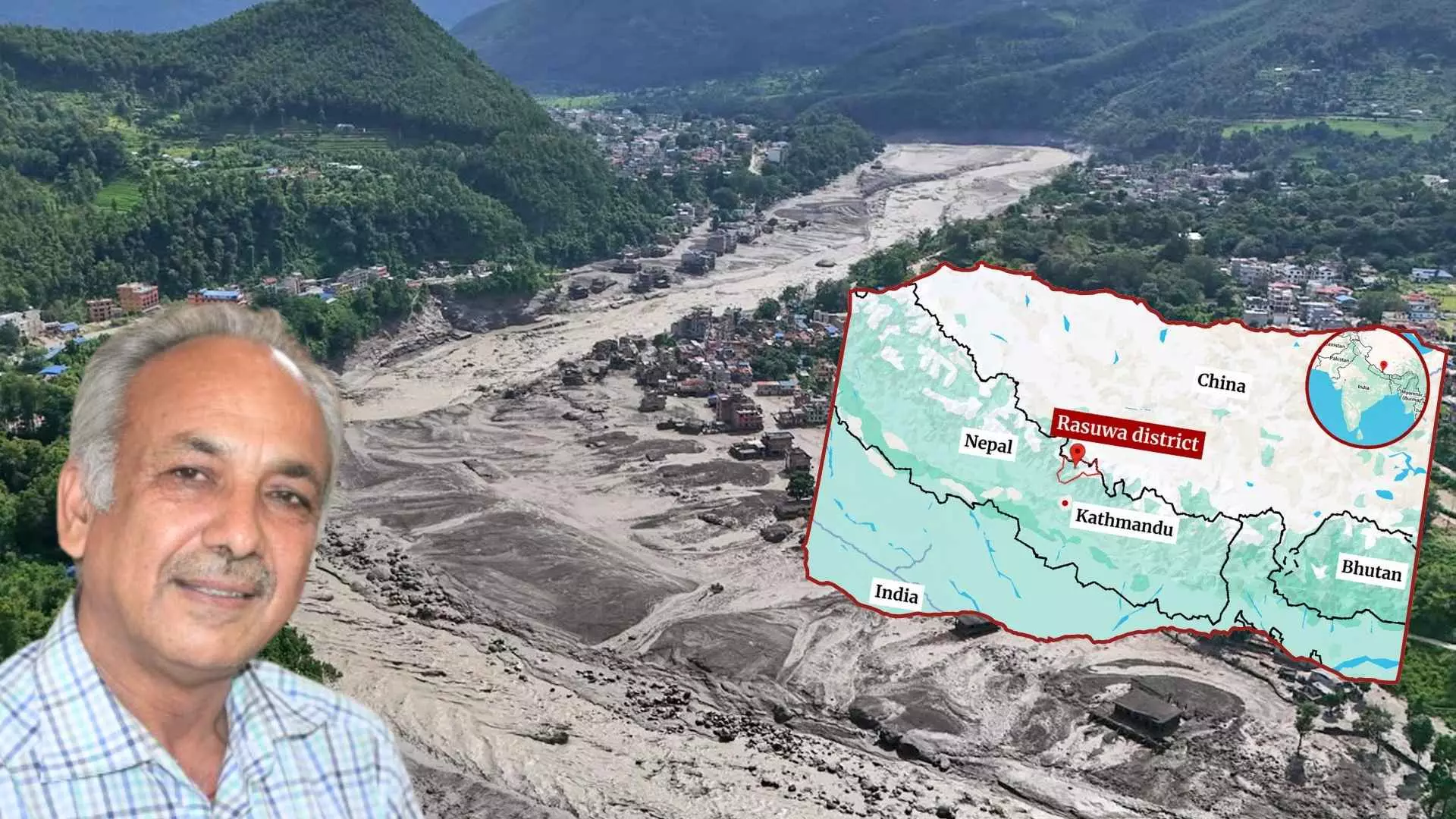
Killer floods: Is Nepal underprepared for natural disasters? Yubaraj Ghimire exclusive
Senior journalist Yubaraj Ghimire shares his insights on the disaster in Nepal's Rasuwa near the Tibet border, and the systemic issues that triggered it

The massive flash flood, triggered reportedly due to a glacier burst on the Tibet side, has devastated parts of Nepal’s Rasuwa district, sweeping away homes, villages, roads and vehicles along a major traditional trade route. With several people confirmed dead and hundreds still unaccounted for, rescue teams face a race against time as darkness and difficult Himalayan terrain hamper operations.
Also read: 19 dead, 105 Indians missing as flash flood sweeps through Nepal’s Rasuwa district
The disaster has also raised fears of further flooding downstream, with water flowing towards Nepal’s southern plains and potentially into Bihar and Uttar Pradesh.
Follow live updates of Nepal floods
The Federal spoke to veteran journalist Yubaraj Ghimire, who has covered Nepal’s politics, constitutional crises and development challenges for three decades, about the scale of the disaster, the rescue effort, the risks to India and what the catastrophe reveals about climate vulnerability in the Himalayas.
Edited excerpts:
What happened in the Rasuwa region on Wednesday morning, and why was the flooding so sudden?
Around 9 am, the areas adjoining Tibet, near a place called Kyirong, were suddenly hit by an enormous volume of water in the Bhotekoshi River, without much warning.
It seems that a glacier burst on the Tibet side, and the river was filled with floodwater. Along at least a 60-km route from the Tibet border through three districts in Nepal — Rasuwa, Nuwakot and Dhading — and much beyond, the entire population and settlements were affected.
This is a heavily populated area. There are business centres and a traditional, centuries-old trade route with Tibet. Houses have been substantially damaged and entire settlements have been swept away.
We still do not have an authentic official figure on the number of casualties, which I think could be in the hundreds.
What is the extent of the damage reported so far?
Seven deaths have been officially confirmed, but we have reports coming in from different areas.
The entire customs office in the area, which has 14 employees, has been affected and their whereabouts are unknown. Banking and police facilities have also not been properly connected or able to communicate with their headquarters.
Also read: Nepal’s deadliest disasters: From earthquakes to flash floods and avalanches
The worst part is the situation at one of the oldest, 80-year-old schools in the area, called Thiruvanth. Out of 1,650 students, only 150 have been reported safe. We do not know about the others.
Many vehicles, crops, houses and villages have been swept away by the rivers, with occupants inside. So it will take a while for us to know the exact loss of life.
The government has so far released a token relief amount — one crore each for two districts and Rs 50 lakh — but that is only immediate relief.
Rescue operations have begun, and the Army has taken the lead. People have been rescued. It may take until tonight for us to get the initial assessment of human loss, but that figure will be far below the actual loss of life and damage.
Why is rescue more difficult in this region compared with the plains?
It is a hilly area with difficult terrain and very turbulent rivers.
Security personnel have been rescuing people whom they are able to locate. People are stranded on the roads. For instance, two people were rescued after they were spotted holding on to a tree.
Also read: Nepal reels from climate extremes as droughts and floods wreak havoc
There are many challenges. But I think the security personnel are ready.
What are the immediate concerns for residents over the next 24 to 48 hours?
The immediate concern is human safety and rescue. Relief and rehabilitation come after that. But the immediate challenge is rescue in adverse weather conditions.
There is another fear. The report we have received is that there is a glacier that has burst, but it has taken the shape of a water reservoir on the Tibet side, forming a dam about seven metres high.
What if that also bursts and the water is released towards Nepal? The river flows from north to south and Nepal lies to the south. So that presents another immediate challenge.
How unusual is a flash flood of this magnitude, and what does it indicate about changing climate patterns in the Himalayas?
It is rare. In terms of casualties, I think it is unprecedented. Flash floods were not very rare, but never on this scale.
There are long-term measures and coordinated exercises taking place at the academic and policy formulation levels. But something of this scale has happened.
Also read: Arunachal Pradesh: Five Army personnel missing after flash flood; 4 killed in landslide
At the moment, the challenge is to contain the damage and save as many human lives as possible.
How will a disaster of this scale test Nepal’s relatively new government and its crisis-management capacity?
We have the National Disaster Risk Reduction and Management Authority, but it was definitely not prepared.
We do not have the full and authentic information yet. It seems that it had alerted the authorities about the possible occurrence of an event of this magnitude. So this has happened, but we do not have the full details yet.
I would not be able to comment conclusively on that. But there is definitely a lack of experience on the government side, and perhaps it was not prepared to face this kind of situation.
What are the immediate economic risks, particularly after damage to hydropower infrastructure and major highways?
Nepal’s major source of water-related economic activity is the hydropower business. The disaster has caused damage to anywhere between 450 and 700 megawatts of production or generation. We do not know how long it will take to restart it.
But if it takes a longer time, obviously the effect on human life and power trade would be enormous.
Could the flooding also affect Bihar, Uttar Pradesh and other parts of India?
That would be a natural possibility because the water coming down from the area that flows into the Bhotekoshi River, which joins the Trishuli. The Trishuli joins the Narayani, and the Narayani joins the Gandak, which flows through Bihar and Uttar Pradesh and beyond.
I do not know the extent of the possible loss there. But there is a possibility because these waters will feed into rivers flowing down towards Bihar, Uttar Pradesh and beyond.
Should people in neighbouring Indian districts and states be worried?
Yes, certainly. Although the initial reports indicate that the Chinese and Indian governments have shown some kind of helping gesture towards Nepal, we do not know how much that would immediately affect the situation.
Also read: Heavy rains trigger deadly flash floods across Afghanistan, 17 killed
In the long term, it could help, but immediately, how much it will reduce the possible damage is something we do not know.
How do communities in areas such as Rasuwa typically recover from a disaster of this scale?
They are definitely worried because this adversely affects their long-term planning for economic growth and agriculture. This is the agricultural season. Paddy and other crops have been substantially damaged, leading to food scarcity in the coming season.
There are reports of around 100 Indians among roughly 400 travellers reported missing. Is there any further information about them?
This is tourist season, and Indians do come to some of Nepal’s most preferred tourist destinations, many of which have been affected.
The roads to and around Pokhara and Chitwan have been cut off and affected. There is also the route leading to the Muktinath shrine.
Although Muktinath is safe, these are preferred destinations for Indians. There are also other places such as Gosaikunda.
It is Raksha Bandhan time, two days later, and people go there for a holy dip. They may also have been affected.
But we do not have the exact extent of the loss of life and damage, or information on where exactly the people are.
Does this disaster point to the growing global warming crisis, and are we failing to pay enough attention to it?
No, I would not say that people are not paying attention. There is a growing concern, but it involves both long-term planning, policy formulation and execution.
This is also a problem that we have ignored. It is not only Nepal; the global community has ignored it because Nepal may not be a major contributor to global warming or to the damage it may cause. But we have ignored these issues for decades.
The countries that have contributed to global warming also need to be involved. They need to be sensitive, and they need to develop a humanitarian approach towards this.
Does this disaster represent a major test for Nepal’s relatively new government?
Certainly. But it is not only the government’s problem, although the government needs to show that it is very concerned about it.