



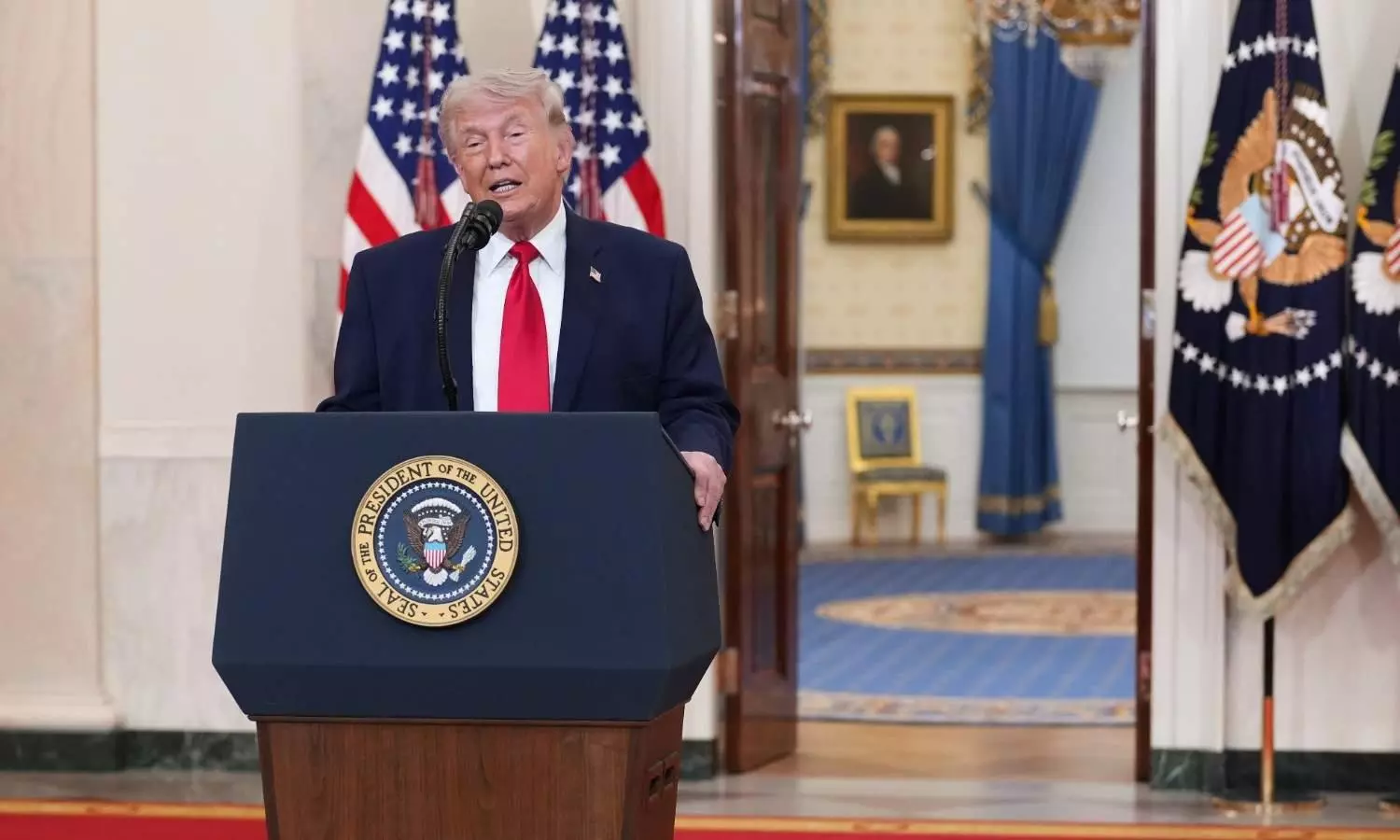
US President Donald Trump speaks about the Iran war from the Cross Hall of the White House on Wednesday (April 1). Photo: PTI
Key takeaways from Trump’s address: No Iran war endgame, NATO escapes flak
Trump justifies ‘Operation Epic Fury’ as vital for US security but offers few details on next steps, even as troop deployments rise and the conflict with Iran shows no clear resolution

US President Donald Trump sought on Wednesday (April 1) to explain his rationale for the war against Iran at a pivotal moment at home and abroad, but he offered few new details as he amasses extraordinary executive authority to prosecute the military operation. The war is fast becoming a signature of his second-term agenda and the speech was a capstone to a remarkable day flexing presidential power.
Trump started the morning as the first sitting president to show up for a US Supreme Court hearing, a stunning reach of the executive into the affairs of the judicial branch. He ended with his first primetime address from the White House about a war he launched on his own, bulldozing past Congress.
Also Read: Live! Trump says Iran war goals near completion, vows to ‘finish the job’ soon
On an early spring night when many Americans may have been looking upward as Artemis II astronauts lifted off for NASA's return to the moon, Trump gave a nod to the historic milestone. Then he quickly refocused attention back to himself — and to the conflict with Iran that has killed more than a dozen US service members and appears to have no easy exit in sight.
"America, as it has been for five years under my presidency is winning — and now winning bigger than ever before. We're going to finish the job and we’re going to finish it very fast,” said Trump.
Tries to sell the war to Americans
The president said at the top of his address that he wanted to “discuss why Operation Epic Fury is necessary for the safety of America and the security of the free world”, showing that part of the goal for Wednesday's speech was to take on the confusion that has persisted as he and his administration have shifted their reasons for launching the mission and its objectives.
But on Wednesday night, Trump did not offer any new explanations.
He maintained that Iran cannot have a nuclear weapon, calling such a prospect “an intolerable threat”. Though he and his administration insisted that the US and Israel obliterated Iran's nuclear programme in strikes last summer, he said on Wednesday that Iran sought to rebuild its nuclear programme after those strikes at a new location. He did not offer details but said it indicated Iran was not backing away from its nuclear ambitions. He also said Iran was building a vast arsenal of ballistic missiles that were a threat to America's homeland.
Also Read: What’s behind Trump’s flip-flops on Iran war?
While he said Iran's ballistic missile capacity was greatly reduced, he didn't explain how the operation had headed off Iran's nuclear ambitions. He instead painted the threats from Iran generally as having been wiped away, though he didn't back up that assertion, especially as multiple competing factions of power remain within Iran's theocracy.
Iran has insisted its nuclear programme was peaceful. It had, however, been enriching uranium up to 60 per cent purity, a short, technical step away from weapons-grade levels. Before the war, US intelligence agencies assessed that Iran had yet to begin a weapons programme, but had “undertaken activities that better position it to produce a nuclear device, if it chooses to do so”.
No clarity about next steps
Thousands of additional US troops are heading to the Middle East. Gulf allies are urging Trump to finish the fight, arguing that Tehran hasn't been weakened enough.
And yet Trump himself has predicted the US will be done “within maybe two weeks”. He said the “core strategic objectives are nearing completion" and did not signal any preparations for a ground invasion by American troops — to retrieve Iran's enriched uranium or secure the Strait of Hormuz, where a chokehold by Iran has sent energy prices soaring.
Also Read: US burns $10,300 a second in Iran war, says SIPRI study
But Trump offered few details about next steps. At one point, he told allies to simply reopen the waterway critical to oil shipments themselves — “take it”, he implored.
Trump is fast approaching the 60-day mark when he must seek approval from Congress under the War Powers Act to continue any military operations. He did not announce the imminent start of peace talks or any other diplomatic effort to end the war. Instead, he recounted the long wars in Korea and Vietnam, and vowed that the US would be better off because of this one.
“This is a true investment for your children and your grandchildren's future,” he said.
(With agency inputs)