



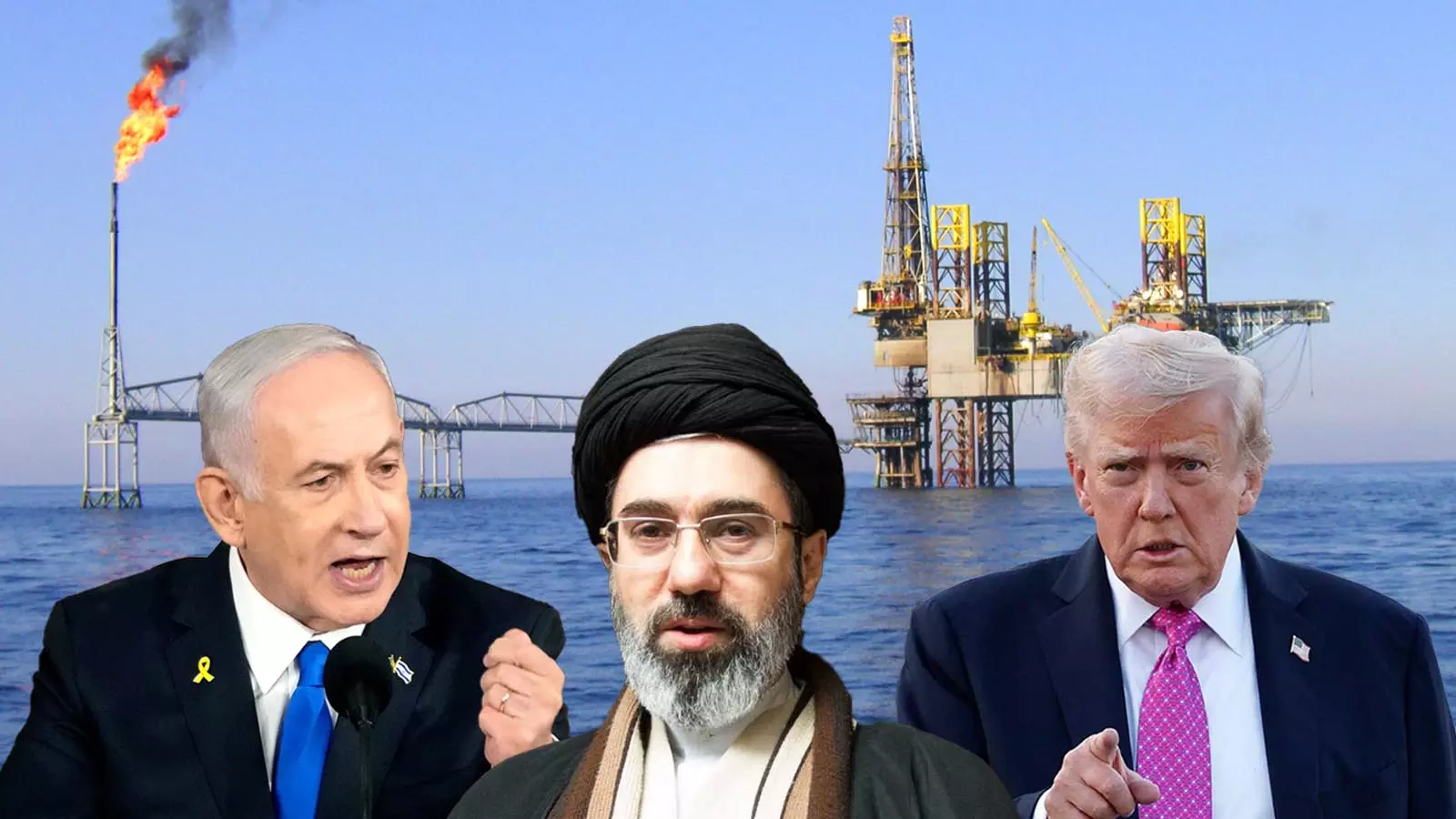
Israel's attacks on a key gas asset of Iran have escalated tensions in West Asia with the US trying to balance things between allies and Tehran.
As Israel, Iran clash over South Pars strike, what attacks on gas assets imply?
Global markets shudder as conflict pivots from military sites to critical gas infrastructure, leaving even the US's friends in the region aghast

Nearly three weeks since the current conflict in the Middle East started, a dangerous escalation was witnessed on Wednesday (March 18) when Israel bombed the giant South Pars gas field in the Pesian Gulf, which Iran shares with Qatar, and Tehran hit back with a couple of attacks on a major gas facility in Qatar and also a barrage of missiles at Saudi, its regional rival. Two refineries were hit in the Iranian attack, claimed Riyadh. Even the United Arab Emirates (UAE) was targeted.
Also read: Israel following usual strategy to kill top Iranian leaders; has it worked in past?
As the situation looked ominous and threatened to worsen an already snowballing crisis over global energy supply links, several countries in West Asia and also those such as Pakistan and Turkey, jointly urged Iran to stop the attacks immediately, after huddling over a meeting in Riyadh on Wednesday.
With Iran facing new attacks and retaliating with forceful ones, US President Donald Trump came up with varied reactions.
Trump says US didn't know about Israel's plans
While saying an angry Israel “violently lashed out” and attacked the gas field in southern Iran’s Bushehr province, the largest in the world, he added that the US had little knowledge about it.
“The United States knew nothing about this particular attack, and the country of Qatar was in no way, shape, or form, involved with it, nor did it have any idea that it was going to happen,” Trump said on his TruthSocial platform on Wednesday.
However, one report by the Associated Press said Washington knew about Israel’s plans but did not take part in the mission. It cited an informed source that confirmed this on the condition of anonymity, but stopped short of saying whether the US was in agreement with the idea of attacking the gas field.
Also read: A crumbling Iran could turn out more dangerous
Trump mentioned Qatar, a key ally of the US in the region, since it suffered “significant damage” in the Iranian counterattack and blamed Israel for launching the initial strikes. The country’s foreign ministry spokesperson even called it a “dangerous and irresponsible” escalation that risked global energy security.
The country’s liquefied natural gas (LNG) export facility at Ras Laffan Industrial City was badly hit by the attacks. Ras Laffan is home to the world’s biggest LNG facilities and the Pearl Gas-to-Liquids plant.
The UAE was also affected, as it said on Thursday that it suspended operations at its Habshan gas facility as a response to falling debris from missiles that were intercepted. The UAE also said the South Pars attack posed threats to global energy and regional stability.
Trump's balancing act after Qatar's complaints
The US president was found balancing the situation by saying on one hand that Israel would not launch any more attacks “pertaining to this extremely important and valuable South Pars Field” and on the other, threatening Iran against attacking Qatar again. He said if Tehran did so, the US would, with or without Israel, “massively blow up the entirety of the South Pars Gas Field at an amount of strength and power that Iran has never seen or witnessed before”.
But why are these latest episodes of attacks and counter-attacks on some of the world’s most critical energy sources being deemed so critical?
Strikes aimed at gas-production facilities such as South Pars not only make the war more dangerous in terms of the immediate fallouts but also leave consequences that are potentially long-term.
Why strikes on energy facilities are deadly
While the US and Israel had previously refrained from attacking Iran’s energy-production facilities in the region so that Tehran doesn’t retaliate against the energy assets of its neighbours, many of which are close to Washington and Jerusalem, the attacks on South Pars and the retaliations have deep implications.
Also read: Who was Ali Larijani, Iran's security chief killed by Israel?
The Financial Times quoted Saul Kavonic, an analyst at MST Financial, as saying, “Something that takes out a few million barrels of production would have a bigger impact because it means there is no way to refill stocks even after the war ends.” If an LNG facility is damaged, it could take several years to repair it, causing serious disruptions to the global energy supply.
The world has seen in the past that repairing an energy-production facility damaged in conflicts is easier said than done. In 2003, it took much longer to bring the facilities in Iraq to the pre-war level, even though the then George W Bush administration had promised that it would be done sooner, The Guardian reported. The same has been witnessed in Ukraine, where the power infrastructure has been under the Russian invasion.
Oil prices rise out of fear
Oil prices soared after the South Pars centre was attacked, driven by fears that disruption to the global energy supplies would turn worse. Trump himself would not be too comfortable either if prices of fuel in the US head north, which it is already seeing, ahead of the midterm elections later this year. Even though neither the US nor Israel is dependent on Iran’s energy hubs for their oil and gas requirements, the fallouts of a global energy crisis emanating from the West Asian conflict would be all-encompassing.
Also read: Iran war: Trump lit the fire, now wants the world to help extinguish it
While the US depends on countries such as Canada, Mexico, Brazil and a few West Asian nations such as Saudi Arabia and Iraq for its oil and gas requirements, Israel imports oil from countries such as Azerbaijan, Kazakhstan, Brazil and is dependent on its own sources for domestic gas demand.
Hits climate commitments
What also makes the natural energy production sources key is that they contribute to the global plan to move away from polluting fuels. Disruption of such an important energy resource hurts the ambition to reverse the planet’s climatic challenges.
Geopolitical significance
South Pars also has a geopolitical significance since it is located in the Persian Gulf, which is sensitive due to the ongoing tensions and conflicts and close to the Strait of Hormuz, through which a major share of global energy passes. This makes South Pars a strategic leverage point, which, if crippled, could multiply the overall impact of the war. Disruption in the supply of LNG can also leave an adverse impact on faraway countries that are highly dependent on it to meet their domestic needs. India, which imports a large share of its LNG from Qatar, is one of them.
Moreover, West Asia's energy facilitates détente between various regional adversaries, such as Saudi Arabia and Iran, and unrestrained hostility aimed at them could badly bruise the political and diplomatic fabric of the region, besides revenues.