Iran war: 'There are clear red flags in ceasefire deal'
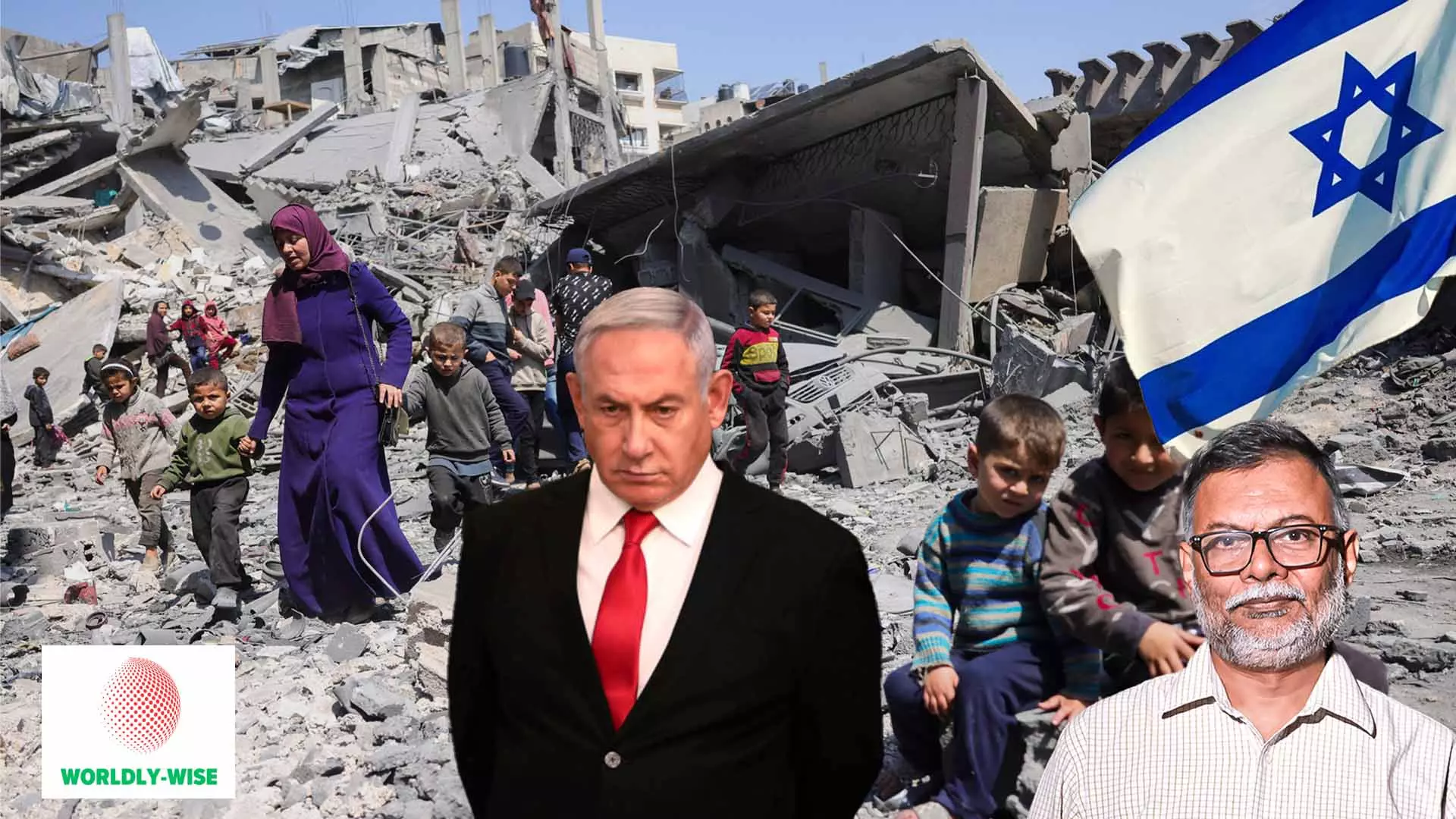
Israel’s bombing of Lebanon post ceasefire has pushed peace to the edge. International affairs expert KS Dakshina Murthy decodes the grave situation

The two-week ceasefire in the Iran war has brought relief all around, but tension still prevails over whether it can be sustained and lead to lasting peace. Israel has reluctantly come on board, but is insisting that Lebanon is not part of the deal. US President Donald Trump is backing this position.
Also read: Doomsday averted, but can Iran war be settled across the table?
Israel’s bombing of Lebanon, after the ceasefire, killing over 180 civilians, has pushed peace to the edge. In this episode of Worldly-Wise, The Federal's Consulting Editor KS Dakshina Murthy, an expert in international politics, decodes the grave situation.
Will the ceasefire survive?
That is really the question the entire world is asking. It looks pretty shaky. If you look at Israel, it seems to be holding all the cards. If you go back to June 2025, when negotiations were on, it was Israel that disrupted the talks and, along with the US, started bombing Iran.
The same thing happened this year as well. Talks were going on until February 27, and then on the 28th, there was an attack, again attributed to Israel influencing Donald Trump. This is the second time this has happened.
Now, coming to the latest situation, there are clear red flags in the ceasefire deal. One is Lebanon. Lebanon got involved because Hezbollah, a close ally of Iran, fired rockets into Israel after the assassination of Iran’s supreme leader, Ayatollah Ali Khamenei. Israel retaliated, and that has continued.
Israel has not only continued attacks but has expanded its presence, capturing large parts of southern Lebanon and holding strategic positions. So Lebanon is effectively in a war with Israel, even if it is not directly linked to the US-Israel action in Iran.
When the ceasefire was discussed, Pakistan made it clear that Lebanon was part of it. Iran’s proposal, which Trump said the US accepted, also included Lebanon. But Netanyahu welcomed the ceasefire while insisting Lebanon is not part of it, and the US has not contested that.
This gives Netanyahu massive leeway and could backfire on the ceasefire. There are already reports that Iran has warned it may shut the Strait of Hormuz. If that happens, the US will likely retaliate, bringing us back to square one.
Negotiations haven’t even started yet—they are scheduled to begin shortly. Even before that, Israel has shown its reluctance towards the ceasefire by bombing Lebanon. So yes, the ceasefire is definitely shaky. It now depends on Iran’s reaction and the US response.
Also read: Pakistan's Vishwaguru moment? It's a narrow escape, not ceasefire
Why is Israel insisting that Lebanon is not part of the deal?
As far as Israel is concerned, it has a massive issue with Hezbollah. Hezbollah is both a militia and a political party in Lebanon. It plays a major role in Lebanese politics.
Historically, in 1982, when Israel occupied Lebanon, it was Hezbollah that pushed Israel out. That gave it a strong reputation. Lebanon has significant Shia representation, and Hezbollah represents that community, making it very influential.
It has members in Parliament and ministers in government. The Lebanese Army exists, but it does not appear to have as much power as Hezbollah. Lebanon has multiple power centres—the Army, the government, and Hezbollah leadership—and Hezbollah is very powerful.
For Israel, there are two key threats: Hezbollah and Iran. It has partly addressed Iran by convincing the US to act. But Hezbollah remains. After earlier agreements where Hezbollah was supposed to disarm, that did not fully happen.
For Netanyahu, this is an opportunity to neutralise Hezbollah, which Israel considers an existential threat, just like Iran. That is why he does not want to let go of Lebanon and continues bombing despite the ceasefire.
What explains the close relationship between Donald Trump and Israel PM Benjamin Netanyahu?
Over the years, Netanyahu has tried to convince several US presidents—Barack Obama, George W. Bush, and even Joe Biden—to act against Iran, but they did not agree. Trump, however, went along with him.
During Trump’s first term, he withdrew from the Iran nuclear deal signed by Obama, largely due to Israeli pressure. He also shifted the US Embassy from Tel Aviv to Jerusalem, effectively recognising it as Israel’s capital, which is contested under international law.
When these decisions were made, there was little global pushback. Later, when Israel and the US attacked Iran, again, there was limited reaction. Trump likely assumed he could repeat this strategy, but he did not expect Iran’s strong response.
As for why Trump is so close to Netanyahu, part of it is political backing. Trump is strongly supported by AIPAC, the American Israel Public Affairs Committee, which plays a major role in US politics.
Additionally, a significant part of Trump’s support base—evangelical Christians—are strongly pro-Israel. These groups have backed him politically and financially. Naturally, any leader supported by such constituencies will align with their interests.
So Trump’s closeness to Israel is influenced by political backing, funding, and ideological alignment. While some argue the final decisions are his, Netanyahu’s influence is clearly significant.
What makes Israel powerful enough to defy global pressure?
If you look at Israel’s response to the Hamas attack on October 7, 2023, it retaliated heavily in Gaza, with the conflict continuing for nearly two years. Many view it as disproportionate, with tens of thousands of casualties and widespread destruction.
Despite global criticism, Israel continued its operations. The key reason is the structure of the international system. Only the UN Security Council can authorise action against a country, and any one of its permanent members can veto it.
The US has consistently protected Israel for decades. This has insulated Israel from international consequences. Whether under Trump or Biden, the US has provided financial, military, and diplomatic support.
This backing allows Israel to act with little restraint. It reflects deeper issues in the global order, where power dynamics override accountability.
Is there any global mechanism to hold the US or Israel accountable?
In theory, the UN Security Council has that authority. For example, after the 9/11 attacks, the US secured international backing before acting in Afghanistan.
However, in Iraq, the US bypassed the UN when it anticipated opposition. In the current Iran situation, the US has largely disregarded the UN and even its NATO allies.
European nations have not been able to prevent US actions. Countries like China and Russia have played limited or behind-the-scenes roles. China, for instance, may have influenced ceasefire talks via Pakistan, but it has not directly challenged the US.
What this shows is that there is currently no effective mechanism to restrain the US or Israel. The global system is unable to enforce accountability in such cases.
This creates a reality where power determines outcomes. It is essentially the rule of the mighty and the survival of the fittest, which is what we are witnessing in West Asia today.
(The content above has been transcribed from video using a fine-tuned AI model. To ensure accuracy, quality, and editorial integrity, we employ a Human-In-The-Loop (HITL) process. While AI assists in creating the initial draft, our experienced editorial team carefully reviews, edits, and refines the content before publication. At The Federal, we combine the efficiency of AI with the expertise of human editors to deliver reliable and insightful journalism.)