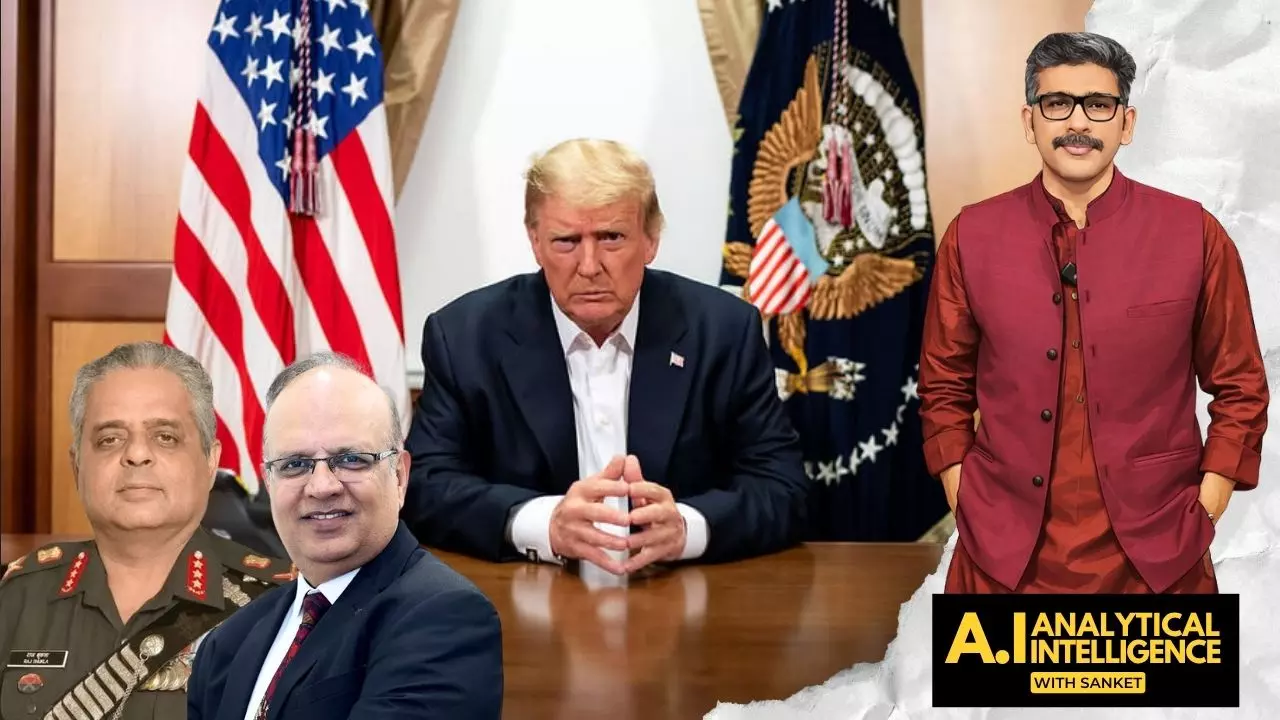
Trump remarks spark global nuclear fears
Trump’s ‘N-button’ threat: Bluff or breaking point in Iran war?
Experts decode US's nuclear rhetoric amid rising US-Iran tensions, warning of risks, Israeli pressure, and the limits of American military power

“Trump may be pushing his luck too far,” warned Lt Gen Raj Shukla (Retd), as global anxiety mounted over US President Donald Trump’s provocative claim that he could “take down a country in a day”.
At a time when tensions between the United States, Israel, and Iran are intensifying, such rhetoric has raised concerns over whether the world is inching closer to a nuclear flashpoint. The Federal spoke to Lt Gen Raj Shukla (Retd), former Indian Army officer, and Col Rajiv Agarwal (Retd), defence analyst, to decode whether Trump’s remarks signal a real escalation or strategic brinkmanship.
American power
Lt Gen Shukla framed the ongoing conflict as a contest between “American resolve and Iranian resilience,” emphasising that the tensions are rooted in decades of hostility following the Iranian Revolution.
Also Read: Is the US a military state camouflaged as democracy?
He pointed out that the US possesses unmatched global military reach, capable of projecting power across continents. Recent operations, including large-scale rescue missions involving hundreds of aircraft and special forces, underscore the sheer scale and efficiency of American military capabilities.
However, Shukla cautioned that military success does not necessarily translate into strategic victory. “From a military metric, it was a brilliant success,” he said, referring to recent operations, but added that the broader geopolitical objectives remain unmet.
Risk factor
A key concern, according to Shukla, is Trump’s willingness to take unprecedented risks.
He noted that the US President has often overridden military advice, relying instead on instinct. “He has been extremely lucky,” Shukla observed, warning that such luck may not hold indefinitely.
The former Army officer highlighted that even limited operations carry the risk of casualties, which could quickly shift public opinion in the United States. A single miscalculation, such as American troops being captured or killed, could dramatically alter the trajectory of the conflict.
Iran resilience
Despite sustained pressure, Iran has demonstrated what Shukla described as “extraordinary resilience.”
He pointed out that Iranian forces have managed to challenge key aspects of American military dominance, including disrupting oil flows through the strategically crucial Strait of Hormuz.
This, he argued, strikes at the core objective of US global military presence — ensuring uninterrupted commerce and energy supply. “Militarily, they may have won battles, but in terms of oil flows, they have lost,” Shukla said.
Escalation dilemma
The discussion also focused on the limited options available to the US.
According to Shukla, one extreme scenario involves devastating Iran’s infrastructure — power plants, petrochemical facilities, and transport networks. However, such action would likely trigger severe retaliation, potentially destabilising the entire Gulf region.
He warned of a “mutually assured destruction” scenario, where both sides could inflict significant damage, making escalation a dangerous gamble.
Ground reality
Col Rajiv Agarwal reinforced the complexity of the situation, particularly the challenges of any ground invasion.
He stressed that Iran’s geography makes it extremely difficult for US forces to operate effectively on the ground. “Boots on the ground may not be geographically possible,” he said, noting that this limitation adds to Washington’s frustration.
Agarwal argued that Trump’s aggressive rhetoric may stem from the inability to secure a decisive victory. While airstrikes and limited operations have achieved tactical gains, they fall short of delivering a clear strategic breakthrough.
Nuclear question
On the issue of nuclear escalation, Agarwal described Trump’s remarks as a “veiled threat” rather than an immediate plan.
He suggested that if a nuclear option were ever to be considered, it might be more likely to originate from Israel rather than the United States, given rising frustration within Israeli leadership.
Reports of escalating strikes and mounting damage in key Israeli regions indicate growing pressure, which could push decision-makers toward more extreme measures.
Israel factor
Both experts agreed that Israel plays a central role in the conflict.
Agarwal pointed out that even if the US and Iran were to reach a ceasefire, it would be ineffective without Israel’s participation. “Unless Israel is part of any negotiation… it is no use,” he said.
He described the conflict as not just a US-Iran confrontation but a broader multi-party struggle involving Israel and Gulf nations, each with distinct objectives.
Bluff or break
Returning to the central question, Shukla dismissed the idea that Trump was explicitly threatening nuclear use.
Instead, he interpreted the “take down a country” remark as a reference to large-scale conventional bombing aimed at crippling infrastructure.
He also highlighted the political dimension of Trump’s actions, noting that his decisions are often calibrated to appeal to his domestic support base. “His political judgments have always been astute,” Shukla said, even if they appear risky.
Limits of power
A recurring theme in the discussion was the limitation of American military strength.
While the US excels in high-altitude, technology-driven warfare, Shukla warned that conflicts become far more complex and costly at ground level.
Drawing parallels with past wars, he noted that initial victories can quickly unravel into prolonged struggles, as seen in Iraq. “They haven’t even got to Tehran,” he remarked, underlining the gap between tactical success and strategic outcomes.
Critical moment
The panel concluded that the situation remains delicately poised.
Trump’s unpredictability, combined with rising tensions involving Iran and Israel, has created a volatile environment where miscalculations could have far-reaching consequences.
Whether his statements are a bluff or signal a potential breaking point, the experts agreed that the risks of escalation are real — and growing.
The content above has been transcribed from video using a fine-tuned AI model. To ensure accuracy, quality, and editorial integrity, we employ a Human-In-The-Loop (HITL) process. While AI assists in creating the initial draft, our experienced editorial team carefully reviews, edits, and refines the content before publication. At The Federal, we combine the efficiency of AI with the expertise of human editors to deliver reliable and insightful journalism.