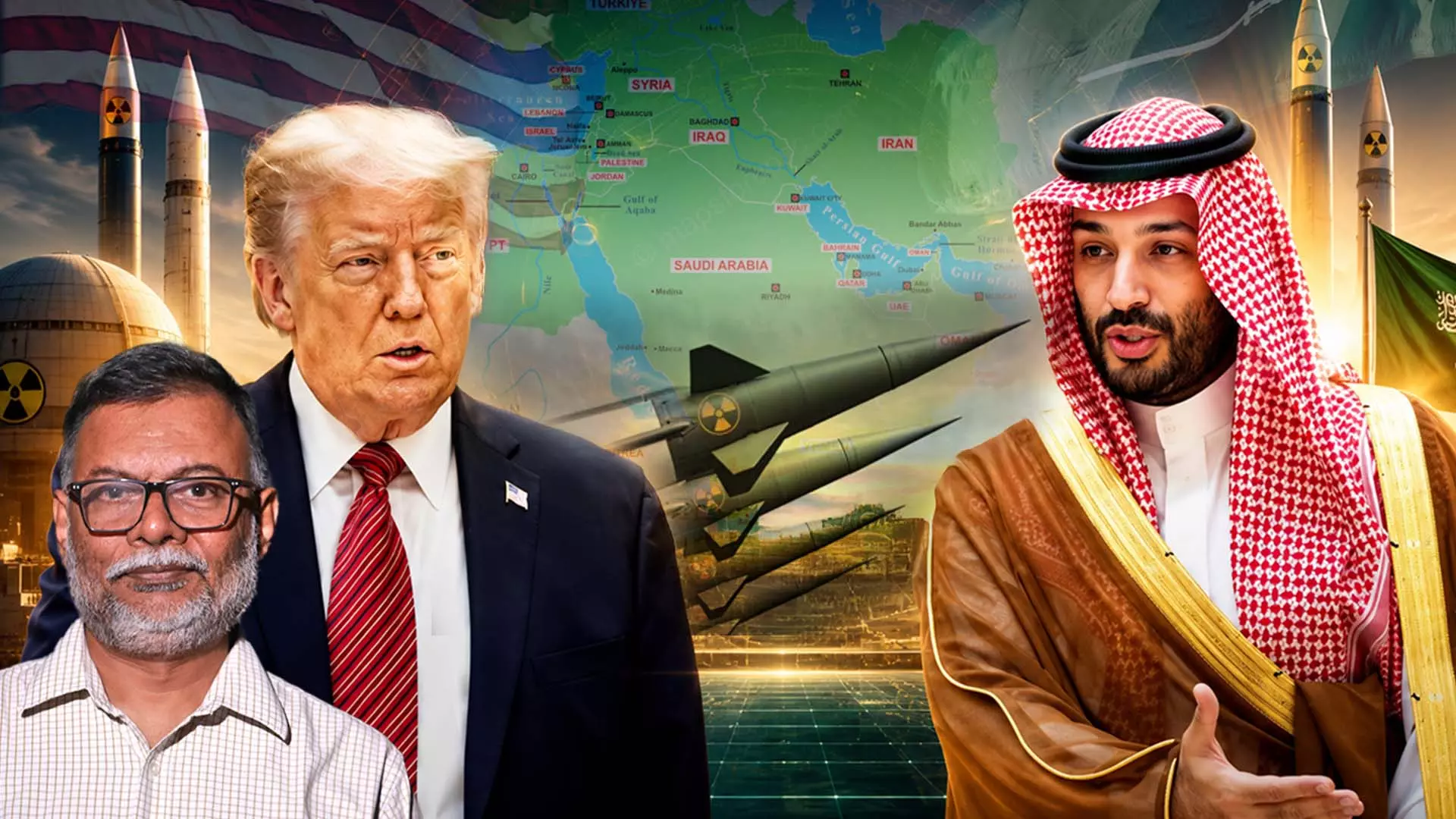
Trump’s N-Deal with Saudi adds fuel to already inflamed Middle East | Ep 101
US President Donald Trump reaches a civil nuclear deal with Saudi Arabia, sparking fears across the Middle East. Will this push the region into a fresh arms race?

United States President Donald Trump has thrown in a curve ball by reaching a civilian nuclear cooperation agreement with Saudi Arabia. In an already inflamed Middle East, or West Asia, the Trump administration’s move to offer nuclear technology to the Saudis could amount to adding fuel to the existing fires that have singed the region for years.
According to the agreement, which will have to get the approval of the US Congress, the US will build two nuclear reactors in Saudi Arabia. Though meant to generate electricity, the deal will allow the Saudis to enrich uranium and reprocess spent fuel—two activities that can theoretically enable the making of nuclear weapons.
The agreement falls under Section 123 of the US Atomic Energy Act of 1954, commonly called the 123 agreement. Trump’s reasons for signing the deal with Saudi Arabia claim to uphold the highest standards of nuclear safety and nonproliferation.
Countering regional rivals
This may sound innocuous, but the reality is that the US is attempting to counter Iran’s successes in developing nuclear technology by giving a similar technology to its rival, Saudi Arabia. Since the Iranian revolution of 1979, relationships between the Saudis and Iran have been severely strained.
They view each other with scepticism, if not outright suspicion and hostility. This largely stems from the fact that the Saudis consider themselves the leader of the Sunni Muslim sect, while Iran projects itself as the head of the rival Shia Muslim sect.
The mutual rivalry has had deep geopolitical consequences for the region. The irony is that Israel is the unintended beneficiary of this divide between the Saudis and Iranians.
Shifting diplomatic ties
In recent years, Saudi Arabia has even politically moved closer to Israel. It would not be wrong to say that the Saudi government shares the Jewish state’s worldview on Iran.
Also read: US will destroy bridge or power plant for each Iranian attack in Strait of Hormuz: Trump
In fact, before the October 7, 2023, Hamas attack on Israel and the consequent genocidal assault by Israel on Gaza, the Saudis were reportedly maneuvering to join the Abraham Accords and establish diplomatic relationships with Israel, similar to that between Israel and the United Arab Emirates, Morocco, and Bahrain, among others.
Saudi Arabia, a close ally of the US, for decades has not criticised the US and Israel for their unprovoked military strikes on Iran. The Saudi ruling family is more upset that Iran has been targeting US military bases in their country.
Rising regional risks
The Saudis' pro-US position has resulted in Yemen’s Houthis, a close ally of Iran, targeting its commercial ships traversing through the Bab-el-Mandeb Strait in the Red Sea, similar to the Strait of Hormuz in the Persian Gulf.
Whether intended or not, Trump, in his usual unpredictable style, has alarmed his closest ally, Israel, by reaching a nuclear deal with the Saudis. For long, US administrations had conditioned such a deal on Saudi Arabia normalising and establishing ties with Israel.
Now that Trump has jettisoned this condition, Israel has lost this leverage against Saudi Arabia. This is seen within Israel as another indication of falling ties between Trump and Israeli Prime Minister Benjamin Netanyahu.
Historical US errors
A few weeks ago, Trump, in a highly publicised call with Benjamin Netanyahu, arm-twisted him into agreeing to stop the bombing of Lebanon and cooperate with the US on its peace deal with Iran. Now, the nuclear accord between the US and the Saudis is the second setback.
If today the Middle East is saddled with a nuclear problem, the fault largely lies with the US. In the 1960s through the 1970s, Israel covertly developed nuclear weapons technology after receiving its first nuclear reactor from the US under the so-called Atoms for Peace program in 1957.
Also read: Iran hardliners slam leadership over US deal as West Asia conflict worsens again
The then US administration of John F Kennedy was apparently not aware that Israel was trying to convert its nuclear infrastructure into a weaponisable one. Later, when the administration got to know what Israel was doing, it preferred to look the other way.
Escalating global concerns
In the case of Iran, it was the US’s Dwight D Eisenhower administration in 1957, under the same Atoms for Peace program, that helped it get a nuclear reactor and the initial infrastructure. This was when Iran was under the rule of the Shah, Mohammad Reza Pahlavi, a close ally of the US.
In the 1979 revolution, Mohammad Reza Pahlavi was overthrown and replaced by Shia Islamists who continued to develop nuclear technology with the help of other nations, including Russia, China, and Pakistan. While Iran insists it is not developing nuclear weapons, it has aroused suspicions among the West, considering that it has enriched uranium to the extent of 60 percent.
When the enrichment reaches 90 per cent, it can be used in weapons. Israel, according to independent and credible reports, already has in its possession an arsenal of nuclear weapons.
Unnecessary political risk
Given the trajectory of Iran and Israel, it should surprise no one if the Saudis, too, later discreetly develop nuclear weapons capability. Given the volatility and political instability in the region for the last several decades, the agreement will end up creating a fresh headache for future governments, including the US, and become another constant source of doubt and insecurity for the world.
Also read: Iran-US MoU: Band-aid solution not working, surgery required
The Trump administration has said that the nuclear technology agreement with the Saudis is being signed to enable it to harness nuclear technology for generating electricity and reducing dependence on oil. With the largest known availability of oil in Saudi Arabia, this reason does not hold much water.
Also, considering that Saudi Arabia is among the nations that can fully utilise solar energy given the quality and reliability of sun power there, the installation of nuclear reactors is more a political move than one of genuine necessity. With a view to countering Iran, Washington is signing a nuclear agreement with Saudi Arabia that, among other things, is bound to destabilise the region even more. In short, Trump, like his predecessors, is making a mistake by gifting nuclear reactors to Saudi Arabia.