



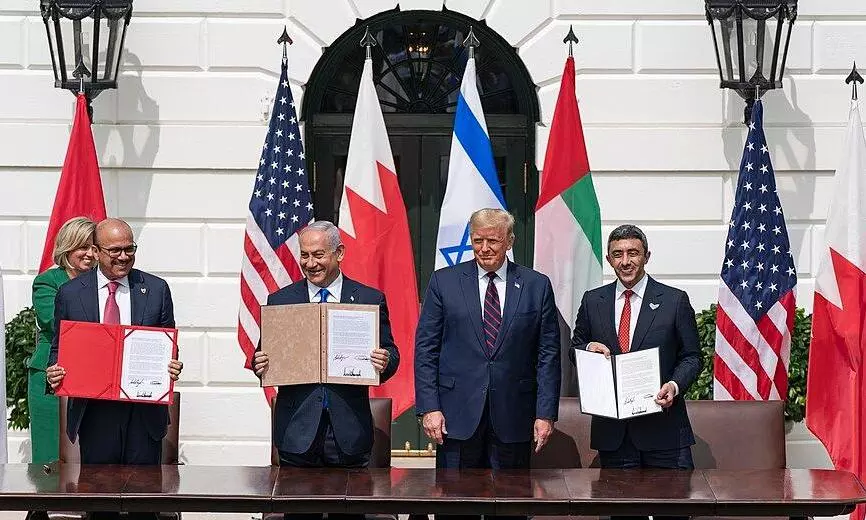
US President Donald Trump, Minister of Foreign Affairs of Bahrain Dr. Abdullatif bin Rashid Al-Zayani, Israeli Prime Minister Benjamin Netanyahu and Minister of Foreign Affairs for the United Arab Emirates Abdullah bin Zayed Al Nahyan after signing the Abraham Accords in 2020. File photo: Wikimedia commons
What are Abraham Accords and why does Trump want them tied to Iran peace deal?
The US President wants countries including Saudi Arabia, Pakistan and Qatar to normalise ties with Israel as part of a broader regional framework tied to ongoing Iran negotiations

US President Donald Trump has revived global attention on the Abraham Accords after urging several Muslim-majority nations, including Saudi Arabia, Qatar, Pakistan, Turkiye, Egypt and Jordan, to normalise relations with Israel as part of a broader regional peace framework linked to ongoing talks with Iran.
Trump recently said he had spoken to leaders from these countries and insisted they should “simultaneously sign onto the Abraham Accords” once a wider agreement involving Iran is reached. His remarks mark a renewed attempt to reshape the diplomatic landscape of West Asia through expanded Arab-Israeli engagement.
Also read: Pakistan maintains anti-Israel stance amid Trump’s Abraham Accords push
The proposal, however, comes at a time when the Gaza war, tensions with Iran and unresolved Palestinian statehood demands have sharply complicated any effort to expand the accords.
What are Abraham Accords?
The Abraham Accords are a series of US-brokered agreements aimed at normalising diplomatic relations between Israel and Arab or Muslim-majority countries.
The agreements were first signed in September 2020 during Trump’s first term in office, when the United Arab Emirates (UAE) and Bahrain formally recognised Israel. The accords were later joined by Morocco and Sudan, while Kazakhstan associated itself with the framework more recently.
Named after the shared Abrahamic roots of Judaism, Christianity and Islam, the accords marked one of the biggest diplomatic shifts in the Middle East in decades. Before the agreements, only Egypt and Jordan had formal diplomatic ties with Israel.
For decades, most Arab nations had maintained that recognition of Israel could happen only after the creation of an independent Palestinian state. The Abraham Accords broke from that position by prioritising trade, investment, security cooperation and strategic partnerships.
Abraham Accords - Key moments
2020: UAE and Bahrain sign in September; Morocco and Sudan follow by December. The deals are brokered during Trump's first term.
2021: Biden administration endorses the accords but does not push expansion. US-Saudi normalisation talks quietly advance.
2023: Gaza war begins in October. Saudi-Israel normalization talks collapse. Arab street opinion hardens sharply against Israel.
2025: Trump returns to the White House and immediately signals intent to revive and expand the Abraham Accords.
2026: Trump links Iran nuclear deal to mass Abraham Accords expansion — calling on six nations to sign simultaneously.
Why is Trump pushing for this?
Trump is pushing to expand the Abraham Accords as part of a broader effort to reshape the Middle East around closer cooperation between Israel, Arab states and the United States, while also countering Iran’s regional influence.
By linking the accords to ongoing Iran negotiations, the Trump administration hopes to create a wider diplomatic and security framework that boosts trade, defence cooperation and political ties across the region.
Trump has also portrayed the accords as one of the biggest foreign policy achievements of his first term and is now seeking to revive and expand them amid continuing instability in West Asia.
How Israel benefits?
For Israel, the accords delivered a major diplomatic and economic breakthrough.
The agreement with the UAE proved especially significant. Since normalisation, the two countries have rapidly expanded cooperation in trade, tourism, technology, intelligence sharing and defence. Bilateral trade reportedly surged into billions of dollars within just a few years, while direct flights and commercial partnerships transformed relations once considered impossible.
Also read: US carries out ‘self-defence’ strikes in Iran as Trump says talks progressing
The accords also helped Israel strengthen its legitimacy in the Arab world and deepen regional coordination against shared concerns such as Iran’s growing influence.
Morocco’s participation opened up tourism and agricultural partnerships, while Bahrain enhanced security cooperation with Israel and the United States.
The controversy
Despite the diplomatic gains, the accords triggered strong criticism across the Arab and Muslim world.
Palestinian leaders condemned the agreements as a betrayal, arguing that Arab countries had rewarded Israel without securing meaningful concessions on Palestinian statehood, settlement expansion or occupation policies.
The criticism intensified after the Gaza war that followed the October 7, 2023, Hamas attack on Israel. Israel’s military campaign in Gaza, which killed tens of thousands of Palestinians, sharply hardened public opinion across Arab nations.
Also read: 'No sovereign nation will accept what US, Israel are dictating to Iran'
Even countries that signed the accords, including the UAE and Bahrain, publicly criticised Israeli military operations in Gaza. Analysts say the war exposed the core weakness of the accords: they largely sidestepped the Palestinian issue rather than resolving it.
Iran has also consistently opposed the agreements, describing them as a threat to regional stability and Palestinian rights.
Why is Saudi Arabia central to Trump’s plan?
Among all potential new members, Saudi Arabia remains the most strategically important.
As the custodian of Islam’s two holiest sites and the Arab world’s largest economy, Saudi recognition of Israel would represent a historic geopolitical shift. The US has long viewed Saudi Arabia as the ultimate prize in efforts to expand the accords.
However, Saudi Arabia has repeatedly stated that it will not normalise ties with Israel without a credible pathway toward Palestinian statehood. That stance has become even firmer amid the Gaza conflict.
Also read: Israel-Iran conflict: What's Axis of Resistance vs Abraham Alliance; is a war inevitable?
The current Israeli government, widely viewed as the most right-wing in the country’s history, has rejected major Palestinian statehood concessions, creating a major obstacle for any Saudi-Israel breakthrough.
Why Pakistan rejected the proposal?
Pakistan became the first country mentioned by Trump to publicly reject the idea of joining the accords.
Pakistan’s Defence Minister Khawaja Muhammad Asif said Islamabad would not support any arrangement that contradicts the country’s longstanding position on Palestine. Pakistan has consistently maintained that it will recognise Israel only after the establishment of an independent Palestinian state based on pre-1967 borders, with East Jerusalem as its capital.
The issue remains politically sensitive within Pakistan, where support for the Palestinian cause runs deep and religious groups strongly oppose recognition of Israel.
Expansion plans
Trump is attempting to link three major goals into one regional framework: containing Iran, expanding Arab-Israeli normalisation and reshaping Middle East diplomacy.
Supporters argue the accords created real economic and strategic partnerships between participating countries. Critics, however, say they failed to deliver broader regional stability or progress toward resolving the Palestinian issue.
Also read: Trump, Netanyahu had tense phone call on future of Iran war: Reports
Whether Trump can persuade more Muslim-majority nations to join will likely depend on several unresolved issues, especially the future of Gaza, Israel’s position on Palestinian statehood and the outcome of negotiations with Iran.
For now, the Abraham Accords remain both a diplomatic success story and a deeply contested political project whose next phase is far from certain.