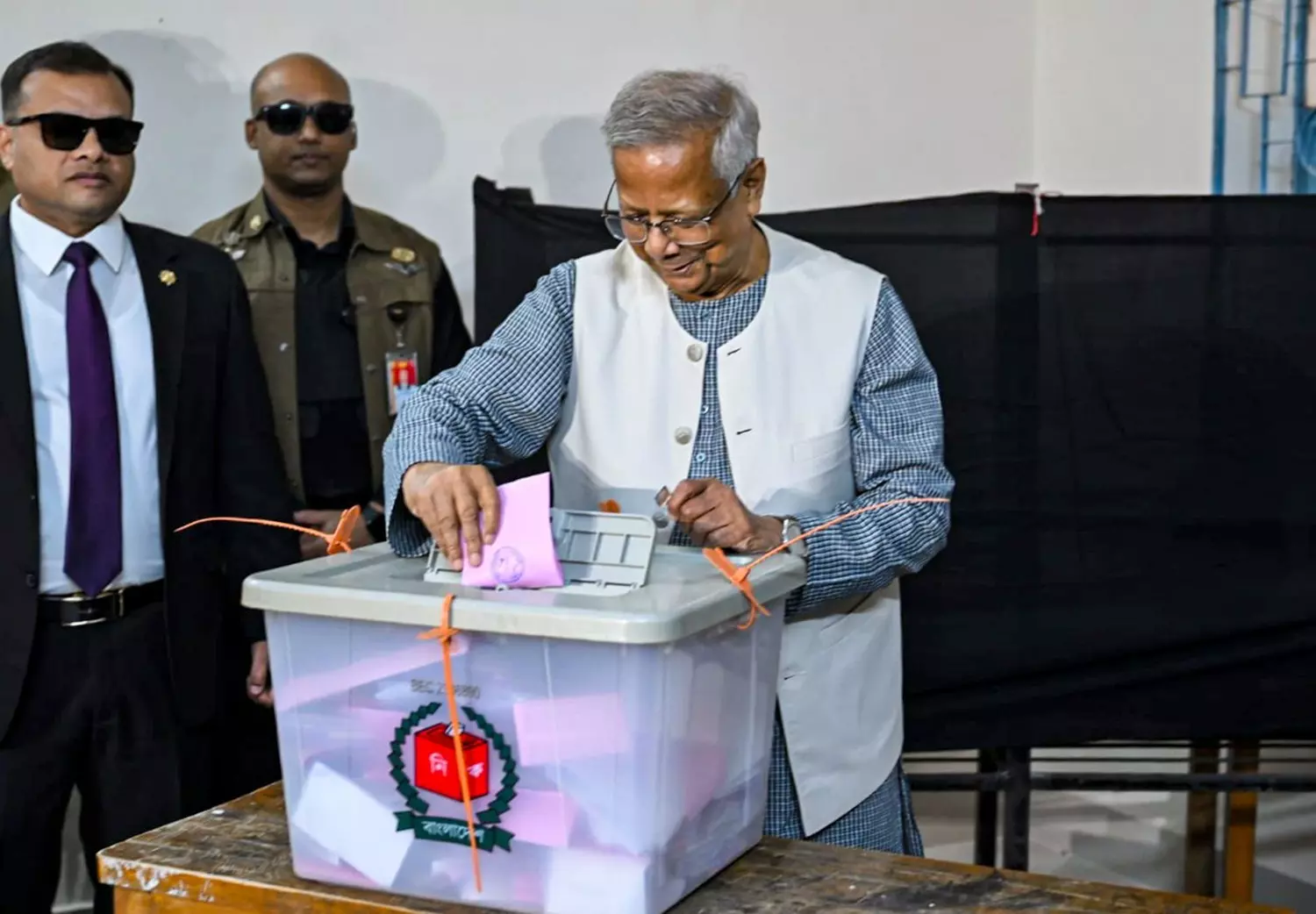
Bangladesh Chief Adviser Muhammad Yunus casts his ballot during voting in the country's parliamentary elections in the national capital Dhaka on February 12, 2026. Photo: @ChiefAdviserGoB/X via PTI
Bangladesh poll body claims 55-60% turnout, but ground reports tell a different story
Two contesting alliances level charges of electoral fraud and violence against each other; Chief Adviser Yunus says election day is like a festival

The Bangladesh Election Commission may finally report a reasonable turnout of 55-60 per cent in the country's national elections held on Thursday (February 12), but reports from multiple districts across Bangladesh suggest the claimed turnout does not quite matchon the ground.
At 11 am Bangladesh Time on D-Day, the commission reported a 14.96 per cent turnout in the first three-and-a-half hours of polling. An hour later, at 12 noon, it reported a 32.88 per cent turnout. At 2 pm, the poll body placed the national turnout at 47 per cent.
Also read: Bangladesh election outcome unlikely to ease ties with India
As polling closed at 4.30 pm local time, commission sources said the final turnout may be " anything between 55 and 60 percent".
Unlike previous election trends
Having regularly covered Bangladesh elections since 1991, this writer finds this trend odd. The maximum turnout in all previous polls was witnessed in the first four hours of polling, and then it tended to drop after midday, especially post-lunch.
This writer spoke to dozens of journalists in multiple districts across Bangladesh. The feedback was uniform: very low turnout, especially in the early hours and the post-lunch session, with only 5 to 10 voters appearing in most places.
In one booth near the usually bustling Dhaka University, there was not a single voter around midday. A Bengali daily journalist said she waited for 30 minutes but failed to spot any voters. The turnout numbers were higher in rural areas, but again much lower than usual.
Rival alliances cite 'false propaganda'
Both rival alliances in the election — one led by the Bangladesh Nationalist Party (BNP) and the other by the pro-Pakistan Jamaat-e-Islami — blamed the low turnout on "false propaganda" about possible violence without pinpointing who was behind such rumour-mongering.
Also read: Bangladesh elections marred by violence; BNP leader dies during altercation
The former ruling Awami League of deposed prime minister Sheikh Hasina, which has been barred from this election and had called for a boycott, alleged that the Muhammad Yunus-led interim government was trying to "inflate the turnout statistics to back its claim of a successful election".
"This election has proved the relevance of the Awami League in Bangladesh politics. People have largely stayed away from the polls because they want us back," party spokesperson Rokeya Prachy, a national award-winning actress-turned-trade-unionist, said.
The League, even in the worst of situations, is known to command a 40 per cent loyal vote bank. With its supremo Hasina calling for a boycott, it is expected that the party diehards have largely stayed away.
Yunus ecstatic but avoids uneasy queries
Chief Adviser Yunus was, meanwhile, euphoric after he cast his vote at an elite Dhaka locality. "We are celebrating the rebirth of Bangladesh, it is like a huge festival, a Maha Eid," he said, but avoided uncomfortable questions over allegations of poor turnout and electoral fraud.
Also read: Budget 2026-27: India slashes aid to Bangladesh, skips Chabahar port funding
In many booths, those who went to vote found their franchise had already been exercised. Police chased away fake voters in many places and arrested a few, but allegations of "night voting", stuffing of ballot boxes and signing of result sheets before the polls ended were doing the rounds.
Many party functionaries were also caught distributing cash to voters.
Even the two contesting alliances levelled charges of electoral fraud and violence against each other.
But the polls were largely peaceful, mainly due to the presence of huge military and paramilitary forces.
Tarique Rahman confident
BNP chairperson Tarique Rahman, who returned to Bangladesh in December 2025 from exile, appeared confident of victory and forming the next government. But it appeared he was not yet sure of the victory margin, amidst predictions of a close fight with the Jamaat-led Islamist alliance.
Also read: Bangladesh flays India over Sheikh Hasina’s ‘hate speech’: 'Surprised, shocked'
"We will try to get everyone in the government; we will try running the nation by consensus and not conflict," he remarked to journalists just before the polling ended.
A 'national govt' not ruled out
Analysts said Rahman was keeping the option of a 'national govt' open. Though his party has fought it out with the Jamaat this time, the two are former allies and have run coalition governments together. Jamaat chief Shafiqur Rahman has already said his party will cooperate with the government of the day.
Also read: US seeks ties with Bangladesh Jamaat-e-Islami, but with a tariff warning: Report
So, Bangladesh seems destined to get an elected government after 18 months of uncertainty, but the shape of the government will become clear when all the results come out.
The real uncertainty hovering over the country is the one linked to the referendum. In case it returns a "yes" vote, there will be huge pressure on the elected government to go for a new constitution based on the July Charter. That could mean the end of the 1972 Constitution, which gives Bangladesh the contours of a secular democracy.