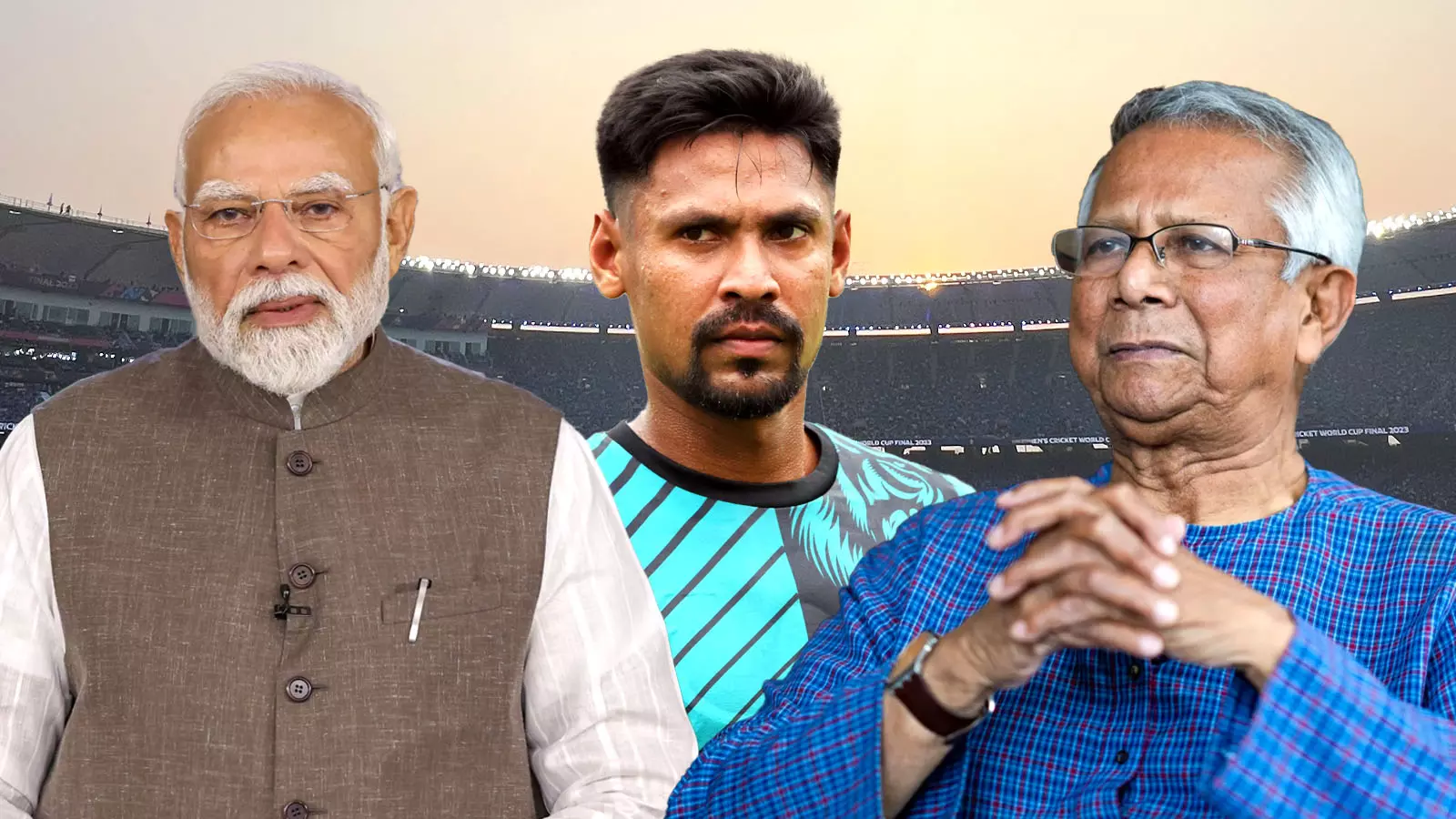
At a time when it was imperative for the Modi government to defuse tensions with Bangladesh, it's inexplicable why it allowed the Mustafizur episode to happen
Dropping Bangladesh cricketer Mustafizur Rahman from the forthcoming Indian Premier League (IPL) tournament may prove to be a strategic political error, making it that much more difficult for India to repair relations with its neighbour, which is arguably at its lowest ebb now.
There is widespread expectation that the Bangladesh Nationalist Party (BNP), tipped to win the general elections, will ease relations with India. But, given the aggression in Bangladesh’s reaction to India’s treatment of Mustafizur, New Delhi will find it difficult to restore its once genial relationship with Dhaka.
If the Mustafizur incident hadn’t happened and Bangladesh had played in India as scheduled in the T20 World Cup, it would have only kept alive the line of friendship between the two.
After initially threatening a boycott, Pakistan has eventually decided to go ahead and play India in the ongoing T20 World Cup. It has satisfied cricket’s requirements and the enormous financial stakes linked to it. But, what needs to be noted is the sequence of events that followed Bangladesh’s opting out of the high-profile tournament.
Also read: Yunus makes clarion call for 'Yes' vote in Bangladesh reform referendum
Since the ouster of Shaikh Hasina, Pakistan has been making the most of India’s slip-ups, cosying up to Bangladesh. India’s decision on Mustafizur, willy-nilly, gave Pakistan an unexpected but useful handle to emerge as a big supporter of Bangladesh. The interim administration of Muhammad Yunus encouraged Islamabad’s stance — and cemented their newfound bonhomie, while further alienating New Delhi.
The confabulation that followed among Bangladesh, Pakistan and Sri Lanka — that enabled the resurrection of the India-Pakistan World Cup encounter — made it clear that New Delhi was out of the diplomatic equation.
What drove the decision?
At a time when it was imperative for the Narendra Modi government to defuse tensions with Bangladesh, it is inexplicable why it allowed the Mustafizur episode to happen. India’s cricket board, on paper, takes the blame. But it is a no-brainer that the Board of Control for Cricket in India's (BCCI) move could have only happened at the instance of the government in New Delhi.
Also read: Bangladesh polls: Jamaat on back foot after chief’s remarks on working women
It is not clear what the BCCI (read Modi government) hoped to achieve by shunting out Mustafizur from the IPL, who, by playing in the tournament, would have in no way affected the politics or anything else between the two neighbours. It could not have hurt India in any way.
The move effectively came across as churlish and indefensible, especially since it was a done deal between Mustafizur and actor Shah Rukh Khan’s Kolkata Knight Riders (KKR).
Souring relations
If the Mustafizur incident hadn’t happened and Bangladesh had played in India as scheduled in the T20 World Cup, it would have only kept alive the line of friendship between the two (or whatever that remains) and kept Pakistan away from opportunistically dabbling in it.
Relations between New Delhi and Dhaka have nosedived since the ouster of Hasina as Bangladesh's prime minister in August 2024. Anti-India sentiments have, since, been reportedly running high in that country due to the extremely close ties between New Delhi and Hasina and her asylum in the Indian capital.
A consequence of the student-led uprising, in which the right-wing Islamist Jamaat-e-Islami played a key role, has been the targeting of minority Hindus. This caused enormous angst among India’s ruling Hindutva elite, worsening ties between the two South Asian neighbours.
US trade deal with Bangladesh
Amidst this comes an unexpected salvo — US President Donald Trump’s trade deal with Bangladesh, which, among other things, could further alienate Dhaka from New Delhi.
Also read: US cuts Bangladesh tariffs to 19%, gives Dhaka edge over India in textiles
The latest deal is designed to force Bangladesh to buy cotton from the US after cutting off traditional Indian supplies. Buying cotton from the US is beneficial for Dhaka as it means zero tariff on its textile imports from that country.
In the context of the anti-Hasina student uprising and the widespread mood against India, Tarique will find it difficult to go against the students’ sentiments and restore some element of amicability in ties with New Delhi.
The agreement between the US and Bangladesh, at the expense of Indian cotton producers and exporters, shows yet again that in a Trumpian world, there is no place for diplomatic sensitivities.
If the new arrangement works for Bangladesh’s garment-makers, it will effectively cut India out of Bangladesh’s garment trade and make it less dependent on India — that will in turn further reduce New Delhi’s already diluted leverage with its neighbour.
The role of Tarique Rahman
The only silver lining has been the return to Dhaka of Bangladesh’s BNP leader Tarique Rahman from exile, someone that the Indian establishment hopes can arrest the fast-slipping relations.
But given the ratcheting of tensions over trivial issues like the Mustafizur episode and the bigger role of Pakistan in Bangladesh — backed by Turkey and China — the moot question is whether Tarique will be willing, and even if he is, whether he can carry out a policy of detente with India.
Also read: Budget 2026-27: India slashes aid to Bangladesh, skips Chabahar port funding
Moreover, in the context of the anti-Hasina student uprising and the widespread mood against India, Tarique will find it difficult to go against the students’ sentiments and restore some element of amicability in ties with New Delhi. Pakistan too will be active and try everything in its power to ingratiate itself with the new dispensation and prevent a reset in Bangladesh-India relations.
Returning to where we started, the dropping of Mustafizur from the IPL, it becomes clear why that may have been a needlessly costly mistake on the part of the Modi government, unless it is an indication that New Delhi is ready to up the ante against a post-Hasina Bangladesh, irrespective of the consequences.