Why Symphony Orchestra of India's 20th anniversary is all about Western classical music's journey in country
Symphony Orchestra of India (SOI) marks two decades of music-making with a landmark 2026 season at Mumbai’s National Centre for the Performing Arts. Having already demonstrated that a professional symphony orchestra can survive and flourish in India, the question now is whether it can create the infrastructure of continuity — trained musicians, returning alumni, national networks, adventurous audiences and a culture of listening that extends beyond individual star performances.

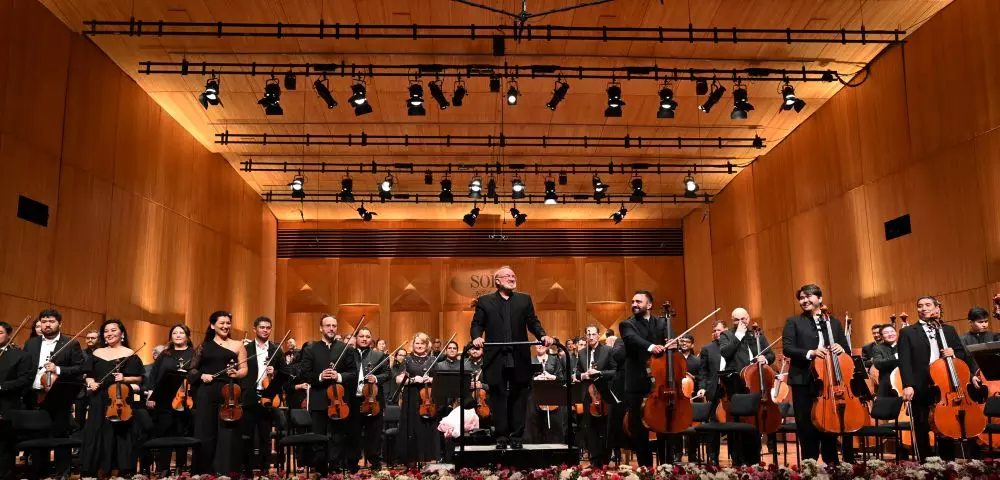
Martyn Brabbins conducts a Symphony Orchestra of India concert. Photo: By special arrangement
At 20, an orchestra is neither a prodigy nor quite a grown-up. It is an age of intent rather than arrival, of appetite sharpened by experience. As the Symphony Orchestra of India (SOI) marks two decades of music-making with a landmark 2026 season at Mumbai’s National Centre for the Performing Arts (NCPA) — the celebrations started earlier this month, on August 23 — the moment feels less like a victory lap for a single institution and more like a meditation on the longer, more improbable journey of Western classical music in India.
The celebratory gloss is unmistakable, not least in the return of internationally acclaimed Italian maestro Carlo Rizzi for two concerts at the beginning of the twentieth year. Yet the deeper intrigue lay with British conductor Martyn Brabbins, who began his tenure as chief conductor of the SOI last season. His concerts thus far, the NCPA says, “signal continuity, confidence and a long view”.
For the Briton Brabbins, however, the word debut comes with an asterisk. He has been a familiar presence in Mumbai for more than a decade, watching what he calls the orchestra’s “steady, sometimes hard-won growth” and absorbing “a sense of local musical taste”. What has changed, in his view, is not merely the sheen of the playing, but the orchestra’s sense of purpose.
“There’s been a clear development of ambition and quality,” Brabbins says. “Now the orchestra is 20. That’s not so old in the life of an orchestra. They’re coming into maturity.”
That idea of maturity rather than completion is perhaps the key to understanding where the SOI stands today. The orchestra that began in 2006 as an audacious experiment has evolved into India’s “first and only professional full-time symphony orchestra”, capable of attracting conductors and soloists from the highest international ranks.
Beyond concerts
Brabbins resists the temptation to treat the anniversary as a triumphal endpoint.
“I don’t want to impose radical changes,” he says. “Any change should be a natural evolution.”
He speaks of the orchestra as a “musical organism”, something that grows through listening, trust and accumulated experience rather than through sudden transformation.
Every conductor, he acknowledges, inevitably changes an orchestra’s sound, but personality is never fixed. “There’s always a chance for it to change,” he says, suggesting that his role is less that of an architect arriving with blueprints than of a gardener tending an already flourishing landscape.
That landscape extends beyond the concert platform. Spend time around the NCPA during an SOI Academy concert and the atmosphere is strikingly different from the usual Mumbai cultural evening of late arrivals and foyer conversations. Here the nervous energy belongs to children carrying violins almost as large as themselves, parents clutching programmes as if they were examination results and teachers mentally replaying every rehearsal.
Also read: 30 years since 1st album, why Colonial Cousins feel there's still much to discover about their music
The SOI Music Academy, established in 2012 under its earlier avatar as the NCPA Special Music Training Programme, has become one of the orchestra’s most significant long-term investments. Built around a Russian Conservatoire-inspired curriculum conceived by SOI founders, Kazakh violinist and conductor Marat Bisengaliev and the NCPA’s Khushroo Suntook, it combines instrumental tuition with music theory, history, second-study piano, group singing, chamber music and orchestral training.
Suntook has often framed the academy’s mission in unusually direct terms.
“Start them young, they say, if you wish to make them readers, writers, good listeners, well-rounded individuals,” he remarks, before pointing out that countries such as China, Korea and Japan have invested systematically in arts education, whereas in India learning an art form still depends largely on personal initiative, parental sacrifice and the luck of finding the right teacher.
Catching them young
That observation gains added weight in the orchestra’s 20th anniversary because the academy exists precisely in the space between what public infrastructure does not provide and what a determined cultural institution has tried to build from the ground up.
According to Bianca Mendonca, general manager of the SOI, the programme now functions as an 11-year structured pathway, including a seven-year intensive course followed by a four-year advanced stream for selected students.
“The idea was never simply to create hobbyists,” Bianca says. “Students learn to rehearse together, perform chamber music, play in orchestras and work alongside professional SOI musicians from a very early stage.”
The results are becoming increasingly tangible. The first cohort that entered in 2012 graduated in 2019 and subsequent batches have moved on to conservatories abroad, advanced training programmes and professional performance opportunities. What was once an aspirational experiment is gradually becoming a recognisable alumni network.
This year’s graduating students — Ishaan Subramanian (clarinet), Yuvaan Subramanian (percussion), Aariya Shah (piano), Rahakrishna Mehta (cello) and Rianna Chheda (clarinet) — performed with the SOI Academy Orchestra, while selected soloists appeared alongside members of the SOI Chamber Orchestra under Bisengaliev’s baton. The concert felt less like a student recital than a professional debut, reflecting years of ensemble work and orchestral discipline.
The academy’s ambitions are no longer confined to Mumbai; Bianca notes that a national outreach initiative launched in 2025 has brought in more than 15 students from Goa, Chennai, Kochi and Pune.
The Goa connection is particularly significant because it points to a broader ecosystem the SOI is trying to nurture. Through its ongoing collaboration with the Child’s Play India Foundation, a music education trust founded by Dr Luis Dias, SOI musicians conduct annual camps for children from diverse social backgrounds. Dias has described the orchestra as “a nation’s pride and hope”, arguing that its greatest contribution lies not only in the concerts it presents but in the ecosystem of aspiration, training and collaboration it is beginning to create across India. Bianca similarly describes the partnership as an effort to identify and encourage naturally gifted young musicians who may eventually enter advanced training, become performers or even return as teachers, creating a slowly expanding national network of musical relationships.
A conservative audience
That aspiration feels strikingly relevant to the SOI’s recent trajectory.
Brabbins, who has spent much of his career balancing the classical canon with contemporary music, sees audience development as inseparable from institutional growth. His first season with the SOI included Shostakovich, a composer he admires for his refusal to follow “just one rulebook”.
“One moment biting irony or the grotesque, the next uneasy, double-edged harmonies that never quite settle,” he says. “The unfamiliar shouldn’t be scary.”
He is candid about the realities of the Indian classical audience. “The audience here is conservative,” he observes. “Why shouldn’t they be? They haven’t been exposed to anything other than the great classics.” The task, he believes, “is not to shock listeners but to build trust gradually, introducing newer repertoire through curiosity rather than confrontation.” That long view feels particularly apt for an orchestra that is still defining its identity.
Pianist Andreas König, who has toured extensively across Indian cities, detects encouraging signs that such trust is slowly being built. He speaks of a noticeable expansion in both audiences and educational engagement with Western classical music, particularly in contexts where performance is combined with teaching, workshops and cross-cultural collaboration. The concert hall, in other words, is becoming less of an isolated enclave and more of a meeting point between artistic excellence and musical learning.
The prodigal returns
Hovering over the beginning of the 20th anniversary year was another, older musical lineage: Zubin Mehta. The octogenarian maestro was back in Mumbai for the second consecutive year to conduct the SOI, which the NCPA described as “embodying a remarkable continuity between the city’s orchestral past and its present aspirations”.
Zubin Mehta conducts a concert. Photo: By special arrangement
For Mehta, that continuity begins not with institutions but with family. His self-taught violinist father, Maestro Mehli Mehta, founded (in 1935) and conducted the Bombay Symphony Orchestra (semi-professional, also employed amateurs and depended on ad hoc funding) and later spent 33 years leading the American Youth Symphony in Los Angeles. Before that, however, Mehli had made a bold journey from Bombay to New York to study under the legendary Ivan Galamian, the formidable pedagogue (who later taught the legends Itzhak Perlman and Pinchas Zukerman).
“He returned to what was still ‘Bombay’ as an accomplished violinist in the Russian tradition,” Mehta recalls with a twinkle in his eye, “but my mother Tehmina’s family was unimpressed and hesitant to give her hand in marriage to him.”
Born in 1935 into that intensely musical household, Mehta remembers sound not as an accomplishment to be acquired but as the very atmosphere of childhood. “I probably learnt my mother tongue Gujarati and singing at about the same time,” he says.
Chamber music was a daily ritual, with his father’s string quartet rehearsing regularly at home. After the family returned permanently to Bombay following the Second World War, Maestro Mehli recognised the boy’s growing fascination with music and began teaching him both violin and piano. The apprenticeship quickly became unusually serious. “He even allowed me to lead sectional rehearsals of the Bombay Symphony when I was still a young teenager,” Mehta chuckles. “By 16, he was letting me conduct the entire orchestra during rehearsals.”
Those memories illuminate why Mehta bristles at the suggestion that Western classical music is somehow ‘esoteric,’ ‘niche’ or ‘foreign’. “My father introduced me to this musical language, which is very much part of India,” he says. “Music is music. I don’t know what to make of these labels.”
That refusal to treat orchestral music as culturally alien resonates powerfully with the SOI’s own journey. Mehta, who left Bombay at 18 to study conducting in Vienna with the legendary Hans Swarowsky, sees the Indian orchestra movement not as an imported curiosity but as a young tradition that deserves patience.
“It is culturally still in its infancy,” he says of the SOI. “Give it time and it will flourish.”
Yet his faith is tempered by frustration at the lack of governmental support. “You know, just as I had written to other prime ministers before, I wrote to Narendra Modi soon after he took office in 2014,” he recalls. “But forget responding positively, he didn’t even acknowledge my letter. If this is the level of apathy I faced, can you imagine the fate of others?”
Coming from a conductor who has led the Vienna Philharmonic, Berlin Philharmonic, Israel Philharmonic and Los Angeles Philharmonic, the remark carries the weight of perspective. Mehta resists drawing simplistic comparisons between the SOI and the world’s great orchestras; instead, he emphasises the importance of allowing an institution to grow at its own pace.
Creating an infrastructure of continuity
The academy’s recent experiments — including performances of AI-generated compositions alongside Saint-Saëns and Shostakovich, and collaborations with young trumpeters from The Sunshine Orchestra, the flagship project of the AR Rahman Foundation — suggest an institution willing to explore new intersections between tradition, technology and contemporary creativity.
Also read: A lingering refrain: How the ghazal survived, evolved through the centuries
The broader cultural significance of this evolution is beginning to attract scholarly attention as well. Ankna Arockiam, whose doctoral research at the University of St Andrews, UK, examines young Indian Western classical musicians, argues that Western classical music in India is no longer simply a colonial residue. Rather, it has become part of the complex cultural identities of young Indian musicians, shaped by education, community, institutional support and the experience of moving between multiple musical worlds. Her research offers an important corrective to the simplistic assumption that orchestral music in India remains merely an imported European artefact.
Perhaps that is why the SOI’s 20th anniversary feels less like a retrospective than a proposition. The orchestra has already demonstrated that a professional symphony orchestra can survive and flourish in India. The more consequential question now is whether it can create the infrastructure of continuity: trained musicians, returning alumni, national networks, adventurous audiences and a culture of listening that extends beyond individual star performances.
The most enduring image of the SOI at 20 may not be the thunderous close of a Beethoven symphony or the glamour of an international maestro on the podium. It may be something quieter: a child in an academy classroom marking corrections on a score, repeating a single bar until it finally sounds right.
That is where orchestral culture is truly built — not in anniversary speeches, but in the accumulation of thousands of patient, imperfect, hopeful repetitions. Listening to those sounds echo through the NCPA corridors during this landmark season, one begins to feel that Western classical music in India is slowly ceasing to be merely a colonial echo and becoming, unmistakably, part of India’s own cultural future.