A lingering refrain: How the ghazal survived, evolved through the centuries
The upcoming silver jubilee of the Khazana Ghazal Festival in Mumbai is more than a musical milestone. It is a celebration of the extraordinary journey of the ghazal — from Arabian deserts and Persian courts to digital playlists — and an opportunity to decode what keeps this timeless art form alive in a restless age.

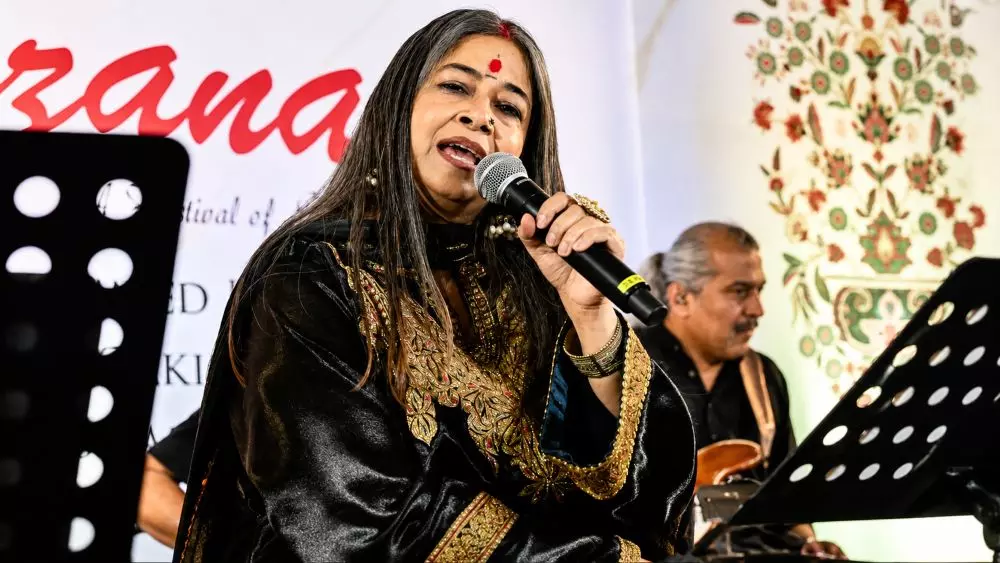
Rekha Bharadwaj performs at the 2019 Khazana Ghazal Festival. Photo: By special arrangement
When the Khazana Ghazal Festival celebrates its silver jubilee in Mumbai on 24-25 July — with a hat-doff at singer Asha Bhosle, whom we lost earlier this year — it will mark far more than the 25th edition of a successful music festival. It will celebrate the survival of an artistic sensibility.
For a quarter of a century, the festival has stood at the confluence of poetry, music and philanthropy. Conceived by the late Pankaj Udhas, with Anup Jalota and Talat Aziz, it was never intended to be just another concert series. “It was built on a radical proposition,” says Udhas’s daughter Nayaab, who now steers the festival. “That music could heal beyond the concert hall. Every ticket sold has helped support the work of the Cancer Patients Aid Association (CPAA) and the Parents Association Thalassaemic Unit Trust (PATUT), transforming evenings of melody into acts of compassion.”
Yet, as Khazana reaches this milestone, another story unfolds alongside it — that of the remarkable journey of the ghazal itself. Few music forms have travelled as widely — geographically, linguistically and emotionally — while retaining their essential character. From the deserts of Arabia to the courts of Persia, from the Deccan plateau to Delhi’s literary salons, from intimate mehfils to cassette players in middle-class homes and from Doordarshan broadcasts to Spotify playlists, the ghazal has weathered every cultural upheaval by quietly reinventing itself.
That is perhaps why Khazana’s silver jubilee feels less like an anniversary than an invitation to reflect on where the ghazal has journeyed and where it might yet be headed.
A language of longing
Long before it became synonymous with velvet voices and softly lit concert halls, the ghazal was an exquisitely disciplined poetic form.
Lyricist and poet AM Turaz, equally at home in contemporary Bollywood and traditional mushairas, traces its beginnings to 7th-century Arabia, before its flowering in Persian and Urdu literature. “The ghazal”, he says, “consists of rhyming couplets bound together by a strict refrain and rhyme scheme. Within that disciplined structure lies extraordinary emotional freedom”.
Its formal discipline allows poets to explore limitless emotional worlds. Traditionally, those worlds revolved around unfulfilled love, separation, spiritual yearning and Sufi mysticism. The beloved could be earthly or divine. A tavern might symbolise intoxication or enlightenment. A night of longing could become an allegory for the soul’s search for God.
Few poems embody this better than Amir Khusrau’s immortal Persian-Hindavi composition Zehaal-e-miskeen makun taghaful (Do not overlook my misery)... More than seven centuries after it was written, its grief, yearning and tenderness remain startlingly immediate, reminding us that while musical styles evolve, human longing rarely does.
Arabia, Persia, the Deccan... and beyond
The evolution of the ghazal mirrors centuries of cultural exchange.
Persian poetry scholar Dr Afsar Makdoom Sheikh, a familiar presence at Khazana, explains that the form emerged as an offshoot of the Arabic qasida (a form of poetry), flourishing around the 6th and 7th centuries. “Early Arabic ghazals celebrated wine, women and love, or lamented love lost,” he laughs. “When the form entered Persia around the 11th century, it absorbed mystical dimensions. The suffering lover became almost saintly.”
(Left to right) Anuradha Paudwal, Suresh Wadkar, Pankaj Udhas, Bhupinder Singh, Mitali Singh and Penaz Masani, flanked by other artistes, at the final rehearsal for the 2012 Khazana Ghazal Festival. Photo: By special arrangement
Its Indian journey, however, remains one of literature’s most fascinating stories.
Contrary to popular belief, Hyderabad-based cultural historian Dr Apparao Reddy argues that the earliest Indian ghazals were composed not in Delhi but in the Deccan. “They were first written in Dakhni [a form of Hindustani spoken in the Deccan, which flourished under the Deccan Sultanates of the 15th- 16th centuries],” he says. “When Wali Dakhni travelled from Aurangabad to Delhi around 1700 CE, northern poets were astonished that a local language could sustain such refined literary expression.”
Reddy also points to the poignant fate of Wali’s grave in Ahmedabad, which, according to the Justice GT Nanavati Commission report, was demolished during the communal violence of 2002, a reminder that literary histories are often shaped as much by politics as by poetry.
Within decades, Mir Taqi Mir, Sauda, Mir Dard and others transformed the ghazal into the defining poetic form of Urdu.
Also read: Why in India, the monsoon is as much music as season
But its journey did not stop there.
Over the years, ghazals have flourished in Bengali (Bulbuli Tui Phul Shakhate by Kazi Nazrul Islam), Punjabi (Ki Puchhde O Haal Fakiran Da by Shiv Kumar Batalvi), Gujarati (Mane Aevi Reetey by Mareez), Marathi (the iconic Asha Bhosle ghazal Tarun Aahe Ratra Azuni by the Ghalib of Marathi poetry Suresh Bhat), Kannada (Koragi Koragi by Subraya Chokkadi), Nepali (Gajalu Ti Thula Thula Aankha by the late Nepalese King Mahendra sung by Ghuam Ali), Assamese (Tumi Kaar Kobitare Kalpana by Tafazzul Ali sung by the ghazal maestro Jagjit Singh) and Sindhi (Hazar Manhoon, Hazar Mehrabun by Ustad Bukhari).
They travelled westward into Turkish, Dari and Pashto; eastward into Malay, Javanese and Burmese. More recently, poets across Europe and North America have begun writing ghazals in English, German and other languages too.
American poet and literary critic John Hollander’s celebrated Ghazal on Ghazals, playful yet technically faithful to the form, demonstrates that while languages may change, the architecture of the ghazal continues to inspire.
Cinema’s inheritance
For much of the 20th century, millions encountered the ghazal not through literary journals but through cinema.
Sheikh calls film music “the greatest ambassador of the ghazal”.
From singers like KL Saigal and Talat Mahmood to lyricists such as Shakeel Badayuni, Sahir Ludhianvi, Kaifi Azmi, Majrooh Sultanpuri, Gulzar and Javed Akhtar, generations have quietly introduced sophisticated Urdu verse to mainstream audiences. Songs such as Kabhi Khud Pe, Aaj Socha To Aansoo Bhar Aaye, Surmayi Shaam and Rasm-e-Ulfat blurred the distinction between film songs and literary ghazals, becoming part of India’s emotional memory.
And then came a tsunami called Jagjit Singh!
“Jagjit ji transformed the sound of the ghazal,” says singer Rekha Bhardwaj. “He introduced guitars, keyboards and lush string arrangements without sacrificing the soul of the poetry. Even when he sang Gulzar Saab’s intricate verses in Mirza Ghalib, he made them deeply intimate.”
If Jagjit Singh modernised its sound, Pankaj Udhas broadened its audience. “His albums entered drawing rooms far removed from traditional Urdu literary circles,” says Sonu Nigam. “He made the ghazal part of middle-class India.”
Together, the two reshaped the modern ghazal. One refreshed its musical vocabulary, the other expanded its reach. Their legacy created the audience that ghazal festivals today continue to nurture.
That widening of the ghazal’s audience found its most meaningful expression in Khazana.
A language under pressure
The future of the ghazal, however, remains inseparable from the future of Urdu.
Poet-lyricist Javed Akhtar believes the form today exists in “a dual state of classical preservation and modern experimentation.” Yet he also recognises the challenge confronting it. “The decline of formal Urdu comprehension across the subcontinent,” he says, “has transformed the ghazal from a mass-market medium into a niche literary pursuit”.
The loss is not merely linguistic. A ghazal often derives its emotional force from words layered with centuries of metaphor, cultural memory and multiple shades of meaning. Translation can preserve the sentiment, but rarely the full resonance.
Turaz, however, sees possibility rather than decline. “If younger listeners don’t understand every word,” he says, “the answer isn’t to simplify the poetry. The answer is to bring them closer to the language.”
Akhtar is equally clear that the ghazal must continue to engage with the world beyond romance. While love, longing and separation remain central to the form, its greatest practitioners have never hesitated to confront the anxieties of their own age.
“Ghazal writers have always responded to the challenges of their times,” he says. “Whether it was Partition, the Emergency or contemporary realities, the form has never been confined to unrequited love.”
He points to the late Rahat Indori, whose poetry transformed personal anguish into a commentary on displacement, fractured identities and the violence of borders.
Akhtar’s own verse reflects the same conviction: “Jo baat kehte darte hain sab, tu woh baat likh/Itni andheri thi na kabhi pehle raat, likh” (Write the words that everyone else is afraid to speak/Write of a night darker than any we have known before). Elsewhere, he urges poets: “Jo roznamon mein kahin paati nahin jagah/Jo roz har jagah ki hai, woh waardaat likh” (Write of the stories that never find a place in the newspapers/Though they unfold every day, in every corner of the land).
For Akhtar, the ghazal remains not merely a vehicle for beauty but also a moral witness to its times.
(Left to right) Rekha Bharadwaj, Sudeep Choudhury, Anup Jalota and Talat Aziz at the 2019 Khazana Ghazal Festival. Photo: By special arrangement
Turaz believes that evolution must also happen at the level of language. “Without disturbing the architecture of the ghazal, if I can reflect the vocabulary of Gen Z, I should. Accessibility should not be mistaken for dilution.”
He smiles as he recites one of his playful contemporary couplets: “Bohat mistake hoti ja rahi hai/Mohabbat fake hoti ja rahi hai/Bure hum ho gaye sohbat mein jiski/Wo ladki nek hoti ja rahi hai” (Many mistakes are being made/Love is becoming fake/The person in whose company I am becoming a bad person/That girl is improving by the day).
The juxtaposition of English with a classical structure may surprise traditionalists, but Turaz sees it as proof that the ghazal is still capable of absorbing the language of its time.
Also read: Why contemporary Hindi cinema seems to have little new to say about Partition
Pankaj Udhas understood that balance perhaps better than most. “Audiences want accessible lyrics and situations,” he once observed, “but accessibility should never come at the cost of quality.”
Emerging vocalist Puja Gaitonde agrees that accessibility cannot replace rigour. “Urdu and Persian demand extraordinary attention to diction,” she says. “A slight change in pronunciation can alter not just a line but the meaning of an entire ghazal.”
She recalls spending years studying tallafuz (articulation) under Ustad Ibrahim Darvez after he gently remarked that although her singing was beautiful, her pronunciation still carried what he teasingly called “a varan-bhaat flavour,” a distinctly Maharashtrian inflection.
Her story recalls another defining moment in Indian music. The late Lata Mangeshkar often credited actor Dilip Kumar with changing the course of her artistic life through a casual remark in 1947. When he observed that singers unfamiliar with Urdu sometimes weakened the poetry through incorrect pronunciation, she immediately began formal lessons in the language.
The result was not simply impeccable diction. It became one of the greatest vocal legacies in Indian music.
Sometimes a language survives not because institutions protect it, but because an artist cares enough to pronounce every word with love.
Between reverence and renewal
If the cassette era gave the ghazal an unprecedented popular following, the digital age has presented a more complicated inheritance.
Albums have largely disappeared. Leisurely radio programmes that once allowed poetry to breathe have given way to breathless chatter and shrinking attention spans. Streaming platforms reward immediacy, while the ghazal asks for patience. It invites listeners to linger over a metaphor, return to a refrain and discover new meanings with every hearing.
Yet the digital revolution has not diminished poetry. In many ways, it has rediscovered it.
Couplets by Ghalib, Faiz Ahmed Faiz, Bashir Badr and Jaun Elia circulate endlessly on Instagram, WhatsApp and X, often finding audiences far younger than anyone might have imagined. Mushairas continue to attract packed halls, while independent musicians are pairing classical poetry with contemporary arrangements that respect the integrity of the verse without sounding trapped in nostalgia.
Arijit Singh’s occasional forays into the ghazal routinely become talking points. “The moment singers like Shreya Ghoshal or Arijit Singh record a ghazal,” observes vocalist Parthiv Gohil, “the response is extraordinary. The audience is clearly there”.
Perhaps listeners have not abandoned the ghazal after all. Perhaps they are simply waiting for artists willing to present it in a language and soundscape that feel contemporary without compromising its poetic soul.
Javed Akhtar believes independent platforms have opened precisely that possibility. Freed from the commercial compulsions of mainstream cinema, lyricists and composers are once again able to experiment, marrying timeless poetic structures with modern musical idioms.
The form is also finding new homes beyond the subcontinent. Across Europe and North America, poets are writing ghazals in English, German and other languages, suggesting that the genre has become global without surrendering its emotional grammar.
The ghazal has never survived by resisting change. It has survived by absorbing it.
Listening as resistance
Talat Aziz perhaps offers the most perceptive diagnosis of where the ghazal stands today. “The ghazal occupies a paradoxical space,” he says. “It is deeply respected, frequently quoted, but not always inhabited as a living habit of listening.”
That phrase lingers long after the conversation ends: a living habit of listening.
The ghazal demands something increasingly rare in an age of infinite scrolling. It asks us to pause over a metaphor, surrender to silence after a sher (couplet) lands and allow language to unfold at its own unhurried pace. It rewards attention rather than distraction.
In that sense, listening itself becomes an act of quiet resistance.
Khazana embodies precisely that spirit. It does not compete for virality or chase fleeting trends. Instead, it creates a space where performers, poets and audiences participate in an experience defined by attentiveness rather than spectacle.
For a few hours, time appears to slow. The singer holds a note a little longer. The audience waits before applauding, allowing the words to settle. The silence between two couplets acquires as much meaning as the music itself.
In those moments, the festival reminds us that the ghazal has never been merely a form of entertainment. It is a way of listening, of remembering and perhaps most importantly, of feeling.
That may well be its greatest act of renewal.
More than memory
There is another reason Khazana matters.
Its significance extends beyond preserving a musical tradition. Over the past twenty-five years, the festival has translated the emotional power of the ghazal into tangible acts of compassion.
Perhaps that, more than anything else, explains the festival’s enduring appeal. It has demonstrated that music can move audiences without losing sight of those who need it most.
The festival’s success also challenges a familiar assumption that classical or literary traditions inevitably become museums of nostalgia. Khazana has shown that heritage remains relevant only when it continues to serve the present.
Its greatest legacy, therefore, may not simply be the preservation of the ghazal, but the expansion of its purpose.
Also read: Why Kanupriya Dhingra’s The Sunday Book Bazaar is a bibliophile's ode to this iconic Delhi market
So what, ultimately, does Khazana’s silver jubilee celebrate?
For Talat Aziz, it celebrates a remarkable community: the legacy of Pankaj Udhas (who passed away in February 2024), the artistes who have returned year after year to make the festival their own, and audiences who still believe that some evenings deserve to be spent listening rather than merely consuming.
Above all, however, it celebrates the extraordinary resilience of the ghazal itself.
Across seven centuries, the form has crossed languages, religions, empires, political upheavals and technological revolutions without surrendering its essential character. It has absorbed new vocabularies, embraced new instruments, travelled to new continents and found new listeners, while continuing to speak in the timeless language of longing, love, loss and hope.
Its future will undoubtedly look different from its past. New voices will bend its conventions. Younger poets will introduce unfamiliar idioms. Musicians will continue to experiment with fresh arrangements. Purists will worry, as they always have, that something precious is being lost.
Yet history suggests otherwise.
The ghazal has never survived because it resisted change. It has endured because every generation found a way to inherit it without merely imitating the one before.
Javed Akhtar believes that responsibility now rests equally with poets, performers and audiences. “It holds out a promise that in an increasingly hurried world there will still remain spaces where poetry is allowed to breathe, where silence carries meaning and where music does something rarer than entertain,” he says. “It teaches us, once again, how to listen.”
That may be the most enduring lesson of ghazal as a genre.
It reminds us that the deepest human emotions can often be contained within two carefully crafted lines which can also inspire compassion, sustain communities and transform art into public good.
As long as human beings seek words for longing, solace and hope, the ghazal will continue to find new voices. And as long as there are listeners willing to pause, to reflect and to truly hear, it will never become a relic of memory.
It will remain, as it has always been, a living conversation.