30 years since 1st album, why Colonial Cousins feel there's still much to discover about their music
PM Modi's gift of Colonial Cousins vinyl to Australian Prime Minister Anthony Albanese has renewed focus on one of the '90s most popular music duos, Hariharan and Leslee Lewis. The rediscovery of Colonial Cousins comes as the duo prepare for their 41st original composition. In interview with The Federal, Hariharan and Lewis hope the current interest will go beyond their best-known tracks — Krishna, Indian Rain and Sa Ni Dha Pa.

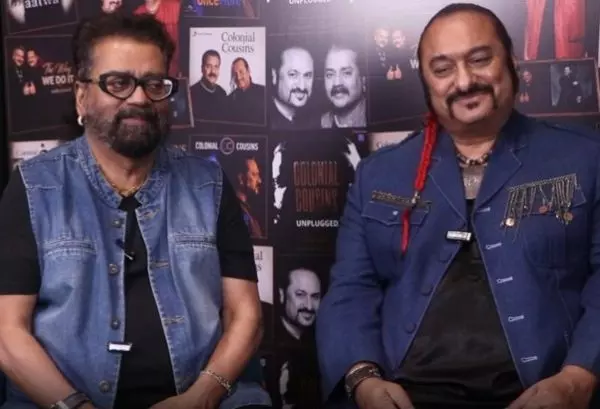
Hariharan and Leslee Lewis, the two halves of the musical duo Colonial Cousins.
It took an unexpected diplomatic gift to remind India of a musical partnership that had taken the country by storm in the ‘90s.
When Prime Minister Narendra Modi presented a collectors’ edition of a vinyl version of the Colonial Cousins’s debut, eponymous album to Australian Prime Minister Anthony Albanese — an avowed vinyl enthusiast — during his visit Down Under last month, it wasn’t just a thoughtful state gift linked to seeking uranium. It reignited a national conversation about a duo that transformed Indian independent music in the mid-1990s. Overnight, Hariharan and Leslee Lewis, the two halves of the Colonial Cousins duo, found themselves back in the spotlight, not merely because of Krishna, Indian Rain or Sa Ni Dha Pa — their better-known tracks — but because listeners are rediscovering an extraordinary catalogue of nearly 40 original songs spanning five albums.
“It was a real ‘wow’ moment,” says Hariharan. “Imagine your album being presented at a diplomatic level as Track II, representing India. It makes you feel that your music has become a part of the country’s cultural identity. It also tells us that the music is still relevant after all these years.”
His “peer and pal “Leslee Lewis is equally moved. “This is a rare honour for any artiste. We are really honoured that our music has found such a pride of place.”
The timing is particularly significant because the duo are simultaneously creating what will become their 41st original Colonial Cousins composition, proof that their partnership born three decades ago is still evolving.
The songs everyone remembers... and the ones they don’t
Ask anyone about Colonial Cousins and the same three titles inevitably surface — KrishnaNee Begane Baro, Indian Rain and Sa Ni Dha Pa. The songs dominated television, won awards and became defining soundtracks of the MTV generation.
But success had an unintended consequence.
“Absolutely,” Hariharan says when asked whether many of their finest songs remained overlooked. “We’ve created nearly 40 original songs across five albums — Colonial Cousins, The Way We Do It, Unplugged, Aatma and Colonial Cousins Once More. Unfortunately, because television in those days [the ‘90s-early 2000s] was driven by music videos, only a few songs became hugely popular because of reach.”
He hopes the renewed attention changes that, encouraging listeners to “discover the complete catalogue”.
Lewis believes the streaming era finally gives those other songs the audience they always deserved. “The real listeners always found those songs. But now, thanks to streaming platforms, the younger generation can discover every song without waiting for a music video.”
Also read: Left confused by all the Gen Z ‘skibidi’? Check out this guide for a quick language ‘glow up’
Even when asked what a Gen Z [those born between 1997 and 2012] listener should hear first, neither chooses the obvious hits. Hariharan recommends The Way We Do It, pointing to the way it integrates Indian classical traditions into a contemporary soundscape. Lewis instead picks Lady from Colonial Cousins Once More, describing it simply as “a beautiful ballad” and one of his personal favourites.
Despite regretting the neglect of some of the lesser-known songs, the duo agree that few Indian pop songs have aged as gracefully as Krishna Nee Begane Baro. Its plea for peace feels perhaps even more relevant today.
“Sadly, it's even more relevant today than when we wrote it,” says Hariharan. “The message of peace, humanity and compassion continues to resonate.”
Lewis broadens the thought.
“Look at what is unfolding around us. If not Krishna, Jesus, Allah or Wahe Guru, who do we beseech?”
Hariharan believes those themes explain why the music continues to endure.
“The themes in our music, not only this song, blend spirituality, humanity, love and hope. No wonder it resonates across generations and cultures.”
Nothing was planned
For a group that would become one of India’s most influential musical acts, there was surprisingly little strategy involved.
“We never sat down and made a marketing strategy,” Lewis laughs. “We made one album, then another and simply followed the music. That’s always been the Colonial Cousins way.”
Hariharan sees something larger at work. “Unless something is ordained, it can’t happen. We might want so many things, but the Universe needs to make it happen.”
That philosophy perhaps explains how even the band’s name arrived by chance.
Lewis had spent weeks trying to invent one. “The names we came up with were all too Sanskritic or such archaic Hindi that we would need a booklet to explain them,” he laughs.
The breakthrough came unexpectedly while Hariharan was in London. He recounts: “A Parsi friend casually introduced me to a Sri Lankan friend, saying, ‘We call ourselves Colonial Cousins.’ The moment I heard it, I knew that was our name. It was catchy, memorable and had great recall.”
Not everyone still got it right. When Anupam Kher once announced them as “Colonial Brothers” during an awards ceremony, both musicians froze backstage. “We thought there must be another group called Colonial Brothers,” Hariharan laughs. Joining him, Lewis remembers a producer pushing them onto the stage.
Too Indian for the West. Too Western for India
Today the word “fusion” comfortably describes thousands of artistes. But back then, the duo remembers, nobody quite knew what to call Colonial Cousins.
Hariharan himself isn’t entirely comfortable with the ‘fusion’ label. “Our songs often begin with recognisable Hindustani or Carnatic ragas before moving into a contemporary sound. But music like that shouldn’t really be labelled. Every listener has their own organic response,” he says.
The cover of the Colonal Cousins's debut album. Photo: Wikimedia Commons
The duo weren’t making instrumental fusion in the conventional sense. “We were making songs that naturally blended different musical traditions.”
The collaborators reflected that philosophy. Their recordings featured musicians ranging from Grammy winner Vishwa Mohan Bhatt to session players who had worked with Madonna, Boy George, Annie Lennox and Vernon Reid.
And despite all that, Lewis remembers the record industry’s confusion. “Someone even called it ‘Bhajan Pop.’ (Good Grief!) The music was simply too new for people to understand.”
Ironically, the album almost never reached audiences at all. Completed in 1994, it remained unreleased for almost two years because record labels couldn’t decide how to market it.
“It took almost two years before it was finally released because people didn’t know what to do with it,” Lewis recalls. “Looking back, maybe it was ahead of its time.”
Hariharan remembers reassuring his increasingly frustrated partner. “I kept telling him either this will launch us into stardom we never envisaged, or we'll never be able to show our faces in public again.”
Fortunately, history chose the former.
A partnership without ego
Given their contrasting backgrounds, creative clashes might have seemed inevitable. Hariharan arrived with formidable grounding in Carnatic music, Hindustani classical music, ghazal and semi-classical traditions, while Lewis brought influences ranging from The Beatles, Jimi Hendrix and Eric Clapton to years composing advertising jingles, alongside an upbringing shaped by his father, legendary choreographer PL Raj and exposure to Indian folk and classical dance traditions.
Yet neither remembers serious disagreements. “Our musical roots are different,” says Hariharan, “but our aesthetics are the same.”
“We never fought over music,” Lewis adds. “If an idea excited both of us, we pursued it. If it didn’t work in the first few minutes, we simply moved on.”
That mutual respect remains unchanged after three decades. “There has never been any ego between us,” Lewis says.
Adds Hariharan: “Nobody is bigger or smaller… We love each other's music, and together we love making music.”
Fashion icons by accident
The music videos became as iconic as the songs.
Their sherwanis paired with jeans created one of Indian pop’s most recognisable visual identities.
Remarkably, there was no stylist.
“We actually styled ourselves,” Lewis reveals. “I bought my sherwani from Asha Bhosle’s clothing store.”
Hariharan smiles.
“I went separately... and bought exactly the same sherwani.”
Neither knew what the other had purchased until they met.
The next chapter
Despite renewed celebrations of the past, Colonial Cousins aren’t interested in becoming a mere nostalgia act.
Their 41st original composition is already taking shape.
Lewis describes it in a single word. “Transcendental”.
Hariharan promises it carries “the unmistakable Colonial Cousins vibe”, while sounding completely fresh.
“Remember,” Lewis says, “in the last 30 years we have grown as musicians.”
“And so has our music,” adds Hariharan.
Asked what he hopes a 20-year-old listener discovers today, Hariharan’s answer is beautifully simple. “I hope they discover songs that stay with them for life and feel proud that this is Indian music.”
Lewis echoes the sentiment. “I want them to feel that the music belongs to them and they belong to the music.”
Also read: Spider-Man to Gemini, how Haryanvi is having its moment in the spotlight
Perhaps that is why Prime Minister Modi’s gift resonates beyond diplomacy. It serves as a reminder that Colonial Cousins was never just three iconic songs or one landmark album. It was a body of work that quietly chronicled love, faith, hope and humanity across nearly 40 original compositions.
Now, as audiences rediscover those songs and the duo prepare to unveil their 41st, Colonial Cousins seem to be doing what they have always done best, not chasing trends, but simply following the music.