Bombay Tabloid review: Kersi Khambatta’s novel is a crackling saga with too many fireworks
Khambatta writes as though somebody has fed him espresso, cocaine and the collected slang of South Bombay, then told him the word limit has been abolished and the editor has gone AWOL. The result is a prose style that’s hyper-caffeinated, gloriously vulgar, and determined to entertain at almost any cost

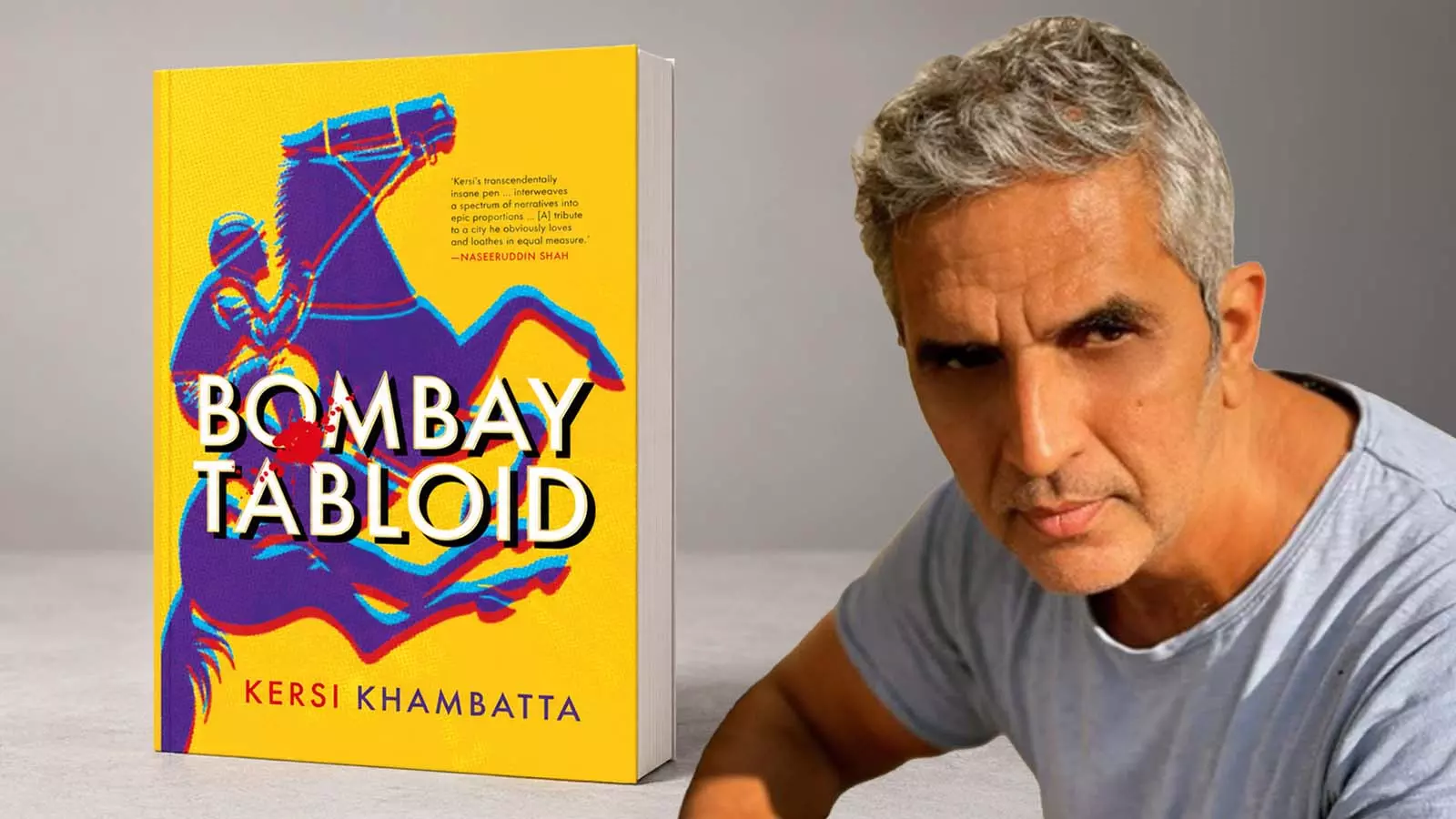
There’s Bombay, there’s Mumbai, and then there’s the Bombay of Kersi Khambatta’s Bombay Tabloid, a city where everybody’s got a story, a scam, a sexual peccadillo or a spectacularly colourful gaali up their sleeve. Preferably all four. And where any simple sentence appears to have been considered a criminal waste of perfectly good adjectives.
At the centre of this gloriously unhinged circus is Cyrus Kerman, son of an Iran-born bakery owner, and his lifelong, on-again, off-again entanglement with Devika Wright, an Anglo-Indian beauty who graduates from dancing and modelling to the law. Cyrus falls in love with her twice. Talk about second innings!
Their story straddles two of Bombay’s darkest chapters: The communal carnage of 1992–93, following the demolition of the Babri Masjid, and the November 2008 terrorist attacks that killed 166. These are the city’s historical bookends, though the novel is less interested in solemnly documenting either than in examining what happens when private lives collide with public madness.
A throwback to Ice-Candy-Man
As a teenager, Cyrus accompanies the older Rumi Dubash into Kamathipura during the communal violence. What follows is a chilling throwback to Bapsi Sidhwa’s Ice-Candy-Man, in which the young Lenny’s betrayal of her beloved Ayah, unwittingly exposing her to the men who abduct her, becomes one of Partition literature’s most devastating moments of complicity and loss.
Also read: The World Was Not Their Story review: A reporter’s journey beyond ‘navel-gazing’ beat
In Khambatta’s Bombay, the betrayal is more calculated. Rejected by Zainab, a young Muslim woman who has agreed to meet Cyrus, Rumi offers her to Hindu rioters in exchange for safe passage. In both novels, communal violence turns intimacy into vulnerability and personal betrayal into a weapon, exposing how easily those who are supposed to protect a woman can become complicit in her destruction. Cyrus tries to protect her; gunfire follows; Zainab dies by suicide, and Rumi’s police-officer father steps in to cover up the mess and threatens Cyrus with a frame-up.
Bombay, after all, has never lacked for men who can fix a crime faster than they can fix a conscience.
Rumi eventually becomes Cyrus’s stepbrother when their parents marry. Years later, Cyrus engineers a losing horse-racing bet, prompting Rumi to unleash gangster-bookmaker Naveen Yadav on him. Three men ram Cyrus’s motorcycle and beat him into a coma. He wakes with his memory all but wiped clean. Eleven years later, when he encounters Devika again, he doesn’t recognise her. Naturally, he falls for her all over again.
A parallel track
Devika, meanwhile, has become a lawyer representing abused women, which is hardly the career choice to endear her to violent men. Threats follow. Cyrus receives a potentially terminal diagnosis, discovers a hidden handgun and decides to become a vigilante. Because, apparently, a midlife crisis, a medical scare, and a spot of existential angst simply aren’t enough for one chap.
Running parallel is the story of Altaf, later known as Dalip Singh, who arrives in Bombay as a stowaway, works as a restaurant valet and is mistakenly arrested during the 2008 attacks. He subsequently claims to have been the so-called eleventh man in the terrorist operation, an additional member of the cell beyond the ten gunmen known to have carried out the attacks. His confession is a lie, concealing a private motive that Khambatta reveals much later.
Also read: Why opinion's divided on whether Gujarat playing National Film Awards host can benefit home industry
That’s the story. Getting to it, however, can sometimes feel like negotiating the Western Express Highway during peak hour: You know there is a destination somewhere ahead, but God alone knows when you’ll get there.
From the screenwriter of Being Cyrus
Khambatta comes to Bombay Tabloid with an interesting CV. He spent 23 years as a sailor before the itch to write became too urgent to ignore. He wrote the screenplays for the critically acclaimed Being Cyrus (2006) and Finding Fanny (2014). His debut novel, The Village of Pointless Conversation (2016), made the Tata Literature Live! Long List for the First Book Award. He has also written for streaming platforms, including Akoori for ZEE5 and Class, Netflix India’s adaptation of the Spanish series Elite, besides a forthcoming hacker-spy show for Lionsgate India.
The descriptions are maximalist to the point of competitive sport. Still, there is no mistaking the voice. Khambatta’s prose doesn’t enter a room quietly. It arrives late, kicks the door open, insults the host, and orders another drink.
Television and streaming, of course, are unforgiving teachers of the art of keeping an audience hooked. Hooks, cliff-hangers, outrageous revelations, and characters with too much baggage are practically occupational hazards. And perhaps that is where the pleasures and problems of Bombay Tabloid begin.
Khambatta’s second novel—a 2026 Speaking Tiger publication—is billed as a crackling, sprawling family saga set in the drug-fuelled, gang-riddled, and communally charged Bombay of the 1990s. It certainly crackles. So much so, that at times, one suspects it might actually catch fire.
A crackling saga with too much crackle
Khambatta writes as though somebody has fed him espresso, cocaine and the collected slang of South Bombay, then told him the word limit has been abolished and the editor has gone AWOL. The result is a prose style that’s hyper-caffeinated, gloriously vulgar, and determined to entertain at almost any cost.
The opening salvo comes in a prologue set in 1997, two years after Bombay was officially renamed Mumbai. Khambatta imagines the existential meltdown of Bombay’s Anglophone elite, suddenly faced with the prospect of becoming Mumbaikars and being propelled into a “bewildering, hostile, déclassé future.”
Also read: Why questions of memory, honesty are central to the art of writing a memoir
The city’s new political masters have “flexed muscle and thundered”; the old-money crowd behaves as though someone has nicked the family silver, changed the name on the front door and told them the club membership is no longer valid. Khambatta takes a swipe at both sides.
Meanwhile, the city’s journalists are getting restless. April 1997 has failed to deliver a suitably lurid catastrophe. No collapsed flyovers, derailed trains, murderous lovers, or burning slums. “Life isn’t cheap here, brother, it’s free,” the narrator declares. “Take it. So where were the nuttos, the psychos, the whackadoodles?”
For this Bombay, disaster is both a lived experience and prime-time entertainment. If nothing is exploding, somebody somewhere is clearly not doing their job.
When seasoning threatens to overwhelm the dish
And then there is Khambatta’s metaphorical overdrive. When Cyrus leaves his mother’s home, and Philomena, the domestic worker who has shown him more tenderness than his own family, he releases “an asteroid belt of grief, ejecting chunks of jagged, stone-heavy sadness through a strangled windpipe.” Elsewhere, eyes are “hurling out solar flares in the dark.” Summer in Mumbai is “as hot and stinky as a workman’s stained underwear.”
Take gangster Parvez Shaikh’s mouth. His teeth apparently have individual genetic codes and absolutely no interest in teamwork. His gums resemble a battered shoreline; the teeth are jagged, blunt monstrosities, like defensive spikes protecting a fort under siege.
The comedy exposes cruelty; the obscenity reveals power; the grotesque becomes a way of confronting the grotesque. The joke is not an escape from the horror but a means of making its absurdity visible.
The descriptions are maximalist to the point of competitive sport. Still, there is no mistaking the voice. Khambatta’s prose doesn’t enter a room quietly. It arrives late, kicks the door open, insults the host, and orders another drink.
The slang- and expletive-riddled chapter titles alone could give a prudish librarian a nervous breakdown. A recently widowed woman is advised to diversify her sexual portfolio: Having spent her life with a Parsi, she should find an Italian lover, head to Africa for a well-hung Maasai or, failing that, “go local” and try a South Indian, Sindhi or a “maka-pao.”
Also read: Left confused by all the Gen Z ‘skibidi’? Check out this guide for a quick language ‘glow up’
Subtle? Not remotely. Entertaining? Depending on your tolerance for verbal bad behaviour, absolutely.
The gaalis are not merely decorative chutney either. They are part of the book’s social grammar. They convey aggression, class, male bonding and the peculiar intimacy of people who can insult each other for 10 minutes and then share a drink as though nothing happened. But there is a point at which the seasoning threatens to overwhelm the dish.
Kamathipura, where the joke stops being funny
The novel’s most revealing set piece is also one of its most disturbing. During the communal violence, corrupt policemen search a brothel while Helen stages a noisy pantomime of sex to conceal Zainab beneath a bed. The unfolding scene is grotesque, absurd and frightening, all at once. The humour doesn’t erase the violence; it makes the vulnerability of those trapped inside it all the more uncomfortable.
Later, a corrupt policeman lectures the women about Gangubai Kothewali, the legendary madam who supposedly had gangsters such as Karim Lala and Haji Mastan “by the balls.” When Jawaharlal Nehru allegedly suggests that she abandon her “base, immoral” profession and marry, she replies: “So marry me then, Mr Prime Minister.”
In Khambatta’s Bombay, everybody’s halo comes with a suspiciously large invoice. And this is where the author’s appetite for outrageousness works best. The comedy exposes cruelty; the obscenity reveals power; the grotesque becomes a way of confronting the grotesque. The joke is not an escape from the horror but a means of making its absurdity visible.
The difficulty is that Khambatta does not always seem to recognise the difference between excess that illuminates and excess that merely decorates. When every scene is determined to be outrageous, the truly outrageous moments have to fight for attention. When every character is equipped with a killer line, the quieter emotions risk being drowned out by the sound of the author enjoying himself.
South Bombay, the darling
For anyone who knows the city, the geography is one of the novel’s pleasures. Rumi’s flat overlooks the Oval near Churchgate Station. Cyrus and Devika meet outside Churchgate, reconnect at Leopold Café on Colaba Causeway and later live in Colaba. Marine Drive makes its inevitable appearances.
Also read: How Partition left its mark on the culinary tradition of Punjab
This is recognisably South Bombay: The promenades, the cafés, the old buildings, the expensive addresses and the unspoken social codes. The musical references narrow the social landscape further. Afro Celt Sound System, Kula Shaker, Ozric Tentacles and the Dandy Warhols coexist with Iron Maiden, Metallica and Loreena McKennitt—the soundtrack of a small, English-speaking, Western-music-obsessed South Bombay tribe, to which both Cyrus and Devika belong.
At a dive called the Hovel, where Cyrus helps assemble the playlists, Devika recognises Billy Cobham’s Stratus, suggests Steely Dan and singles out Kid Charlemagne, the opening track on The Royal Scam. When the song plays later, she knows every word and air-drums her way through the rhythmic changes.
Cyrus realises that they share a musical vocabulary from which Rumi is excluded. It becomes a private language, a means of recognition between two people whose connection survives even when memory does not.
For all its swagger, the novel understands that love often lives in the small things: A song, a familiar riff, a shared taste, the pleasure of discovering that someone else gets the reference without requiring an explanatory TED talk. And that, in a book so keen to shout, is a rather lovely moment. It is a reminder that sometimes a song, a shared memory or a moment of recognition can do more narrative work than an entire paragraph of verbal fireworks.
Funny, filthy but the plot is lost
Khambatta plainly understands stories, hooks and the importance of keeping an audience engaged. Yet Bombay Tabloid sometimes reads like the work of a novelist who has learnt all the tricks of keeping an audience hooked and decided to deploy every single one in every single chapter.
If every scene is a circus, the genuinely disturbing moments have nowhere to stand apart. If every character speaks in quotable one-liners, silence, hesitation and emotional ambiguity become casualties of the performance.
Almost every paragraph wants to be the funniest, filthiest or most extravagantly metaphorical. The riffs and digressions keep elbowing the plot aside. Different characters sound suspiciously alike: Articulate, foul-mouthed, relentlessly quotable and always ready with a zinger. The problem isn’t that the writing is excessive; excess is clearly part of the point. The problem is that the novel repeatedly confuses the capacity to produce a memorable line with the ability to tell a compelling story.
Also read: Why Raghav Chinivar’s biography of Manjamma Jogathi, Dance Like a Trans, is more than an inspiration
Undoubtedly, the underlying story has genuine dramatic weight. Cyrus’s childhood encounter with communal violence, his betrayal by Rumi, the subsequent destruction of his memory, and his rediscovery of Devika offer a powerful framework for exploring trauma, revenge, identity and the persistence of love. The parallel story of Altaf, whose false claim to have been the eleventh man in the 2008 attacks conceals a private motive, adds another layer of deception to a city already awash in it.
These are not lightweight ingredients. They could sustain a compelling family saga and a gripping psychological thriller. But the story must repeatedly compete with the prose for oxygen.
Khambatta understands spectacle exceptionally well. In his Bombay, tragedy and farce coexist without the courtesy of taking turns. His irreverent treatment of political authority and public morality punctures the pretensions of those who believe themselves beyond ridicule. His social observation can be acute, his humour deliciously wicked and his sense of place remarkably assured.
But the technique tends to lose force when applied indiscriminately. If every scene is a circus, the genuinely disturbing moments have nowhere to stand apart. If every character speaks in quotable one-liners, silence, hesitation and emotional ambiguity become casualties of the performance.
A little restraint would not have hurt.