How Partition left its mark on the culinary tradition of Punjab
When India was partitioned at the time of Independence in 1947, millions in Punjab crossed the newly drawn border, leaving behind homes, farms, orchards, livestock, neighbourhoods and kitchens. What they carried with them was often limited to what could fit into a trunk, a bundle or memory. And memory, as it turns out, can be a remarkably resilient kitchen. But the story of Partition’s food legacy is not simply about dishes travelling from one side of a border to another. It is about entire food systems being disrupted.

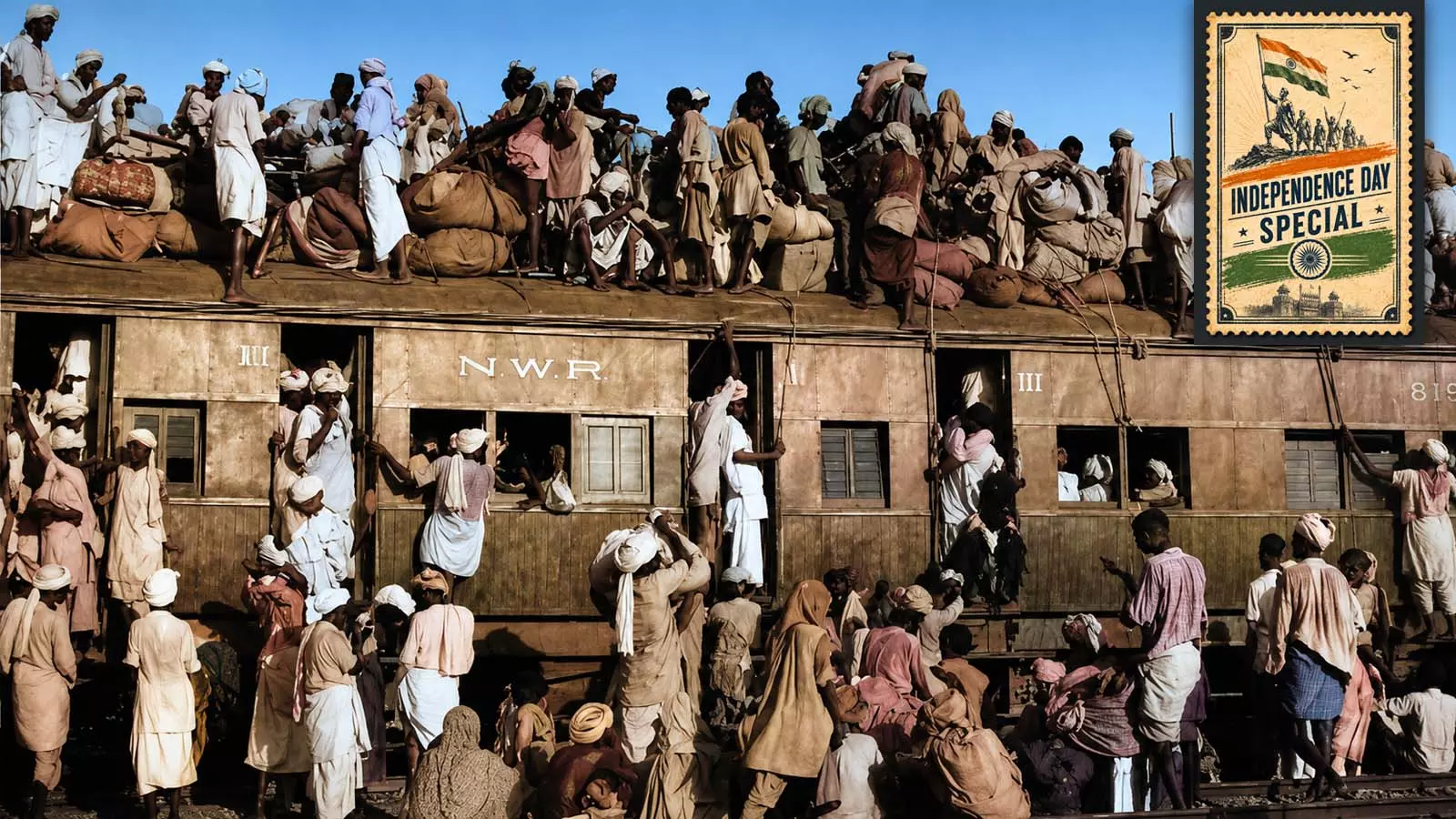
People cross the border as India is partitioned in 1947. Photo: Wikimedia Commons
The lyrics of the Javed Akhtar-written song, “Panchee, dariya, pawan ke jhonke… koi sarhad inhe na koi rokay”—the birds, rivers and wafting breezes that no border can stop — from the 2000 Bollywood release Refugee, could well describe the culinary culture of partitioned Punjab. Borders may redraw maps, separate cities and uproot families, but food has a way of travelling where people cannot. It carries memories across generations.
When India’s Independence from colonial rule on August 15, 1947 brought with it the Partition of the country — and the formation of Pakistan — it triggered large-scale forced migration. Millions crossed the newly drawn border, leaving behind homes, farms, orchards, livestock, neighbourhoods and kitchens. What they carried with them was often limited to what could fit into a trunk, a bundle or memory.
And memory, as it turns out, can be a remarkably resilient kitchen.
“Partition was not merely the division of land or the displacement of millions of people. It was also the rupture of living cultures, and food was one of the most profound casualties of that upheaval,” says Vernika Awal, a culinary specialist from Punjab.
It is an important distinction.
Also read: How RSS, its ally Hindu Mahasabha, opposed Quit India Movement, tricolour national flag
The story of Partition’s food legacy is not simply about dishes travelling from one side of a border to another. It is about entire food systems being disrupted. Punjab was never one homogeneous cuisine. It was a mosaic of regions, communities, faiths and local foodways, each shaped by its own produce, techniques, climate and traditions. Recipes existed within ecosystems. A dish could depend on a particular grain, a seasonal vegetable, locally produced dairy, a specific salt or a wild plant gathered from the fields.
Families could carry recipes, but they could not carry the land that produced their ingredients. They could remember the taste of a particular dal but not necessarily find the same lentils. They could recreate a vegetable preparation but perhaps no longer have access to the vegetable itself. They could remember the way a grandmother made pickle, but urban living offered neither the courtyard nor the time required to replicate the process.
The rupture was therefore deeper than the loss of recipes. It was the loss of the circumstances that allowed those recipes to exist. The recipes survived. The ecosystems often did not.
The East faced it too
Across the country, those displaced in the Partition of Bengal were facing it too.
“There is enough writing available about how Partition in the East (Bengal was divided into West Bengal and East Pakistan, before the latter became present-day Bangladesh) brought frugality into Bengali food; while I do not entirely agree with it, what it did do it turn frugality from a choice to a compulsion, and drove it deeper,” says Tanushree Bhowmik, a Delhi-based food historian and development professional.
She adds: “As someone who comes from a family displaced from Sylhet [in present-day Bangladesh] during the Partition, I have heard this being lamented by many. How the ilish [hilsa] never tasted the same! How foraging and hence a lot of greens were lost as we left behind the house and the fields! How water lily, which was common on the plate at one time, became practically non-existent.”
And yet holding on to the familiar flavours became as much a question of comfort as identity in new surroundings.
As the displaced from East Bengal settled in India, “one of the things that defined the kitchen was the firm presence of Bangaal [as Bengali from the East are referred to] food,” says Bhowmik. ‘With a vengeance that comes from the determination to hold on to memories, of preserving fragments of lives left behind. Most importantly, of making sure that the identity wasn’t lost on to the next generation.”
The birth of modern Punjabi food
Other communities, too, faced it in some measure.
Bhowmik refers to Harshita Lalwani, one of the finalists in the ICA Food Writing Prize in 2024, who wrote about pre-Partition Sindhi food and documented how the community lost access to certain varieties of rice post Partition, reshaping recipes.
But the impact was the most significant on Punjabi cuisine, simply because the scale of displacement here was unmatched by that among any other community.
And yet, from this enormous disruption emerged a new culinary story: the birth of the Punjabi food that India—and eventually the world—came to know.
“With refugees arriving from the North-West Frontier region came the tandoor and a repertoire of robust, minimally spiced, meat-forward cooking influenced by Peshwari and Afghan traditions. Tandoori meats, fish, mutton barrah and mutton tikka became part of India’s evolving Punjabi restaurant culture,” says 90-year-old Mahesh Kaur, who only remembers these as a part of oral history that she heard from her family post Partition.
Bread being baked in a tandoor. Photo: Ayandrali Dutta
The tandoor itself was practical. The traditional bhatthi was made from brick, mud or clay, with wood or grass feeding the fire. It could cook quickly, efficiently and in large quantities—qualities particularly valuable in a rapidly changing urban landscape.
Then came the dishes that would become icons: tandoori chicken, butter chicken and dal makhani. These were more than culinary inventions. They were expressions of refugee resilience and entrepreneurship.
People who had lost homes and livelihoods were rebuilding lives. Food offered a means of earning, feeding communities and creating something familiar in unfamiliar surroundings. The tandoor became both a cooking vessel and a symbol of reinvention.
But there is a delicious irony here. The dishes that survived and became famous were not necessarily representative of the entire culinary heritage of undivided Punjab. In fact, their popularity sometimes obscures the far more complex food culture from which they emerged.
The flavours that quietly disappeared
Puneetinder Kaur Sidhu’s book Punjab – A Culinary Delight, journeys through the flavours of the five rivers, talking about how the province celebrated everything from rustic farmhouse cooking to elaborate tandoori traditions.
With Partition, some of these dishes became culinary ghosts — rarely existing outside family anecdotes and old cookbooks. Pon di Bhurji. Adrak Di Chitt. Kharode da Shorba. Gobhi Vadi. Gud Gajar Wale Chawal. Atta Panjeeri. Kuchnaar de Phool di Sabzi. Swajana de Phool di Sabzi. Lahori Chawal… the list is long.
Some disappeared because ingredients became unavailable. Others were simply too labour-intensive for urban kitchens. Still others were linked to agricultural cycles that families could no longer participate in. Traditional cooking often required churning butter, drying vegetables, preparing pickles over several days, processing fresh dairy and manually grinding spices. Once families moved into cities and joint households fragmented, these practices became harder to sustain.
Chef Amninder Sandhu believes Punjab’s culinary story predates the 1947 Partition. Her own village, Granthgarh, she says, briefly witnessed the Pakistani flag before the Radcliffe Award placed it in India. For her, Punjab’s food heritage begins with Maharaja Ranjit Singh’s expansive Sikh Empire, where Lahore, Multan, Peshawar and Kashmir were connected through trade, migration and culinary exchange. Cooks, ingredients and techniques travelled freely, creating a shared food culture far beyond today’s borders.
Food as material memory
Aanchal Malhotra’s Remnants of a Separation: A History of the Partition through Material Memory explores the objects refugees carried from homes they had been forced to leave—utensils, jewellery, soap boxes and combs. Alongside these tangible objects were intangible memories: the taste of Lalla Musa dal, Lahore’s katlama (a deep-fried flatbread), Peshawari chapli kebabs and sajji (a meat dish) from Balochistan.
The idea is powerful because food can preserve a geography even when the geography itself is inaccessible. Take Pindi Chole. “In India, we call it Pindi Chole because we associate it with Rawalpindi. Yet, for someone living in Rawalpindi, it is simply chole,” explains Awal. “The name itself becomes an act of remembrance, quietly preserving a connection to a place that many families were forced to leave behind.”
And so the word “Pindi” here becomes a culinary postcard.
A plate of Lahori Sajji being served in a restaurant in India. The name of the dish becomes both identity and part of memory here. Photo: By special arrangement
Much of the culinary inheritance travelled through women. Recipes were traditionally passed down not through precise measurements but through observation. A daughter watched her mother. A granddaughter learnt by standing beside her grandmother. So when families migrated, these women became custodians of continuity.
“Both my maternal and paternal grandparents endured the uncertainty of refugee camps, where food became far more than sustenance—it was survival and grace. Their experiences instilled a deep respect for every morsel. My Nani also carried her brass kadhais and deghs [cooking utensils] from Doaba, heirlooms I continue to treasure till today,” says Mahesh.
Post Partition, women only had memories and they had to recreate familiar flavours in unfamiliar kitchens with unfamiliar ingredients. Substitutions became necessary. Techniques changed. Portions changed. Cooking times changed. The result was neither complete preservation nor complete loss. It was evolution.
“Every migrated recipe reflects adaptation as much as preservation,” says Awal. “While some dishes remained remarkably faithful to their origins, others evolved because circumstances demanded they do.”
That perhaps is the most honest way to understand Partition’s culinary legacy. Food did not cross the border unchanged. It crossed carrying memory—and then adapted to survival.
From refugee kitchen to modern restaurant
The story continues today in restaurants and culinary projects that are attempting to look beyond the familiar canon of Punjabi food. Chefs and food historians are increasingly returning to dishes associated with undivided Punjab, including recipes from Sindh, Multan, Lahore and Peshawar.
But there is still a vast amount that remains undocumented. The gap matters because culinary disappearance is also the disappearance of agricultural knowledge, seasonal wisdom, regional biodiversity, language and identity.
Also read: How nonagenarian Manik Varadkar survived Partition, went to prison for Marathi-speaking state
Food traditions are living archives. Unlike monuments, they need to be practised to survive.
As Awal puts it, preserving food heritage means documenting “not only recipes, but also the histories, migrations, rituals and communities that shaped them.” Without that context, dishes risk becoming detached from the people and places that gave them meaning.
Nearly eight decades after Partition, as the country celebrates yet another Independence Day, the culinary consequences of a political division remain deeply embedded in Indian food culture.