How a nationalist media braved British suppression to mobilise masses, play role in India's freedom
From Sambad Kaumudi, launched by Raja Ram Mohun Roy in 1821, to Gandhi's Young India and Navajivan and the Bal Gangadhar Tilak-run Kesari, there are many examples of a fledgling Indian media picking up the gauntlet against the British. The colonial masters responded with repressive laws and judicial action, but the country's nationalist media continued to write against their exploitative policies, helping organise support for the country's freedom movement.

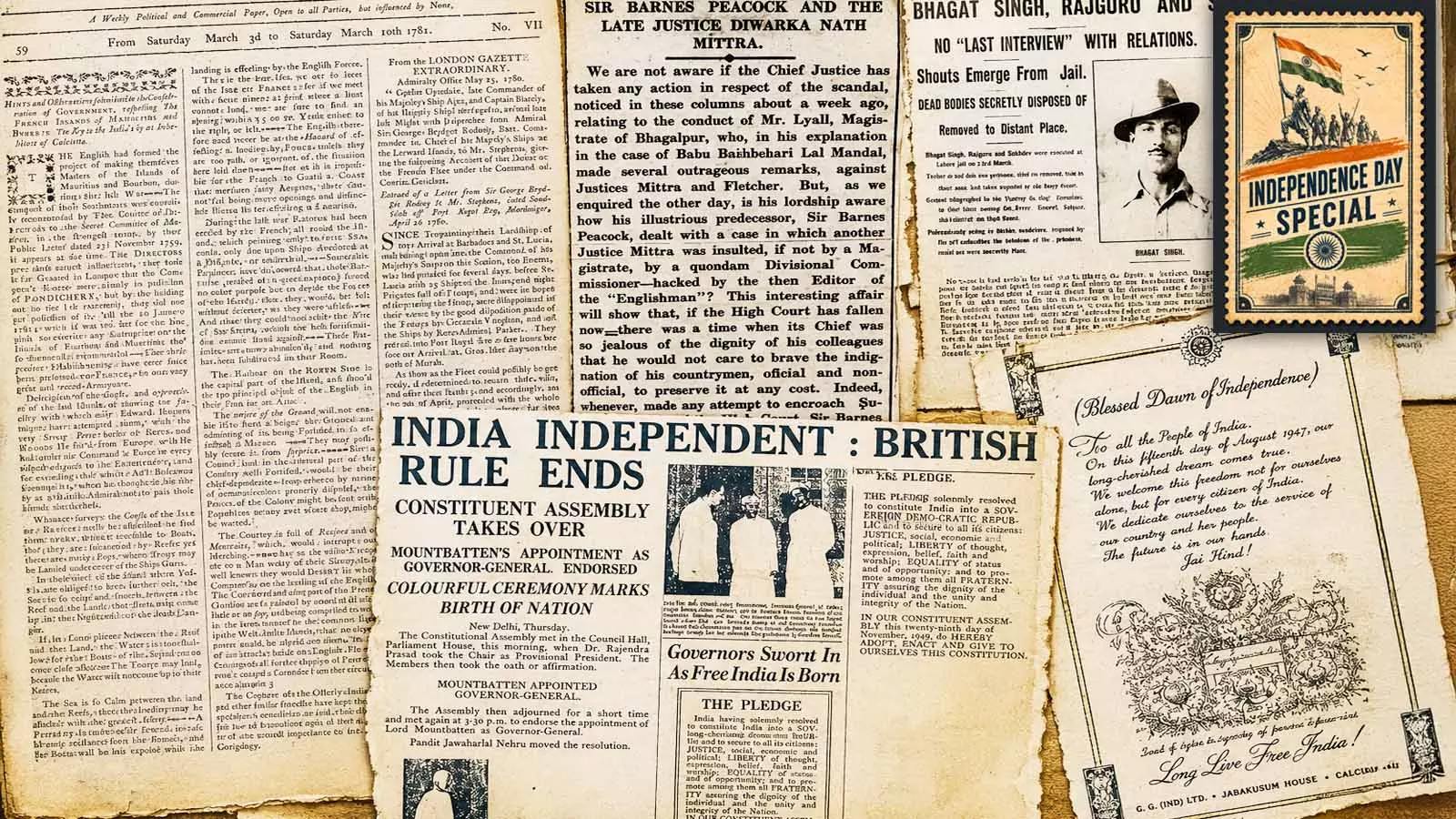
To understand the power of the media in India during British rule, the reader needs to appreciate the sheer grit of those who wrote for those newspapers, magazines and journals and how such journalistic writings threatened the almighty imperial government. One has only to recall the imprisonment that both Bal Gangadhar Tilak and Mahatma Gandhi had to undergo as examples of courage of opinion and repression.
Both were prosecuted and suffered imprisonment for years, for publishing powerful pieces in newspapers and journals. Tilak was prosecuted three times for sedition, two of which resulted in imprisonment. In 1897, Tilak’s writings in his Marathi newspaper Kesari were treated as inciting disaffection against the colonial government. He was subjected to 18 months of rigorous imprisonment. Undeterred, he continued to arouse and awaken the masses, using Kesari as a tool for nationalistic mobilisation. In 1908 he was convicted again and sentenced to six years’ deportation to Mandalay, Burma.
Mahatma Gandhi, too, was tried for publishing seditious writing in his newspaper, Young India, in 1922. He and Shankarlal Banker, the journal’s printer and publisher, were charged for “hatred or contempt” against the British government and exciting “disaffection” against it. Gandhi pleaded guilty and was sentenced to six years’ imprisonment, although he was released after about two years on medical grounds.
The fate of these two leaders is representative of the challenges faced by a nascent nationalistic media in colonial India. Even so, countless newspapers and journals were published in almost every Indian language in every corner of India, despite British watch and its consequences. They played an important role in building up the nationalistic movement in the country, a contribution which must be duly remembered as the country celebrates 79 years of Independence today (August 15).
The birth of Indian media
The first newspaper in India, which was also the first one to be banned by the British, was published from Kolkata (then Calcutta) by a British citizen, James Augustus Hicky. His Bengal Gazette started publication on January 29, 1780, and did rather well as a means of communication among the colonial ruling class and their allies. But soon enough, this first newspaper in Asia became increasingly critical of Governor-General Warren Hastings, the senior officials of the East India Company officials and those associated with them.
The government first retaliated by withdrawing its postal privileges in 1780, preventing Hicky from distributing the paper through the official postal system and Hicky was then prosecuted for libel. As Hicky appeared undaunted, the Supreme Court of Calcutta ordered the seizure of his printing press and shut down the newspaper — on 30 March 1782.
Also read: How Partition left its mark on the culinary tradition of Punjab
Colonial and imperial policy were not conducive to the growth of a free press in India, though pro-regime newspapers, especially in English, did rather well.
In 1799, Lord Wellesley introduced the Censorship of the Press Act, imposing systematic pre-publication censorship, while in 1823, John Adam’s Licensing Regulations imposed further restrictions, particularly affecting Indian-owned publications. Metcalfe’s Press Act of 1835 was, however, substantially liberal, but Indian journalism still found the going tough.
Though vernacular presses started appearing from 1818, it was Sambad Kaumudi, launched by Raja Ram Mohun Roy in 1821 that worried both the British and Hindu orthodoxy. This Bengali weekly was associated with Roy's campaign for social reform and it attacked practices such as sati. It called for reform of Hindu society as well as raised political and administrative questions. Ram Mohun also started a Persian weekly, Mirat-ul-Akhbar, in April 1822, which was widely circulated among educated Indians and officials, who were quite well versed in Persian. This gave him a broader intellectual and political readership and soon emerged as the first assertion of Indian opinion in print.
It morphed into a powerful means of creating an informed public capable of questioning authority. This alarmed the Acting Governor-General John Adam so much that he introduced stringent Press Regulations In 1823, whereupon Roy responded dramatically. He protested against the restrictions on the media — the first ever in India — and shut down Mirat-ul-Akhbar rather than submit to pressures.
The freedom of press, or its absence thereof
It was from this point that press freedom itself became a political issue in India. While newspapers aroused a less-informed Indian public, the central issue soon revolved around the right of Indians to criticise the government.
In 1822, Fardunjee Marzban brought out the Bombay Samachar (it still continues as the Mumbai Samachar); while Harihar Dutta published the first known Urdu paper, Jam-i-Jahan-Numa and Bhabani Charan Bandyoadhyay brought out Samachar Chandrika in Bengali — both from Calcutta. The Indian media had made its first mark in Calcutta, Bombay and Madras, but the central issue was to circulate argued opinions about social, economic and political issues — which some did rather cautiously, while others were bolder.
The major issue confronting educated Indians was how to raise the consciousness of the people at large on matters arising out of foreign occupation of large tracts or Indian geography, as also to spread the idea of 'Indianness' among different Iinguistic and religious communities.
Hicky's Bengal Gazette, the first newspaper published in India. Photo: Wikimedia Commons
As the British went about expanding their domain in India and adding to the profits of the East India Company, they brought dispersed sections of Indians closer — especially through their service, both civil and military, and infrastructure like road and rail. But coalescing Indians was neither their aim nor desire. It was up to the Indian regional leadership to ride over local differences and instil pan-national consciousness, a task that they undertook through newspapers in different languages. These newspapers were not just carriers of news, but heralds of a new Indian unity.
During the 1857 uprising, the government became acutely conscious of the ability of newspapers to influence public opinion. It thus brought in the Press Act of 1857 to suppress critical publications. Contemporary Bengali newspapers reported the successes of the rebels and the widespread nature of the uprising, while the Hindoo Patriot, founded by Madhusudan Ray in 1853, challenged the British description of the revolt as merely a military mutiny. This English weekly also published the Bengali play Nil Darpan, which highlighted indigo planter atrocities and fuelled the 1859 Indigo revolt.
Among the most prominent newspapers that stood up to the Empire was the Bengali Amrita Bazar Patrika, launched by Sisir Kumar Ghosh and Motilal Ghosh in 1868 in Jessore, then a district in undivided Bengal, now part of Bangladesh. It gained wide acceptance for exposing the exploitation of indigo cultivators, but this made it extremely unpopular among colonial officials and the planters.
The paper’s opposition to government policy became increasingly pronounced and Lord Lytton promulgated the Vernacular Press Act on 14 March 1878, targeting publications in Indian languages with pre-censorship and punitive measures. To outwit the general, the paper transformed itself almost overnight on March 21, 1878, into an English-language newspaper rather than submit to colonial pre-censorship mandatory for vernacular papers.
The Amrita Bazar Patrika transitioned from Bengali to English language to evade legislation against vernacular media. Photo: Wikimedia Commons
The Ghosh brothers also raised funds in Calcutta for the defence of Bal Gangadhar Tilak and sharply criticised the sentence imposed on him. It also became an outspoken critic of Lord Curzon, especially during the Partition of Bengal in 1905 and its editorials were so critical that the Indian Press Act of 1910 targeted it and fined it heavily. Amrita Bazar Patrika played a significant role in arousing national consciousness.
More newspapers are started…
Just a few years after the repressive Vernacular Press Act of 1878, Sardar Dyal Singh Majithia founded The Tribune in Lahore on February 2, 1881, It became particularly important during the Punjab crisis following the Rowlatt Act (the Anarchical and Revolutionary Crimes Act, 1919) and the Jallianwala Bagh massacre (the firing on those who had gathered to protest against the Rowlatt Act), which it was among the earliest to report.
On April 17, 1919, The Tribune's then editor Kali Nath Ray was arrested, only four days after the massacre. Though he was sentenced to two years' imprisonment, the paper resumed work within two months. In fact, its reporting on the proceedings of the Hunter Committee of 1919 (officially the Disorders Inquiry Committee, formed in the aftermath of the Jallianwala Bagh massacre) and its editorials reflected Indian public opinion most sharply and influentially.
Also read: How RSS, its ally Hindu Mahasabha, opposed Quit India Movement, tricolour national flag
Another major media opposition to British rule emerged in July 1914 when Annie Besant acquired The Madras Standard and renamed it New India — as the vehicle of her political demand of 'Home Rule'. The British government moved against it and the confrontation became particularly sharp in 1916, when the Madras government demanded a security deposit under the Indian Press Act, 1910.
In August 1916, the government declared the Rs 2,000 security as forfeited and ordered the seizure of all copies of New India, accusing they were bringing the government into “hatred or contempt”. Besant challenged the government’s action in the Madras High Court, but it dismissed her petition in October 1916.
Another irrepressible journal worth a special mention is Navajivan, a Gujarati monthly that was converted into a weekly in September 1919 by Gandhi. It became the Gujarati counterpart of his English weekly, Young India, which rapidly acquired a large readership. Gandhi propagated his ideas of satyagraha, swaraj, non-cooperation, boycott of British institutions and economic self-reliance to ordinary Gujarati-speaking readers through it. British harassment began almost immediately with legal harassment under the Defence of India Rules. Gandhi fought back and it became more confrontational during the Non-Cooperation Movement (1919-1922).
Navajivan became one of Gandhi’s principal means of explaining and mobilising support for non-cooperation and to argue for non-violent resistance to British rule. Gandhi was prosecuted in March 1922 under the sedition provision of the Indian Penal Code, to which Gandhi pleaded guilty and was sentenced to six years’ imprisonment, as mentioned earlier.
The confrontation continued even after his release, especially during the Civil Disobedience Movement (launched in April 1930). After Gandhi’s arrest following the Dandi March (in 1930, as part of the Civil Disobedience Movement, against the British salt monopoly), the British government seized the Navajivan Press. By July 1930, the government had shut down scores of nationalist newspapers and printing presses; Gandhi’s own account records that the Navajivan Press was seized and that Young India and Navajivan subsequently appeared in cyclostyled form.
Historian Sumit Sarkar, who died earlier this week on August 13, has studied this phenomenon well and has explained how nationalist leaders mobilised political support through the press, along with other forms, like public meetings, pamphlets, political associations and popular culture. The nationalist press was not merely reporting the movement—it was one of the mechanisms through which nationalist politics was created and disseminated, ultimately leading to India's freedom from British rule.