How RSS, its ally Hindu Mahasabha, opposed Quit India Movement, tricolour national flag
While the BJP-led Centre has been pushing the 'Har Ghar Tiranga' programme to 'invoke patriotism' in the public, past accounts show that the Rashtriya Swayamsevak Sangh, the BJP's ideological fountainhead, had been vociferous in its opposition to the tricolour at the time of the country's Independence and only accepted allegiance to it under pressure. Earlier, the Hindu Mahasabha ‘resisted’ the Quit India Movement of 1942.

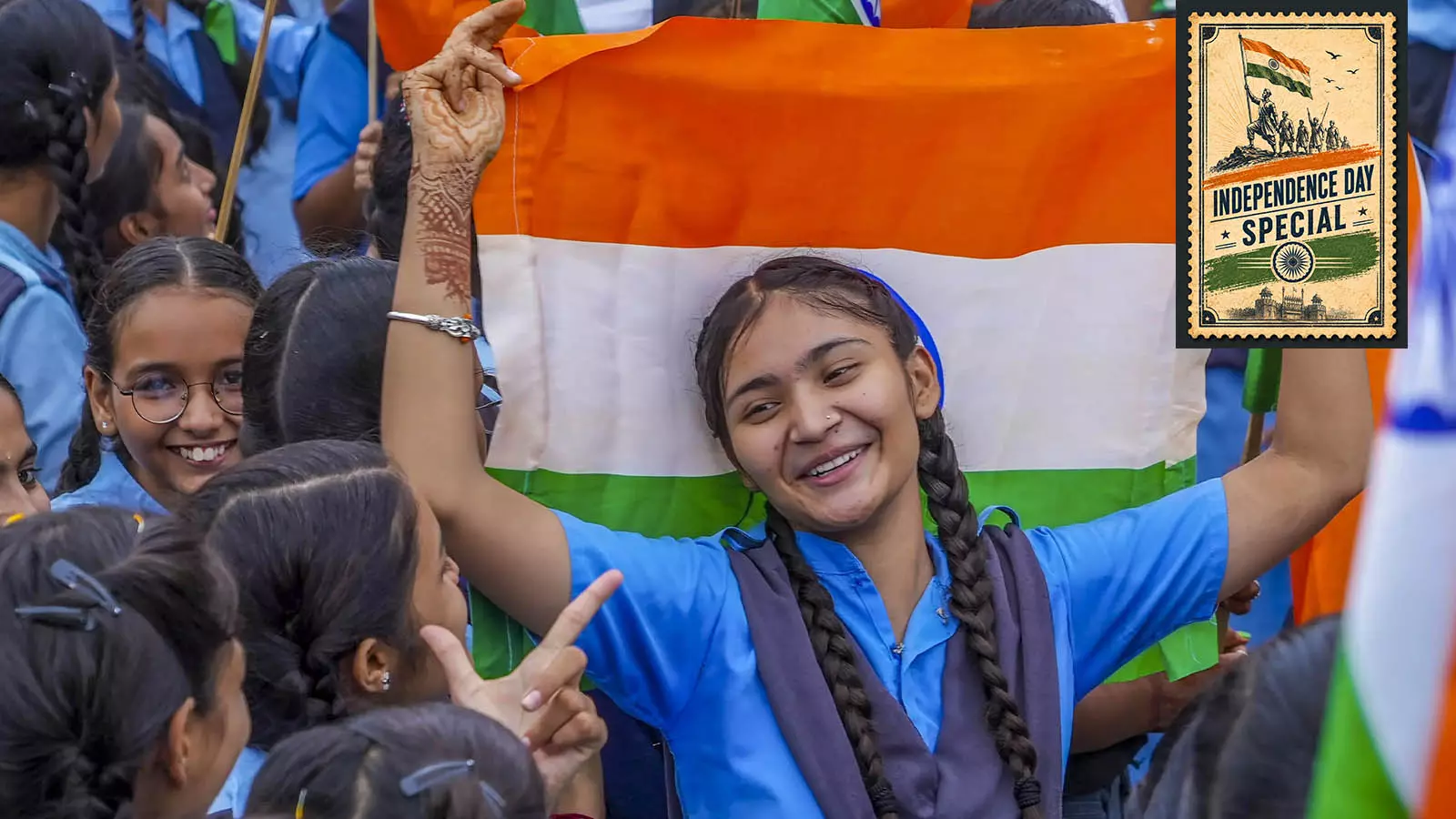
File photo of students participating in a tiranga rally as part of the 'Har Ghar Tiranga' campaign. Photo: PTI
For the past few years, every Independence Day has seen the Centre push the "Har Ghar Tiranga" (a tricolour in every home) programme, aimed at “invoking patriotism” in the public and strengthening the “commitment to nation building”. What is remarkable is that the campaign is led by a party allied to the very same Rashtriya Swayamsevak Sangh (RSS), which had opposed the Tricolour and had stayed away from India's Freedom Struggle — the Bharatiya Janata Party (BJP)-led National Democratic Alliance (NDA) government at the Centre.
To understand the role of the RSS in the freedom struggle, or its absence thereof, one needs to read an essay written by the organisation's second chief, MS Golwalkar, titled 'Towards a Masculine Nationhood'. In it, Golwalkar argued that he did not consider agitating against British imperialism an act of nationalism.
Indeed, the Hindu Mahasabha, an RSS ally, had even actively resisted the Quit India Movement of 1942, one of the most crucial phases in India’s struggle for independence.
Against Quit India Movement
In a letter to the Lieutenant Governor of Bengal, John Herbert, on July, 26, 1942 — the eve of the launch of the Quit India Movement on August 8, 1942 — Hindu Mahasabha leader, Syama Prasad Mookerjee, then a member of the Fazlul Haque ministry of undivided Bengal, wrote, “So anybody, [meaning the Congress] who during the war [a reference to the then ongoing Word War II], plans to stir up mass feeling, resulting in internal disturbances or insecurity, must be resisted by any Government that may function for the time being.”
He added: "Any movement producing widespread disorder during wartime would endanger Bengal, so the administration of the province should be carried on in such a manner that despite the best efforts of the Congress, this movement will fail to take root in the province.”
Mookerjee went on to write that “As a minister of your government, I would like to express my total support to you.” The leader did not stop at that, instead going on to remind the imperial government that "preserving internal order is essential because Japanese forces are advancing in Asia and Bengal faces serious military risks".
A procession taken out as part of the Quit India Movement. Photo: Wikimedia Commons
Mookerjee contended that responsible provincial ministers should persuade the public that constitutional governments (ie the British Imperial Govt) already provided Indians with meaningful participation in administration and therefore revolutionary agitation was unnecessary, because “…the freedom for which the Congress has started the movement already belongs to the representatives of the people.”
And thus, a very powerful voice of the Hindu Right made it publicly clear that India's Congress-led freedom struggle was redundant as the British had already handed over power to the elected representatives of people.
Also read: 79 years after Independence, what a ‘free’ India looks like to Gen Z
To recall this is not to belittle Mookerjee, who went to take part in or lead many more political developments thereafter, but to remember the unambiguity in history.
It is not common for political parties and leaders to admit overstepping or error — and where Mookerjee is concerned, the question does not arise as he died much too early, under tragic circumstances of neglect in Kashmir in June 1953, with history forever pointing a finger at the then Sheikh Abdullah government there. But that his followers have turned around from blindly opposing the Congress and its Quit India Movement to celebrating that momentous event in history as a national landmark is itself heartwarming.
For of late, Prime Minister Narendra Modi has shared tributes on social media honouring Mahatma Gandhi and all freedom fighters who participated in the 1942 movement. Modi has specifically mentioned that the historic "Do or Die" clarion call raised by Gandhi injected renewed energy and unyielding determination into India's fight for independence. This is better than being on the defensive or feeling uneasy with the day — a position the current regime showed till recently.
Indeed in 2020, the BJP-led Centre, in the midst of the then raging Covid pandemic, marked August 8 as the launch of a week-long campaign for ‘garbage-free’ India. The fact that, of late, the day has started being marked as the official commencement of the ‘Har Ghar Tiranga’ initiative (running from August 9 to 17) is a much more positive and mature stance.
But here again, history throws a spoiler.
Push for Bhagwa Dhwaj
When India finally became independent in 1947, the Sangh Parivar (the Hindu Right comprising the RSS, Hindu Mahasabha and other) began a campaign against the tricolour. The issues of the Organiser magazine, an RSS mouthpiece, published on July 17 and 22, 1947, openly attacked the Indian tricolour, with then RSS chief MS Golwalkar stating that Hindus would never accept the flag because they considered ‘three’ as an inauspicious number.
Indeed, Golwalkar seemed to have had forgotten that since antiquity, Hindus have worshipped the trinity of Brahma-Vishnu-Maheshwar and their three roles as creator, nurturer and destroyer.
In his book, Bunch of Thoughts, Golwalkar claimed that this “glorious and ancient nation..had a flag of its own...(for) thousands of years”. His choice was the saffron split-flag of Hindus, the Bhagwa Dhwaj, which he demanded be adopted.
Similarly, the RSS severely criticised the new Indian Constitution as a “cumbersome, heterogeneous…articles”, claiming that it had been copied from western nations and demanded that the Manu-Smriti be adopted as the country’s guide.
Representational image of the Bhagwa Dhwaj. Photo: iStock
Matters changed dramatically after the assassination of Mahatma Gandhi on January 30, 1948, when the then Deputy Prime Minister and Home Minister, Sardar Vallabhbhai Patel, banned the RSS and imprisoned its leaders. It is ironic that PM Modi has since constructed the world's tallest statue in honour of Patel. When Nehru is said to have had doubts about the harshness of Patel’s stand, the late leader wrote on February 27 that Gandhiji’s “assassination was welcomed by those of the RSS and the (Hindu) Mahasabha who were strongly opposed to his way of thinking and his policy”. He also mentioned “allegations that sweets were distributed” by these two Hindu outfits.
On July 18, 1948, Patel wrote that “our reports do confirm that, as a result of the activities of these two bodies (RSS and the Hindu Mahasabha), particularly the former, an atmosphere was created in the country in which such a ghastly tragedy became possible. There is no doubt in my mind that the extreme section of the Hindu Mahasabha was involved in the conspiracy. The activities of the RSS constituted a clear threat to the existence of Government and the State. Our reports show that those activities, despite the ban, have not died down. Indeed, as time has marched on, the RSS circles are becoming more defiant and are indulging in their subversive activities in an increasing measure.”
Patel did not budge an inch on his ban on the RSS for one-and-a-half years, despite pleas from Golwalkar and others and even nods from Nehru. It was only on July 11, 1949, that he lifted the ban — after the RSS pledged to stay away from politics and professed "loyalty to the Constitution of India and the National Flag", among other things.
Also read: A tale of two Indias: How the country evolved in the decades following Independence
It is ironic that at present it is the RSS and the BJP that are directing all Indians to display public respect for the flag; indeed, failure to do so may potentially get one branded ‘anti-national’.
It is also worth noting that the RSS and the BJP are now flaunting their proximity to Gandhi and praising several (not all) of his ideals. The Organiser issue of October 15, 2019, was quite overt in declaring that “Mahatma Gandhi’s encounter with [KB] Hedgewar, who founded RSS in 1925, could be traced back to the non-cooperation movement. When the Congress organised a mammoth rally in Nagpur in 1922 in reaction to Gandhiji’s imprisonment, it was Hedgewar who addressed the rally. Hedgewar proclaimed that there was no difference between the words and actions of Mahatma Gandhi,” the article stated, before going on to allege that Gandhi was misled by his supporters in 1942 into believing that the RSS was against Muslims or the Quit India movement.
The pro-RSS-BJP Swarajya magazine has also attempted to explain Gandhi’s purported respect for the RSS, its philosophy and discipline.
And so, while the RSS-BJP is redefining their relationship with Gandhi, those who once opposed the tricolour have turned into its most ardent supporters. This is real progress, and a welcome one, indeed.
(Jawhar Sircar is a former Rajya Sabha Member. He was appointed by the Trinamool Congress, but resigned from the post in 2024 in protest against the then-ruling party in West Bengal. He has also been India's Culture Secretary.)