







Why the Delhi Town Hall’s story dates beyond its colonial-era history
The site where the Delhi Town Hall stands, now on the verge of total collapse — a section of the building reportedly collapsed earlier this month, damaging the “facade, walls of the main entrance porch and the clock atop the hall”, among other things — used to be a caravanserai for the well-heeled merchants and travellers in the Mughal era. Commissioned by Jahanaara, Shah Jahan's daughter, and known as the Begum ki Serai, it was placed inside a large garden called the Begum ka Bagh.

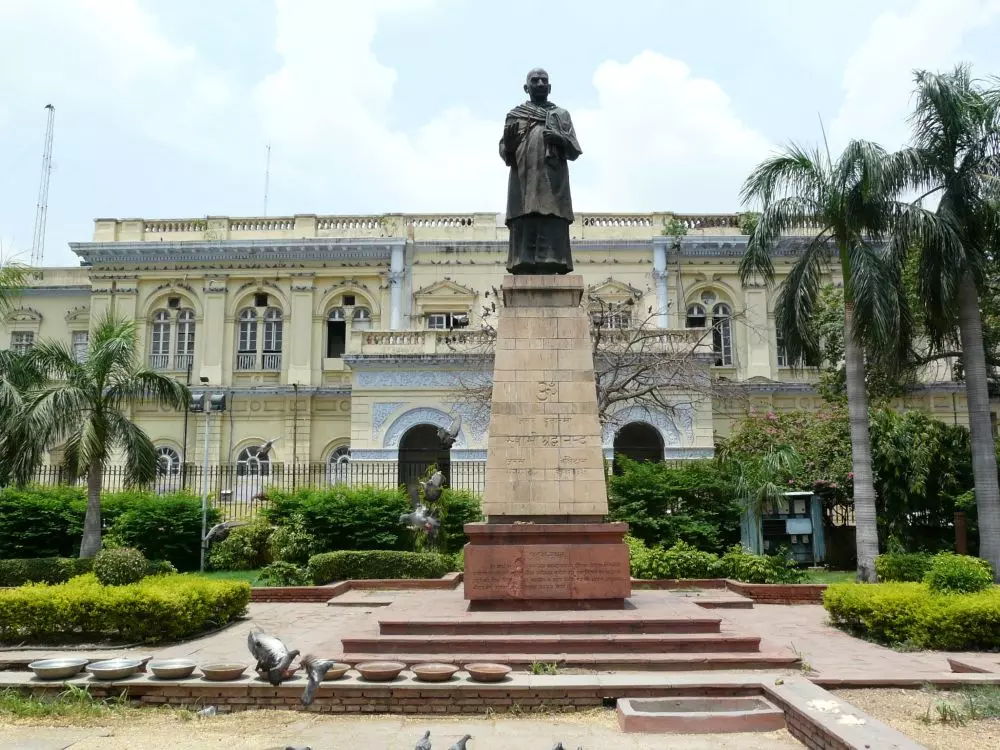
File photo of the Town Hall. A statue of Queen Victoria was removed and replaced with that of Swami Shraddhan of the Arya Samaj decades after Independence. Photo: Wikipedia
When Mughal emperor Shah Jahan (1592-1666) decided to shift the capital of his empire to Delhi in 1639, he asked many members of his family to help build parts of the city by commissioning structures that they wanted to be remembered by. An aunt, Bulaqi Begum built a residential area around her own house, naming it Kucha Bulaqi Begum. Three of the senior queens of the emperor, Sarhindi Begum, Fatehpuri Begum and Akbarabadi Mahal, commissioned a mosque each. Akbarabadi Mahal also built a grand bazaar, then known as Akbarabadi Bazaar or Faiz Bazar and now called Daryaganj. Shah Jahan’s eldest son, Dara Shukoh, built his own palace and library in the Kashmir Darwaza Area; the site is currently occupied by the Ambedkar University. Shah Jahan asked his eldest child, Jahanaara, to build the central avenue and the main bazaar of the city.
The site where the Delhi Town Hall stands, now on the verge of total collapse — a section of the building reportedly collapsed earlier this month, damaging the “facade, walls of the main entrance porch and the clock atop the hall”, among other things — used to be a caravanserai for the well-heeled merchants and travellers. Commissioned by Jahanaara and known as the Begum ki Serai, it was placed inside a large garden called the Begum ka Bagh. Once the British ran over Delhi, the Caravanserai was destroyed and replaced by a two-storied structure; a library on the ground floor and a club for the ‘Whites’ on the first floor. This was to be later taken over and turned into the Town Hall with additional structures.
The Begum’s garden
The site where the Town Hall came up was originally the elaborately designed heart of the grand bazaar, built under the supervision of Jahanaara Begum.
The market conceived by Jahanaara was to eventually become one of the grandest bazaars and avenues in the then-known world. Now known as Chandni Chowk, it was originally five markets, placed in a straight line, one leading to the other. Starting opposite Lahore Darwaza, the ceremonial and public gate of the Fort, the bazaar extended for almost a mile to Masjid Fatehpuri. The first of the five bazaars was the Urdu or Lashkar Bazar, followed by Dareeba Bazar, Kotwali Bazar, Chandni Chowk and the Fatehpuri Bazar. The entire stretch is now wrongly called Chandni Chowk.
A chowk is a crossing and this is a street; the only chowk or crossing is Chandni Chowk at the Town Hall.
A canal, the construction of which was started by Feroze Tughlaq in the second half of the 14th century, was repaired on the orders of Akbar and extended 130 kilometres by Ali Mardan Khan, an engineer of Shah Jahan’s, to flow in two streams through Shahjahanabad, one through Chandni Chowk and the other as a parallel channel through the Begum Ka Bagh.
A photo of the caravanserai of Jahanaara Begum, which used to be when the Town Hall stands today, from the albums of Sir Thomas Metcalfe. Photo: Wikipedia
The stream that flowed through the garden was the same that eventually flowed all the way to the Red Fort, near the Asad Burj, where its waters were lifted through water locks, rising 40 feet without any pumps, to run through all the palaces inside the fort. Inside the fort, the stream became the Neher-e-Behisht.
The streams that flowed through the garden of Jahanaara and the one that flowed through Chandni Chowk were certainly in existence till the late 18th century, when Begum Samru (1778-1836, the ruler of Sardhana, a principality near Meerut) built her palatial bungalow in Chandni Chowk.
Jahanaara built a large reservoir in the middle of Chandni Chowk and the stream flowed through the reservoir on its way from Masjid Fatehpuri to the end of Chandni Chowk. After the caravanserai was pulled down by the British, in its place came the Lawrence Institute. The Begum ka Bagh became the Company Bagh, now the Gandhi Park, both the streams dried up and, despite a couple of attempts, were never revived.
The fall of a proposal to restore and conserve the Town Hall
Even after it was bought by the municipality of Delhi in 1866 and before it turned into a full-fledged headquarters for the Municipal Corporation of Delhi (MCD), the Town Hall building continued to serve both functions: a club and a reading room and library and the municipal headquarters of Delhi. Surprisingly, a small municipal public library continued to function from the premises even after the MCD headquarters had moved out to its new premises on Jawaharlal Nehru Marg in 2009.
Polling booth at the Town Hall during Independent India's first elections in 1952. Photo: Wikipedia
It would have been early 2002 or thereabouts that Mayank Sharma, additional commissioner at MCD, got in touch with me, with an Idea to convert the Town Hall into a heritage structure. We had several meetings and I suggested that it would be a good idea to draw in all the elements of the history of the site to create a centre that could become a cultural hub in the heart of Shahjahanabad. The additional commissioner supported the idea and I proposed that as the site had been a caravanserai to begin with, we should retain an element of that and use the space as a hotel, but also have a library, a performance area, a centre that highlighted the diverse cuisines of Delhi, an exhibition and an activity area for children.
Also read: Beyond the unbroken line: How Jogen Chowdhury chronicled the anxieties of modern India
I roped in historian Naraini Gupta, who has done remarkable work on the transition of Delhi from the late Mughal period to the post-1857 period; Anisha Shekhar Mukherji, the conservation architect behind the restoration of Jantar Mantar and Rahul Verma, an expert on food, especially the street food of Delhi.
The four of us and Sharma had many meetings and gradually the outlines of what can be done emerged. Finally, a proposal with architectural drawings, plans for recasting traffic flow, creating a definitive library that will collect every book ever written on Delhi or facsimile copies of rare and out-of-print books on or about Delhi, aimed at creating a definitive collection of all published material on Delhi as an important resource for research. This had to be strengthened with audio-visual material of all kinds on Delhi, including copies of all films shot in Delhi or made about the history of Delhi.
This was to go hand-in-hand with setting up of three restaurants, one of vegetarian Delhi food, one of non-vegetarian Delhi food and one high-end restaurant that would regularly organise festivals of diverse food cultures of Delhi.
All this was to be combined with a street food festival, with 30 stalls, rotating on a quarterly basis, chosen from a list of one hundred of the finest street food items, to be organised along three sides of the facing lawns of the Town Hall. The old Kotwali Chauki building to the east of the Town Hall was to be converted into a heritage boutique hotel to maintain a link with the caravansarai of Jahanaara.
The final proposal, including the budget estimates, was approved by the MCD in a meeting of the house. The proposal was sent to the Union Home Ministry and the release of the first instalment was approved. Two things happened in quick succession. Sharma had completed his posting in Delhi and was recalled, the election to the parliament was called, the government changed and everything came to a standstill.
The town hall was completed in 1863; time has systematically been weakening the 163-year-old building. The proposal outlined above met all necessary approvals 12 years ago. Stones are very strong and very patient, yet crumble and collapse before the callousness of humans.
