Beyond the unbroken line: How Jogen Chowdhury chronicled the anxieties of modern India
Jogen Chowdhury’s art was shaped by poverty, displacement, power and desire, resulting in a body of work that mirrored the tensions and absurdities of his times

Among Pablo Picasso’s most powerful works were not just his Cubist paintings but his anti-war works as well. Guernica, in particular, expressed his horror at the 1937 bombing of the Basque town during the Spanish Civil War. The works of major artists have often expressed or recorded the social and political concerns of their time. It is through this lens that the work of the late Indian artist Jogen Chowdhury can be viewed.
Chowdhury died in Kolkata after a prolonged battle with blood cancer on October 25.
“He observed people from corner to corner, so minutely,” says Jyotirmoy Bhattacharya, an art curator and author who co-curated Chowdhury’s retrospective, Compelling Presence, in 2016. The exhibition presented more than 200 works. The images he glimpsed through the fences of a childhood, marked by the anguish of Partition, remained with him. His works evoke memories of the rustic roads of Faridpur’s Kotalipara and the limpid water body in front of his home. “Post-Partition, his nomadic life sprawled across Calcutta (Kolkata), Paris, Madras, New Delhi, and Santiniketan, his experiences spilling over onto his canvas,” Bhattacharya says.
Although he disliked the term, Chowdhury was often called the master of the unbroken line. He maintained that art was more than lines alone. Understanding his work, however, begins with understanding the experiences that shaped it.
I could barely afford to buy colours, brushes or canvases due to the dire financial situation at home. So, I started using newsprint, pen and ink…We did not have electricity at home, so my paintings were done in daylight or in the soft glow of hurricane lamps in the evenings. We were really down and out in Calcutta, wracked by poverty. The abject gloom of those times is evident in my paintings.... This may explain the dominance of black in my paintings right from the onset: Jogen Chowdhury in an old interview
Art born of ‘impossible hopelessness of life in Calcutta’
In his early student years, from 1955 to 1960, his portraits were realistic and haunting. His student drawings at the Government College of Art and Craft in Kolkata offer an early glimpse of his interest in observing people and understanding form. The lines were intensely black, which Ina Puri, a Gurgaon-based writer and curator who interviewed the artist on several occasions, attributes to the desolation of the period.
Also read: Uttam Kumar at 100: The man behind the ‘hero’ who put super in stardom for the Bengali audience
In Chowdhury’s own words: “I could barely afford to buy colours, brushes or canvases due to the dire financial situation at home. So, I started using newsprint, pen and ink…We did not have electricity at home, so my paintings were done in daylight or in the soft glow of hurricane lamps in the evenings. We were really down and out in Calcutta, wracked by poverty. The abject gloom of those times is evident in my paintings, as are many other intimate subjects and thoughts—especially the darker aspects of living, the deepening disquiet. This may explain the dominance of black in my paintings right from the onset. Another reason may be the lack of electric light at that time. The jumble of everyday adversaries may have triggered the dense mesh of interwoven lines that feature in my works. My earliest paintings bore all these pointers.”
His paintings from this period depicted people caught in what he described as the “impossible hopelessness of life in Calcutta”.
Pen and ink works by Jogen Chowdhury since the 1980s.
The years of shock and learning in France
In 1965, Chowdhury left for Paris on a French government scholarship to study at the École nationale supérieure des Beaux-Arts, where he trained in Italian mosaic, fresco and etching, or intaglio. His exposure to European art broadened his understanding of artistic practice, but it also forced him to question what his own work should be.
He visited museums and galleries, absorbing the work of European masters without wanting to imitate them. The experience was both stimulating and unsettling. “The cruel dichotomy of the grim living conditions in our country vis-à-vis the easy affluence of the progressive Western lifestyle hit me hard,” he recalled. “I transferred the angst into my line drawings and oil paintings and these works were nothing mind-boggling in terms of ideas and manner but they were straight from my heart.”
Also read: Shakuntalabai Nagarkar obit: Why death of award-winning Lavani artiste marks end of an era
When he returned to India in 1968, Chowdhury joined the Handloom Board in Madras, now Chennai, as a textile designer. For almost a year, he struggled to paint as he tried to reconcile what he had encountered in Europe with his own cultural inheritance. He eventually found his way forward not by choosing between the two but by developing a visual language of his own.
While his paintings used distortion, contour and cross-hatching to make the human body convey psychological tension, sculpture offered him another way to explore volume, gesture and physical presence: A collector of Jogen Chowdhury’s works
The ache of displacement and a new language
That search found expression in Reminiscences of a Dream (1969), a series of more than 30 pen-and-ink and mixed-media works inspired by his childhood in the erstwhile East Bengal (now Bangladesh). Lotus flowers, fish, snakes and other images of the natural world mingled with memories of village life. The works were dreamlike and sensuous but they also carried the ache of displacement. His memories were not merely recollections of a lost home but they became material through which he could explore the relationship between imagination, experience and identity. The series also marked a turning point in his use of cross-hatching, a technique that would become central to his later style.
By 1973, when Chowdhury moved to New Delhi to become curator of the art gallery at Rashtrapati Bhavan, his artistic language was taking shape. He held the position for 15 years, gaining an unusually close view of the country’s political establishment. Yet his art was not simply a record of the people and institutions around him.
Uday Jain, director of Dhoomimal Gallery, recalls that Chowdhury sketched Parliament and the flora and fauna around the capital’s political centre. His work, however, tended to comment on society more broadly than on individual political figures. “He did dwell with subjects such as Emergency, or exploitation but was more symbolic, which is how art should be,” Jain says.
Clockwise from top left: Woman Under The Quilt (2004), Man, and Man Relaxing, all pen and ink and pastel
The art of harshness and bleakness
That symbolic approach was evident in The Tiger in the Moonlit Night (1978), a work now in the collection of the National Gallery of Modern Art in New Delhi. A tiger attacks a prostrate woman beneath a moonlit sky. The image has been interpreted as a response to the Emergency imposed by Indira Gandhi between 1975 and 1977. Chowdhury himself described the painting as an interplay between the real and the unreal, using a disturbing image to convey his response to the political climate.
Also read: How a centuries-old song is travelling from Golconda to Cannes and Toronto
The work illustrates how he could engage with power without resorting to straightforward political illustration. Its menace comes not only from the tiger but also from the vulnerability of the human figure and the ambiguity of the scene.
Chowdhury’s engagement with violence was not confined to India. His work on Abu Ghraib, the Iraqi prison where detainees were tortured and abused, conveyed the physical and psychological devastation of such treatment. In a six-foot-long work from the series, the gaunt despairing figure is rendered through an unbroken network of lines. The technique gives the image a visceral quality, making the body appear both fragile and trapped.
“Jogen-da’s lines spoke like no one else’s, be it his contemporaries like Ganesh Pyne or Bikash Bhattacharjee,” Ina Puri says. “There are contradictions in his art and, in spite of distortions, the lines are beautiful. The works are not decorative, they have harshness and bleakness yet there is beauty in them.”
Vanity, vulnerability, sensuality and absurdities of human behaviour
The tension between beauty and discomfort became one of the defining qualities of Chowdhury’s mature work. His figures were increasingly distorted with exaggerated bellies, sagging flesh and awkwardly contorted limbs. But the distortions were not stylistic flourishes. They allowed him to explore vanity, vulnerability, sensuality and the absurdities of human behaviour. The dense cross-hatching gave the bodies texture and volume, while the sinuous lines seemed to register their psychological tensions.
In the 1980s, satire became more pronounced in his treatment of public life. Puri describes these works as “bitingly sarcastic about hypocrisy around him”. Leader in a Rainbow Sofa is one example of his interest in the relationship between appearance and authority. His figures could be at once comical and unsettling, exposing the gap between public stature and private character.
Jain particularly admires the couples Chowdhury painted from the mid-1980s. “His human figures, especially the couples from the mid-80s, were what I really like,” he says. He recalls buying and later selling a cross-hatched drawing of a couple, Pradarshan, a decision he now regrets.
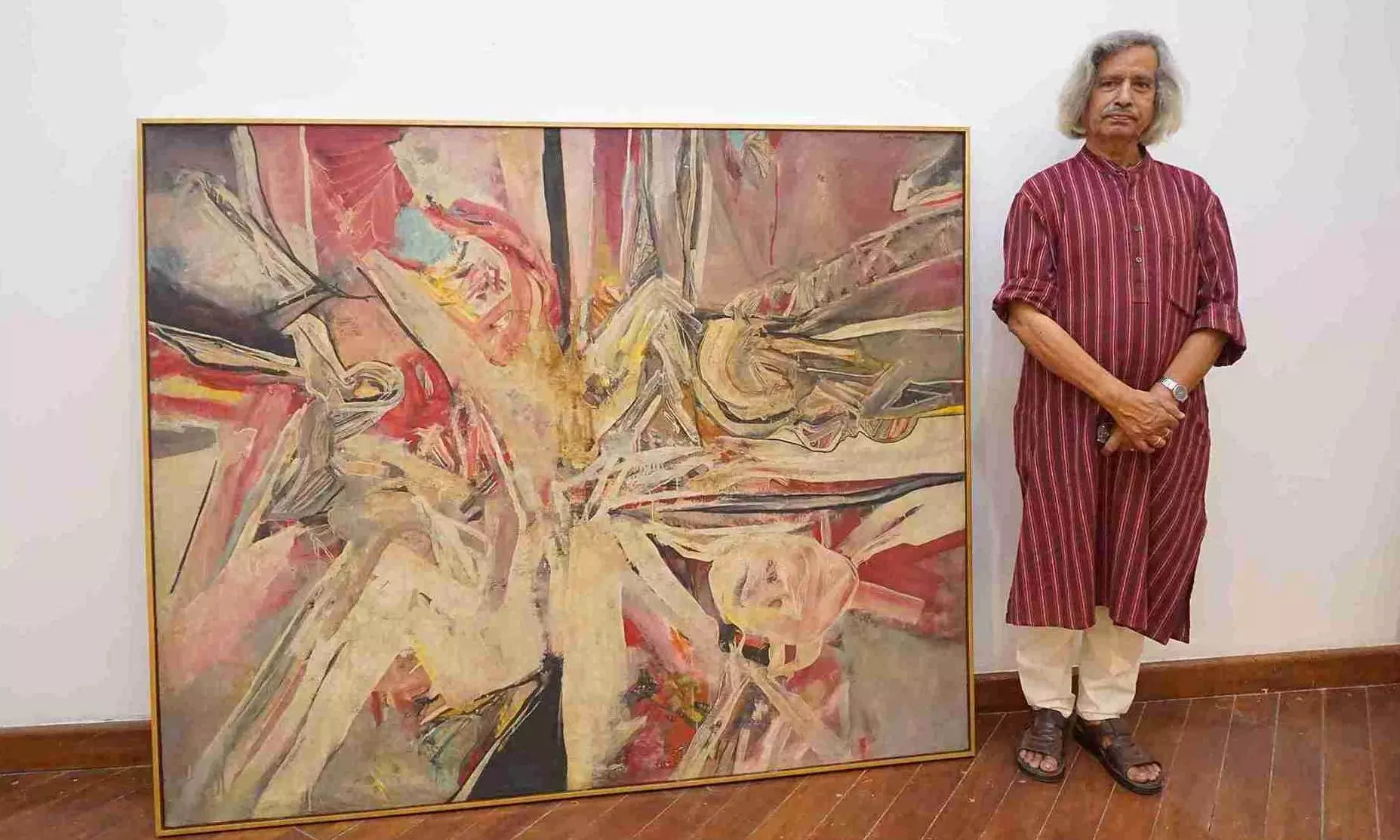
Bhupen Never Loved Woman, a 2013 oil on canvas painting by Jogen Chowdhury.
One painting in the 2016 retrospective depicted a potbellied politician alongside a voluptuous, bare-breasted woman. The work was reportedly prompted by a scandal involving a politician from Odisha. Chowdhury told me that the politician’s face was actually that of his attendant at Rashtrapati Bhavan, which was a private joke between the two. The anecdote captures the artist’s preference for suggestion over direct accusation and humour and distortion allowed him to expose the incongruities of public life without spelling out his target.
The relationship between aggressor and victim
As his career progressed, Chowdhury extended this scrutiny of power into the realm of personal relationships. Story of Woman explores themes including lovemaking, submission, romance, friendship and aggression. Rather than presenting women through a single narrative, the work moves across different kinds of intimacy and conflict, inviting viewers to consider the power dynamics that shape relationships.
Also read: Mysuru Dussehra love story: Mahendra and Lakshmi, the Kumki pair, steal the show
“The work speaks for most women in a powerful language of expression,” Bhattacharya says. Its significance lies in the way Chowdhury uses the human figure to explore social relationships, vulnerability and unequal power, concerns that run through his work even when the subject is not overtly political.
In Age of Tooth and Nail (2020), Chowdhury continued to depict the relationship between aggressor and victim. The work offers another way of reading his figures, as expressions of a world in which violence and vulnerability remain intertwined. The body, which had been a vehicle for satire and sensuality in his earlier work, could now convey anguish and the brutality of contemporary life.
Jogen-da’s lines spoke like no one else’s, be it his contemporaries like Ganesh Pyne or Bikash Bhattacharjee. There are contradictions in his art and, in spite of distortions, the lines are beautiful. The works are not decorative, they have harshness and bleakness yet there is beauty in them: Ina Puri, writer and curator.
Dabbling in sculpture
Late in his career, Chowdhury began exploring sculpture. Elephant Museum (2020), which he cast in Indonesia, marked an expansion of his practice beyond the drawn and painted figure. He also made Banalata Sen during a workshop organised by the artists’ collective Open Window. The work is possibly his last sculpture before he got sick with a rare form of blood cancer.
“While his paintings used distortion, contour and cross-hatching to make the human body convey psychological tension, sculpture offered him another way to explore volume, gesture and physical presence,” says a collector of Chowdhury’s works who chose to be anonymous.
Chowdhury’s contribution to the art world extended beyond his own practice. He was an educator, an institution-builder, and a writer on art. His students included artists such as Mithu Sen and Tanmay Samanta. Through Charubasona, his museum in Kolkata, he also sought to preserve his work and provide opportunities for other artists.
Also read: From reel to real: Why Imran Khan’s 'Matru Ki Bijlee Ka Mandola' feels relevant again
“Among the contemporary Indian artists, Jogen-da was the best of the best,” Puri says. She recalls that in 1993, when she was a young curator, Chowdhury invited her to bring her curated exhibition of miniatures by his contemporary Manjit Bawa to Santiniketan. “He gave me an opportunity to bring the works of his peer when I was a young curator.”
The artist beyond the lines
As an artist known for his lines, the line was never merely a means of outlining a figure. Reinforced by intricate cross-hatching, it gave the body texture, movement and psychological depth. It could be tender or satirical, sensual or disturbing, at once describing the figure and revealing what lay beneath its surface. “When Jogen-da broke the lines, it expressed his mastery,” Bhattacharya says. “He believed in them and such were their power that even in his black and white works, one could see the colour.”
Over the years, Chowdhury became an artist who pursued his vision on his own terms, unapologetically. “With minimum colours and his uniquely expressive lines, Jogen-da conveyed his way of thinking,” says artist Paresh Hazra. It was this ability to distil the times he lived in through a language entirely his own that set Chowdhury apart. His work found acceptance among collectors and the public but he did not need their approval to affirm his vision. “Jogen Chowdhury needed no validation.”