Why the Bastar Dussehra is a celebration of human dignity, the accountability of power
The annual celebration spanning 75 days was held between August 12 and October 27 this year. Here, Dussehra doesn't mean the burning of the Ravan effigy. Rather, it sees a female deity being taken out in a chariot and a centuries-old covenant involving the people, the state, nature and the divine being honoured.

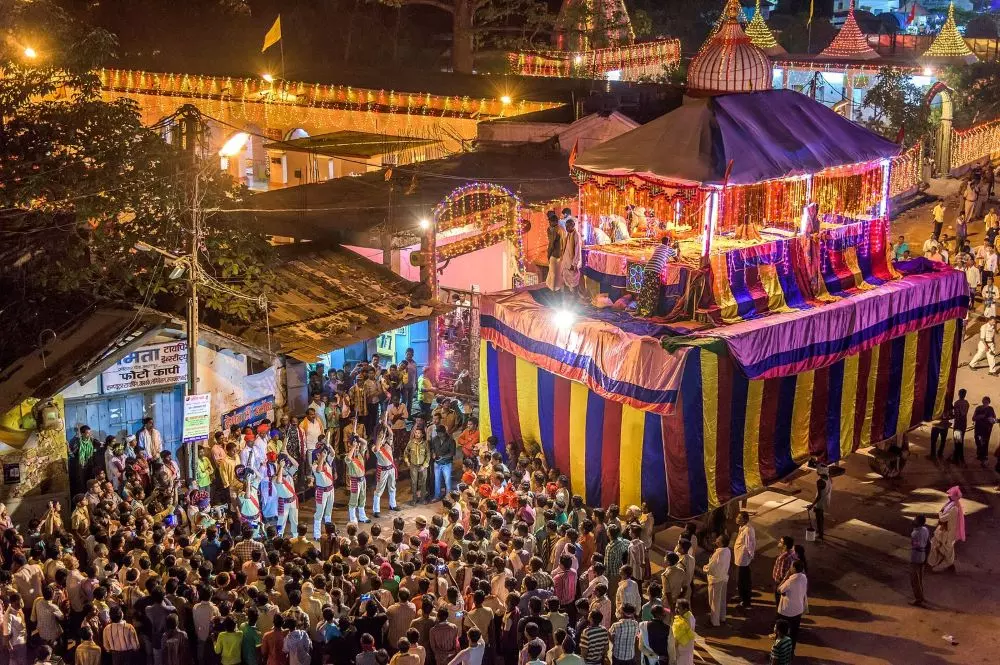
The chariot of the local deity Ma Danteshwari is the high point of the celebration. Photo: Mujeeb Rahman Kinalur
The signs started appearing even before we (a friend and I) reached Jagdalpur, the district headquarters of Bastar. For years, the Chhattisgarh district was synonymous with Naxalism in the country. Last year Union home minister Amit Shah set a March 31, 2026 deadline for “eradication of Naxalism”; he has since declared the country “Naxal-free”.
Often ignored amidst all the violence and in political narrative is the area’s cultural traditions. We were on our way to experience one such local annual celebration, the Bastar Dussehra. This year, the nine-day Navratri period, celebrated across parts of India, before the culmination into Vijaya Dashami, or Dussehra, took place between October 11 and 19. Dussehra was celebrated on October 20. But in Bastar, Dussehra is a more stretched-out celebration, spanning 75 days. This year, it was celebrated between August 12 and October 27
As we neared Jagdalpur last month, we started passing a silent stream of barefoot devotees making their way to the town, which acts as the centre of the festival. Some carried bamboo staves covered in cloth; others, fulfilling vows of penance (manauti), crawled forward on their knees, prostrating every few meters across the gravel baked hot under the midday sun. At regular intervals, makeshift bamboo shelters (sewa samitis) had been set up along the road, where local volunteers ladled out salt, warm water to soothe the feet of the devotee and a thin rice gruel (pej) for nourishment.
We watched the devotees from the car window, waiting for our glimpse of the effigy of Ravana (the character from the Hindu epic Ramayana), traditionally burnt on Dussehra in many parts of the country.
Instead, what unfolded before us was the celebration and honouring of a centuries-old covenant involving the indigenous clans, earthly spirits, forest deities and the state.
The tale of a king and a deity
The roots of the celebration date back to the 15th-century monarch of the Kakatiya dynasty, Maharaja Purushottam Dev, according to locals. It is believed that Dev walked to Puri (in Odisha), the seat of the Hindu deity Jagannath and the main centre of the annual Rathyatra (chariot festival) of Jagannath and his siblings, Balaram and Subhadra. The monarch returned from Puri with the title of Rathapati (Lord of the Chariot). The Bastar Dussehra has echoes of the Puri festival, but instead of Jagannath, here, it is the local kuladevi, or presiding deity, Ma Danteshwari, who is taken out in a chariot.
Also read: Why Bengalis eat a dish of 14 seasonal greens, or Choddo Shaak, on the eve of Kali Puja
It is said the local sovereigns surrendered their power to Ma Danteshwari. But before her chariot is taken out, the state representatives and the erstwhile royals have to seek permission from the locals. It is said the deity delegates the execution of certain tasks connected to the festival to certain local tribes.
The festival begins with Pat Jatra Puja, the worship of a ‘sacred’ branch.
In recent years, tourism and commercial interests have turned the celebration into a photo opportunity for the many visitors who crowd the area during this 75-day period. Photo: Mujeeb Rahman Kinalur
In Kanchhengudi Puja, another ritual of the festival, held on October 10 this year, a pre-pubescent girl from the marginalised Mirgin Mahara weaver caste is chosen as the living medium for Kachan Devi, an indigenous spirit of the wild. She is made to lie atop a swing made of the thorns of a wildly growing plant (babul), in what appears to be a trance. Under the watchful eyes of the clan elders, the girl lies, miraculously unscratched on her thorny bed, swaying gently until she utters the sacred assent for the celebration. Only with her blessing could the district collector, police chiefs, and the representatives of the erstwhile royals celebrate the festival.
The subversion of institutional power was breathtaking: without the nod of a girl from a marginalised community, an entire administration stood frozen.
Equally haunting was Jogi Bithai. A youth from the Halba tribe is chosen and lowered into an earthen pit, buried up to his torso. For nine days and nights, he fasts there, acting as a human lightning rod to absorb whatever misfortune might stalk the people. Locals believe the ceremony seeks blessings and good fortune for the region.
The rath of Ma Danteshwari
When the festival eventually reached the day of the Rath Parikrama of Ma Danteshwari, between 13 and 18 October, Nasir and I were swept into the crowd surging around the colossal, double-decked wooden chariot. Constructed afresh each year, without using a single iron nail or bolt, its architecture is a triumph of tribal artistry. The work remains strictly allocated by ancestral memory: woodcrafters from the ethnic Saora community fell and shape the timber, artisans from the Dhakar caste (traditionally agriculturists) supervise the joining of the timber to craft the chariot and youth from the Parja tribal community forage forest creepers to braid into thick haulage cables.
Finally, the massive Sal wood wheels began to turn, the air reverberated with the shrill, primeval blare of turhi (brass trumpets) and the thunder of tribal dhol (drums). Hundreds of youths from the Madia and Dhurwa tribal communities, their foreheads streaked with rice paste and wild peacock plumes bobbing above their turbans, threw their weight onto the vine cables.
Nasir and I managed to reach through the crowd too and grip the rope. The coarse fibres bit into our palms. The timbers groaned, and the chariot lurched forward. The titular king of the erstwhile royal family walked barefoot along the chariot, a mere attendant to the deity.
Then, on a night known as Bahar Raini (October 22), coinciding with Vijayadashami, the chariot was stolen. This is part of the festival script and has been performed for generations. It is taken out of the town and hidden at a place roughly three kilometres away, Kumdakot.
The following morning, a ritual called Muriaya Darbar is held. Under a broad awning, village headmen (manjhis) and clan elders sat eye to eye with the district collector, legislators, and bureaucrats (in the past the meeting would be between the locals and the king). Grievances are shared and acknowledged over a meal of the season’s newly harvested rice. Unfinished forest roads, missing schoolteachers, mining encroachments upon sacred groves… the concerns were varied.
Only after a formal negotiation is done, is the chariot returned.
It is humbling to watch how a local festival weaved in the hearing of mass concerns, ensuring the balance of power for generations.
Time to bid adieu
In recent years, tourism and commercial interests have turned the celebration into a photo opportunity. Drones buzzed intrusive circles over sacred rites; corporate hoardings framed Sirhasar Square in Jagdalpur where the celebration was being held; and barricaded VIP enclosures had cropped in a space once open to all.
Urban sightseers with long-lensed cameras jostled devotees.
The ecology sustaining the festival itself is at some risk, claim locals. Village elders spoke with quiet sorrow of having to travel deeper into the woods to find mature timber sturdy enough for the chariot wheels. And the young generation often find themselves wrestling between inherited ritual obligations and the relentless demands of modern survival.
The festival draws to a close with Maavli Maata Vidai, a farewell ceremony for the deities, and Ohadi, during which the deities are returned to their temples. As part of Kutmbh Jatar, members of local tribes who had assembled for the festival are also bid adieu.