







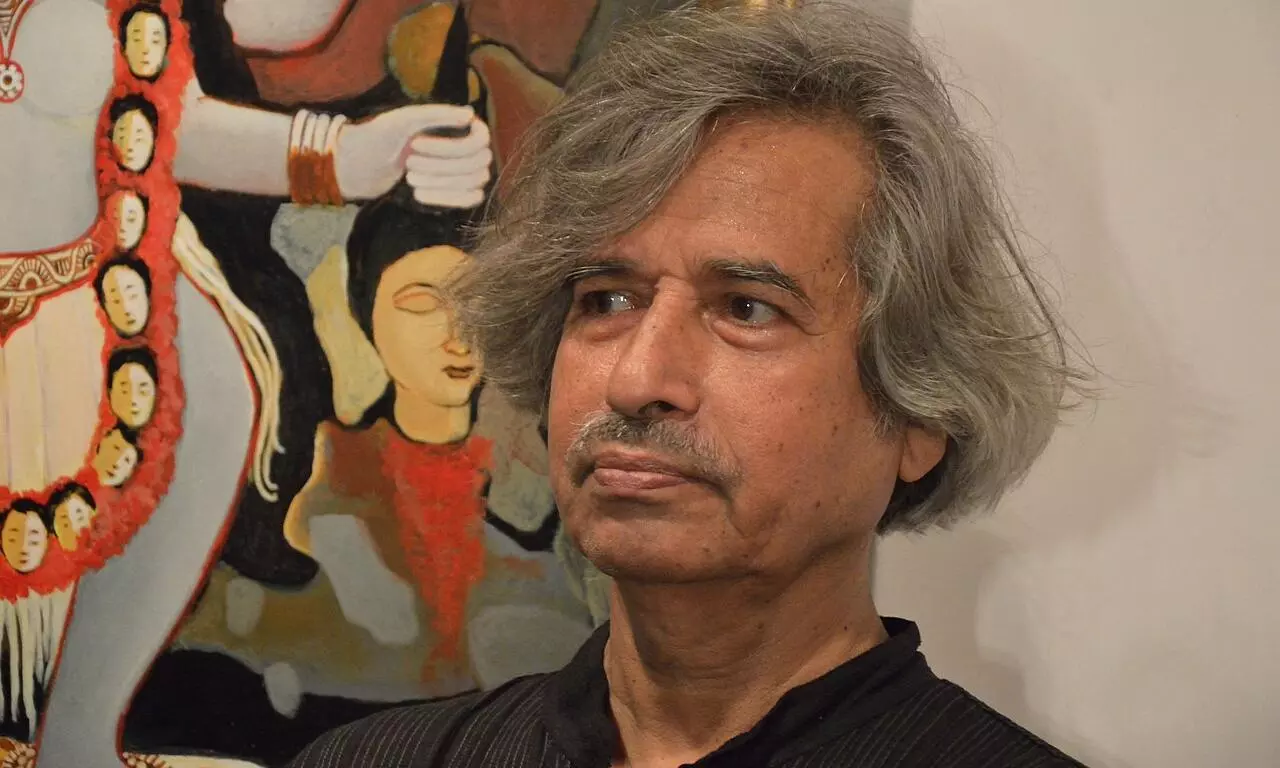
End of an era in Indian art: Jogen Chowdhury dies at 87 after battle with cancer
Renowned painter and former TMC MP Jogen Chowdhury dies at 87 in Kolkata after battling rare blood cancer; CM says his legacy will endure

Eminent painter and former Trinamool Congress Rajya Sabha MP Jogen Chowdhury died at a private hospital in Kolkata on Sunday (October 25) after a prolonged battle with a rare blood cancer. He was 87.
Chowdhury had been suffering from myeloproliferative neoplasm, a rare form of blood cancer, for the past 14 months and was undergoing chemotherapy, according to a statement issued by Ruby General Hospital. He was admitted to the hospital in southeast Kolkata on October 16 after falling ill and died at 10.15 am on Sunday.
“It is with profound sadness that we announce the demise of Shri Jogen Chowdhury, the renowned Indian painter,” the hospital said, adding that he had also required hospitalisation during his illness for urinary tract infections.
End of an era
Tributes poured in from across the state, with West Bengal Chief Minister Suvendu Adhikari describing Chowdhury as an artist of exceptional stature whose legacy would remain “immortal through the ages”.
“The body of work he left behind is a treasure for the state and the nation. His rich contributions are evident in numerous government buildings, including Rashtrapati Bhavan. The works he left behind will remain for centuries,” Adhikari told reporters in Purba Medinipur’s Ramnagar.
Painter Samir Aich termed Chowdhury’s death a “personal loss” and said his passing marked the end of an era in Indian art, including the Bengal School of Art tradition. Bengali writer Sirshendu Mukhopadhyay, mourning the loss of a long-time friend, recalled their many conversations and described his death as “a great loss”.
Distinctive visual language
Widely regarded as one of India’s most distinguished contemporary artists, Chowdhury was known for a distinctive visual language that blended influences from Indian and European art traditions while engaging with political and social themes.
Born on February 16, 1939, in Daharpara village in Faridpur in undivided Bengal, Chowdhury developed an early interest in art under the influence of his mother, who practised the traditional floor-art form alpana. His family migrated to Kolkata during Partition, where he later received formal artistic training.
He began his professional career as an art teacher at Howrah Zilla School before joining the Handloom Board in Kolkata as a designer in 1962. In the late 1960s, he pursued higher studies at the Ecole Nationale Superieure des Beaux-Arts in Paris, where he further honed the style that later became his hallmark.
Stint in public life
Chowdhury also maintained a residence in Santiniketan, whose red earth and distinctive landscape often inspired his work.
Apart from his artistic achievements, he had a stint in public life, serving as a Rajya Sabha member on a Trinamool Congress ticket from April 2014 to April 2020. In 2012, the West Bengal government conferred on him the Banga Bibhushan, one of the state’s highest civilian honours.
His death marks the end of a career spanning decades, during which he emerged as one of the most recognisable faces of modern Indian art, leaving behind a body of work that continues to adorn galleries, public institutions and government buildings across the country.
(With agency inputs)