



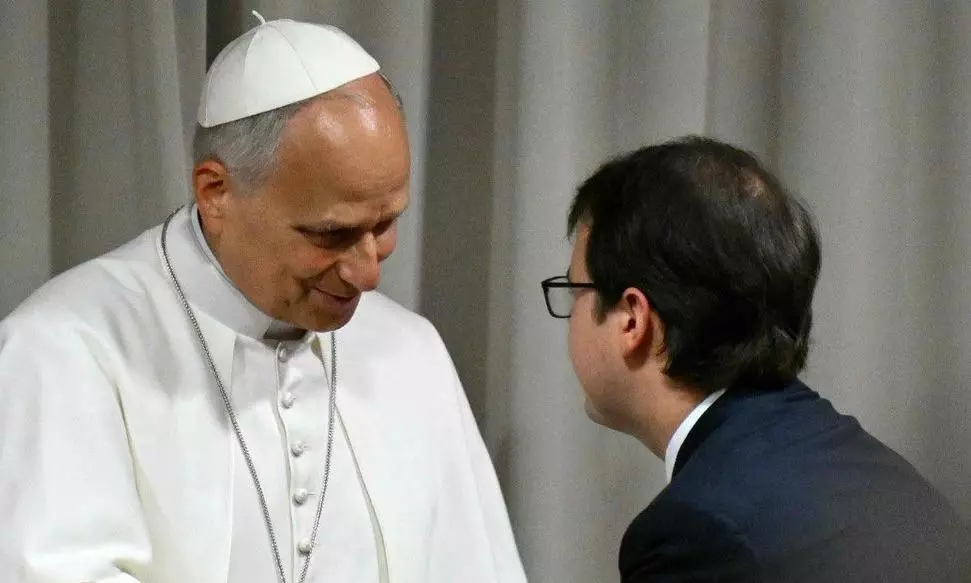
Olah and the Pope: What's Anthropic doing in the Vatican?
Believing that tech labs and governments lack ethical guardrails, the Vatican seeks to offer a moral compass in an AI-driven world, and Anthropic welcomes this

They are clearly an odd couple: a global religious leader and a Silicon Valley AI pioneer.
Eyebrows were raised and a massive meme fest sparked when Pope Leo XIV shared the stage at a major Vatican event with 33-year-old atheist Christopher Olah, the co-founder of Anthropic. The Pope had joined Anthropic “as a safety consultant”, quipped some.
What brought these leaders from opposing flanks together, considering the Vatican has been critical of AI? How did the Church team up with a multi-billion-dollar company that is driving the very AI revolution it fears?
Anthropic is dubbed as the “world’s most disruptive” company, with its product ClaudeAi notching up 30 million users. So, what’s behind the bonhomie between the two?
What's their philosophy?
Anthropic, founded as a public benefit corporation, has built itself an image of being safety-conscious. Olah often stresses that the company prioritises ethics and caution. The AI firm famously said an absolute 'no' to the US government on lethal autonomous weapons and American mass surveillance.
Also read: Google's USD 40 billion bet on Anthropic in escalating AI race
Meanwhile, the Vatican has kept a vigilant eye on the evolution of AI, warning that it presents profound moral and anthropological risks. For years, the Church has advocated strict global regulation, demanding that AI be "disarmed" and anchored to human dignity rather than driven by blind corporate greed or geopolitical power plays.
Believing that tech labs and governments lack the ethical guardrails needed for this technological leap, the Vatican is positioning itself as a vital moral compass to fill the gap.
How did the two tango?
The Vatican and Anthropic want to partner with each other to keep an eye on the growth of AI. In his presentation of his encyclical on AI, Magnifica Humanitas ("Magnificent Humanity"), Pope Leo said the Church wanted to work together to “find a way for humanity in this time of artificial intelligence”.
The church and Anthropic want to bridge the gap between spiritual ethics and technical implementation.
Olah echoed the Pope's warnings, acknowledging that AI could displace human labour on a massive scale, calling for "moral voices that the incentives cannot bend". He also said he is committed to protect the human person in the age of artificial intelligence.
"We take seriously the task of safely guiding the world through a technological revolution that has the potential to change the course of human history, and are committed to helping make this transition go well," he said at the Vatican event.
Olah, who is an atheist, likened his role to a priest guiding Claude to "be a good person, in some sense". He said that he had spent much of his career trying to make AI systems safer and had engaged with followers of more than 15 religions on ethical questions surrounding the technology.
What's in it for each?
The Pope can command global moral attention, but tech leaders hold the keys to the code. Bringing the Anthropic founder into the presentation of Magnifica Humanitas signals that the Vatican doesn't just want to criticise AI from afar, but wants to actively collaborate with the people building it to ensure the technology serves "Magnificent Humanity" rather than replacing it.
Also read: Trump and Anthropic clash over AI ethics
By appearing alongside Olah, the Pope signalled that the Vatican wants a seat at the table where AI’s future is being shaped.
For Anthropic, this is the latest step in the AI company's multiple efforts to reach out to religious leaders.
What are the key ideas behind the partnership?
Olah has identified three pressing challenges that require urgent global attention, where the Church’s voice is desperately needed:
1) If AI replaces human labour on a massive scale, supporting displaced workers becomes a historic moral imperative. Since AI development is concentrated in a few wealthy nations, the world lacks a mechanism to share its benefits globally—a systemic inequality the Church historically refuses to let the world ignore.
2) Humans should be able to thrive in an AI-driven world, especially considering how chatbots impact children's minds. As Olah noted, tech labs cannot answer these psychological and spiritual questions: “The machinery is the work of math and programming... But what character we choose, how it ought to interact with the world—these are questions for the humanities, religion, and philosophy.”
Also read: Elon Musk says Anthropic’s Claude AI is ‘misanthropic and evil’, 'hates men'
3) Researchers are discovering AI internal states that mirror human neuroscience, introspection, and emotions like joy, fear, and grief. Hinting at early signs of consciousness, Olah warned, “I don’t know what that means, but I think it warrants ongoing discernment.”
Will the Vatican guide the AI industry?
Olah argues that AI companies need outside critics who are not influenced by the financial and competitive pressures driving the industry
“We need informed critics who will tell the labs when we are failing,” Olah said, adding that they need moral voices that the incentives cannot bend. He emphasised that commercial viability, geopolitical pressures, and personal ambition can influence even well-intentioned developers.
"Some might believe that matters of AI are best handled by computer scientists like myself. They are mistaken: the questions raised by AI are bigger than the AI research community, not just in their implications, but also in their nature," he said.