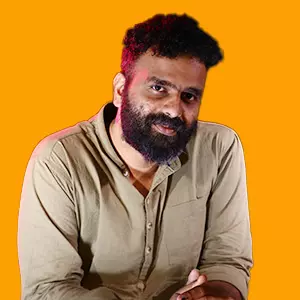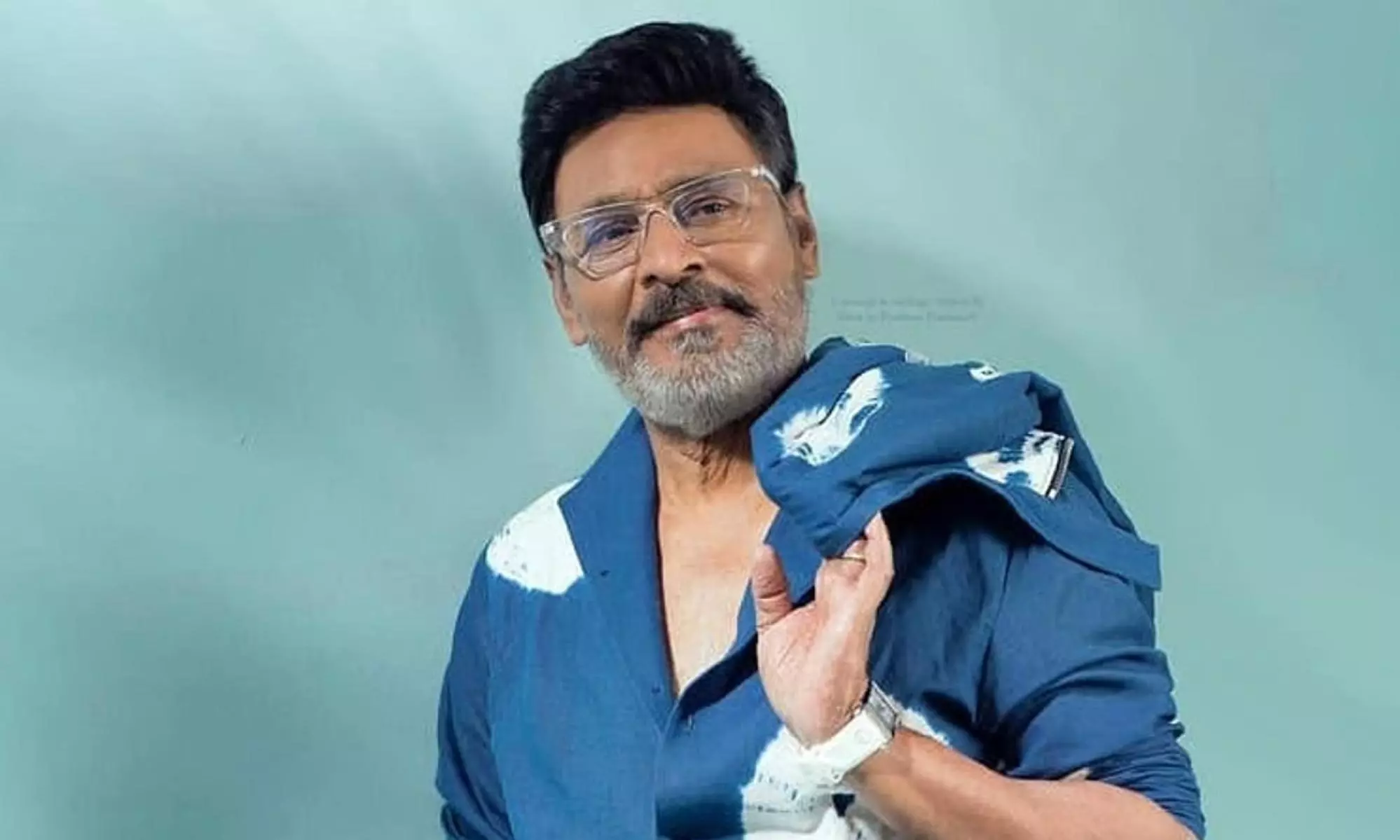
Bhagyaraj passed away at 73 following a cardiac arrest. Image: FB/Bhagyaraj
Breaking the superstar mould: How Bhagyaraj redefined the Tamil film hero
The writer-director who found humour, heartbreak and humanity in Tamil Nadu's streets and neighbourhoods dies at 73, leaving behind a cinematic language that remains unmatched

When one thinks of K Bhagyaraj, the image he cuts is of a mischievous but kind-hearted man, living up to the reputation of the innate sarcasm and wit of the Kongu region. That was the persona he had built on screen, which, in turn, reflected himself, given that he wrote and directed most of his iconic hits.
Regarded as the screenplay king of Tamil cinema, the multifaceted filmmaker started his career as an assistant to Iyakunar Imayam Bharathiraja, who passed away on June 10. The mentee followed his mentor to the very end, dying of a cardiac arrest on June 27 in Chennai at the age of 73, just 17 days later. It was a devastating twist in a story nobody saw coming. He had attended actor-politician Khushbu Sundar's daughter's wedding in Goa just days before, as ebullient as ever.
From rickshaw puller to MGR’s Kalaiulaga Vaarisu
Born Krishnaswamy Bhagyaraj on January 7, 1953, in Vellankoil near Gobichettipalayam in the Erode district, his path to cinema was anything but straight. He dropped out of college in Coimbatore and, in a chapter that seems almost too cinematic, worked as a rickshaw puller and a circus clown in Kakinada before finding his way to Madras. There, he became an assistant to directors G. Ramakrishnan and Bharathiraja, quietly absorbing the craft as the industry around him underwent one of its most turbulent and creative transitions, shedding studio artifice for the rooted realities of rural and sub-urban Tamil Nadu.
Also Read: Veteran Tamil filmmaker-actor K Bhagyaraj dies at 73
His early fingerprints were everywhere before his name was above the title. He wrote the dialogues for Bharathiraja's Sigappu Rojakkal (1978) and the screenplay for Kizhakke Pogum Rail (1978), appearing in small roles in both. It was in Puthiya Vaarpugal (1979), directed by Bharathiraja, that he got his first significant lead role and won the Tamil Nadu State Film Award for Best Dialogue Writer the same year, for the same film.
A world built around neighbours
It is hard to prise apart the director and the actor in K Bhagyaraj. He made his directorial debut with Suvarilladha Chiththirangal (1979), a tragic story of poverty that announced the world he would keep returning to: ordinary families in unassuming neighbourhoods, their dignity and desperation tangled up together. The film follows a struggling family pushed to the edge, where the daughters eventually end their lives rather than repeat their mother's fate. It was a grim, unflinching beginning for a filmmaker who would later become synonymous with comedy.
That range, between gut-punch drama and rooted humour, was always his truest signature. His Indru Poi Naalai Vaa (1981) is a case in point. Three men from the same neighbourhood all fall for the same girl. Bhagyaraj played one of them and eventually gets the girl, who had been running an elaborate test of his sincerity all along, having invented a fictitious lover to see who would love her regardless. The film attained cult status; its broken-Hindi dialogue, "Ek gaon mein ek kissan raghu thatha," became a permanent fixture in Tamil cultural memory.
Bhagyaraj was the first to capture this particular grammar of Tamil life, the lane gossip, the joint-family negotiation, the sub-urban aspiration. He claimed to have written the script for Indru Poi Naalai Vaa overnight, which, given how lived-in it feels, is either a boast or a testament to how thoroughly he had internalised the world he was depicting.
The Filmfare winner who broke the mould
As an actor, Bhagyaraj entered an industry where Kamal Haasan and Rajinikanth were establishing themselves as the new superstars, having taken the baton from MGR and Sivaji Ganesan. The odds were formidable. He didn't possess the conventional prerequisites, not the skin tone, the hefty build, nor the voice that the industry at the time considered essential. And yet he became unavoidable.
He won the Filmfare Award for Best Actor, Tamil for Mundhanai Mudichu (1983), a film he also wrote and directed, about a widower's problems in a conservative village. The film was a blockbuster with a silver-jubilee run, and it launched Urvashi in Tamil cinema. It was also remade in Hindi as Masterji with Rajesh Khanna, making Bhagyaraj nationally famous as a screenwriter. Somewhere in there, he found the time to introduce Urvashi's sister Kalpana in Chinna Veedu (1985) to Tamil cinema as well.
Also Read: Bharathiraja obit | Why the filmmaker was more than the sum of his films
Along with Rajinikanth and Vijayakanth, Bhagyaraj broke the stranglehold of what a Tamil film hero was supposed to look like. His success was such that MGR, whose own image as the incorruptible saviour had defined the industry for decades, declared Bhagyaraj his Kalaiulaga Vaarisu (heir to his film legacy).
The Bhagyaraj formula and its fault lines
His peak years through the 1980s produced a string of hits that read like a roll call of Tamil household memories: Mouna Geethangal (1981), Andha 7 Naatkal (1981), Darling, Darling, Darling (1982), Dhavani Kanavugal (1984), Chinna Veedu (1985), Enga Chinna Rasa (1987). Almost all of them were remade in Hindi. Anil Kapoor and Govinda built significant parts of their careers on Bhagyaraj remakes, a fact the Hindi industry rarely acknowledges.
What defined his writing was not just wit, though there was plenty of it, often double-edged, but structural ingenuity. Younger filmmakers still study his films to understand how to build a scene, time a revelation, deploy an interval block. Andha 7 Naatkal (1981), in particular, is still cited in conversations about unconventional Tamil film endings.
What his films also reflected, though, were the popular sentiments of his era in their less flattering dimensions. Mouna Geethangal (1981) asks audiences to follow a husband who cheats on his wife, and treats the subsequent reconciliation as the emotional destination.
Chinna Veedu (1985), whose title literally translates to "mistress", follows a man who relentlessly body-shames his wife before, eventually, arriving at acceptance. They earned him blockbuster after blockbuster because they reflected what audiences wanted to feel, which is different from what they perhaps needed.
Bhagyaraj reflected the era's popular sentiments without much friction, and that mirroring was precisely what made him commercially invincible. He batted for holding love, familial, and marital ties as sacred, which, in practice, sometimes meant the women in his films holding the institution together while the men arrived at decency on their own terms and timelines.
The Drumstick, legacy, honesty
One cannot write about Bhagyaraj without the murungakaai. With Mundhanai Mudichu (1983), he turned the drumstick, a staple vegetable of Tamil Nadu, into something closer to an aphrodisiac in the state's collective cultural memory. He became a poster boy for adult comedy, and instead of distancing himself from that identification, he owned it with characteristic honesty. That willingness to stay true to his own instincts, even when it invited controversy and brickbats, was consistently his most recognisable quality.
Also Read: Kuberaa review: Dhanush delivers towering performance in slow-paced drama on greed
He remained a one-man industry for much of his peak: writing, directing, acting, producing, and even composing music, mostly all in the same film. He also edited the weekly magazine Bhagya and wrote novels. As his directorial output tapered off in later years, he continued acting in supporting roles, with his most recent appearancein Dhanush's Kuberaa (2025). Earlier this year, at celebrations marking 50 years in cinema, he had announced plans to return to direction, a new feature film and a web series.
But, now, Tamil cinema has lost, within 17 days, both a pioneer and his most celebrated student. An ending that is as gutwrenching as the unrequited love of Palakkad Madhavan from Andha 7 Naatkal.