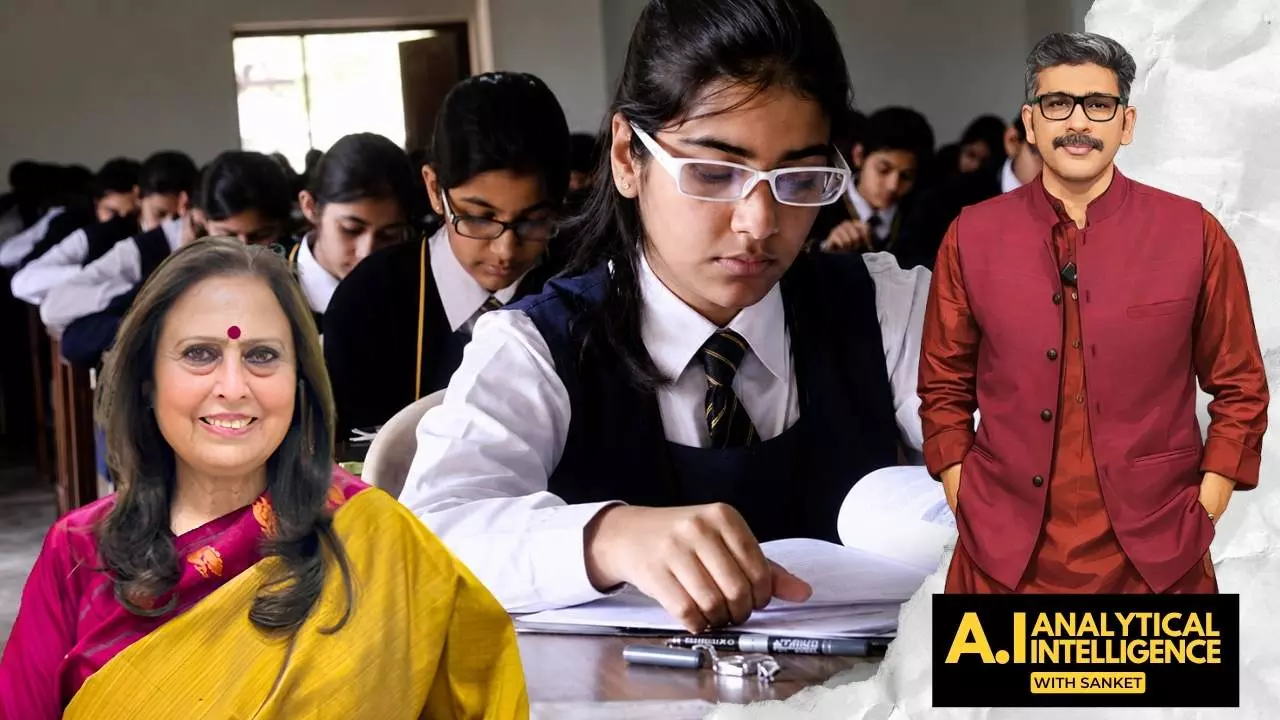
Three-language policy leaves students, parents, educators under stress | AI With Sanket
Parents and educators raise concerns over the sudden implementation of the three-language policy for Class 9 students, calling for phased execution and clarity

The Federal spoke to Dr Ameeta Mulla Wattal, Chairperson of DLF Foundation Schools, and Archana Rani Barnwal, a parent and petitioner, on the confusion and anxiety triggered by the policy’s rollout. While both agreed that promoting Indian languages is important, they argued that the current implementation has left schools, parents, and students in disarray.
Sudden rollout
Archana Rani Barnwal, whose son studies in Class 10 at DPS Vasant Kunj, said the abrupt introduction of the policy has created enormous stress for students and families.
She explained that her son had been studying German since Class 4 and was suddenly expected to switch to Sanskrit as the third language. According to her, students had already selected Hindi and German at the start of the academic year, but the new notification effectively removed German from the formal structure.
Also read: No Hindi imposition in 3-language policy but timing could be better: NCERT ex-chief
Barnwal said students were already struggling with a revised syllabus, advanced mathematics, advanced science, and the delayed availability of textbooks. Adding another language requirement in the middle of the session, she argued, was unfair and impractical.
“We are all very much concerned,” she said, adding that the family now faces “a complete mess” at home as students juggle academic pressure and coaching classes for competitive exams.
She also pointed out that during an earlier CBSE webinar in April, parents were told the policy would be implemented phase-wise, beginning from foundational classes. However, the new notification announcing implementation from July 1 came as a shock.
Schools in disarray
Dr Ameeta Mulla Wattal said she sympathised with both parents and schools dealing with the sudden policy shift.
She explained that schools had already begun discussions with parents earlier in the academic year after initial indications suggested the policy would gradually come into effect by 2030. According to her, many parents had reluctantly accepted the phased transition.
However, the sudden notification changed the situation entirely.
Also read: Karnataka drops Hindi weight in SSLC marks, signals pushback against 3-language policy
“With this knee-jerk reaction that has happened, I can very well understand the anxiety,” Wattal said.
She added that schools are now grappling with uncertainty regarding Classes 7, 8, and 9, especially because many students had been preparing international languages like German, French, and Spanish as board subjects.
Wattal said schools are also worried about the future of international language teachers, many of whom may lose their positions if schools discontinue such subjects.
“A lot of schools are doing that because they find it simpler to just remove that language,” she observed.
Language confusion
One of the key points raised during the discussion was the treatment of English as a “foreign language” under the interpretation of the policy.
Barnwal questioned the logic behind forcing students to choose Hindi, Sanskrit, and English while removing flexibility for other foreign languages like German, French, or Spanish.
“If they consider English as a foreign language, then how can we choose German, French, or Spanish?” she asked.
Also read: Is English native or foreign? CBSE third-language rule sparks confusion in schools
Wattal also expressed confusion over the classification of English in India’s education system. She argued that English has long functioned as a “modern Indian language” and remains deeply embedded in administration, business, law, and education.
“We as educators never looked at English as being a foreign language,” she said. She noted the contradiction in the fact that constitutional institutions, including the Supreme Court and the Central government, continue to function primarily in English while the policy debate categorises it differently.
“I think some clarity has to come in giving us this understanding of where English stand in this country,” Wattal remarked.
Pride versus practicality
Throughout the discussion, both guests repeatedly stressed that they were not opposed to promoting Indian languages.
Barnwal said the issue was not about rejecting Hindi or Sanskrit but about the manner in which the policy was being implemented. “This should be implemented phase-wise from the foundation class, not in the senior class,” she argued.
Also read: CBSE three-language policy sparks political row over Hindi imposition fears in South
Wattal echoed that sentiment, saying the ideal approach would have been gradual implementation beginning in lower grades, allowing students and schools enough time to adapt.
At the same time, she acknowledged that governments in India often introduce sweeping reforms abruptly.
Recalling past transitions such as the move to CNG buses and continuous comprehensive evaluation (CCE), she said large-scale reforms in India are rarely phased in smoothly.
Still, she maintained that there was “no need” for such immediate implementation in Class 9 when schools and parents had already been told they had time until 2030.
North-south debate
The discussion also touched on the larger political and cultural debate surrounding language policy in India, particularly concerns over Hindi imposition in southern states.
Sanket pointed out that policymakers often defend the policy by arguing that it could bring regions closer together by encouraging students in northern India to learn southern languages and vice versa.
Also read: Why NEP’s three-language formula has sparked a Centre-TN clash
Wattal, however, questioned whether compulsory learning could genuinely create unity. “How do we sort of say that you have to learn a language spoken in North India in Kerala or Tamil Nadu?” she asked.
She said language learning is deeply connected to identity, memory, and lived experience rather than merely functioning as a communication tool. “Language is more than just a tool of communication. It’s a vessel of memory, identity, imagination,” she observed.
Barnwal also argued that India’s strength lies in “unity in diversity” and warned against reducing linguistic diversity to only Hindi and Sanskrit.
Skills concern
Another issue raised during the discussion was the perceived neglect of skill-based education under the NEP framework.
Barnwal said schools were promised greater emphasis on practical skills, AI, and robotics, but according to her, those changes are not visible in classrooms yet. “Skill toh kuch bhi nahi hai, sirf language hi sikha rahe hain (There is no skill, they are just teaching the language),” she said, expressing frustration that language debates are overshadowing other educational reforms.
Also read: How Modi regime used central institutes to enforce NEP on state varsities
Wattal concluded by urging policymakers to adopt a more compassionate and thoughtful approach while dealing with young students. “We are dealing with the lives of young people who are going to grow up into adults,” she said.
She added that while diversity should be celebrated, imposing abrupt changes risks turning education into a burden rather than an enriching experience.
Both guests expressed hope that authorities would reconsider the implementation timeline and review the concerns raised by parents, educators, and schools before moving ahead.The content above has been transcribed from video using a fine-tuned AI model. To ensure accuracy, quality, and editorial integrity, we employ a Human-In-The-Loop (HITL) process. While AI assists in creating the initial draft, our experienced editorial team carefully reviews, edits, and refines the content before publication. At The Federal, we combine the efficiency of AI with the expertise of human editors to deliver reliable and insightful journalism.