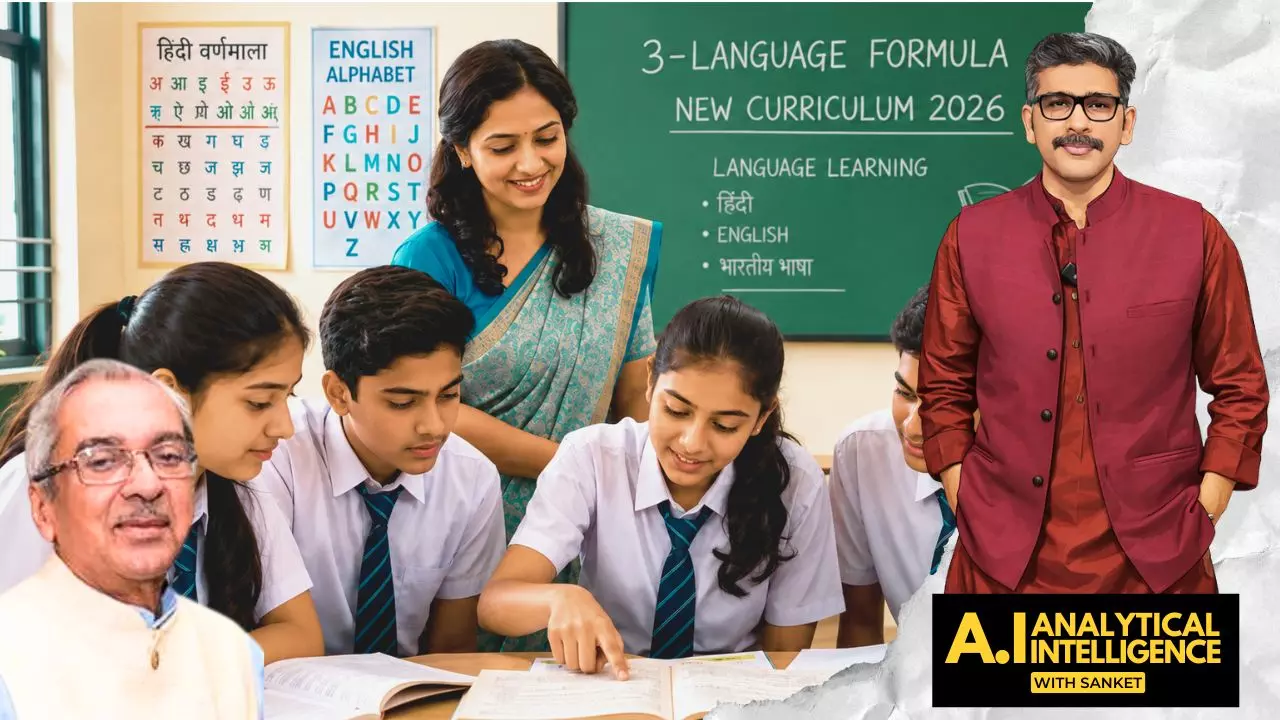
No Hindi imposition in 3-language policy but timing could be better: NCERT ex-chief
Prof. JS Rajput says multilingual learning is essential for national integration but admits the policy “could have been implemented earlier”

The CBSE’s decision to make two Indian languages compulsory for Classes 9 and 10 from July 2026 has sparked a major controversy, especially over its implementation in the middle of the academic session and fears of Hindi imposition in southern states.
The Federal spoke to Professor JS Rajput, former director of NCERT and veteran educationist, about the intent behind the policy, implementation challenges, English versus Indian languages, and the larger debate over multilingualism.
While Prof. Rajput defended the three-language policy, insisting there is “no Hindi imposition” in the framework and arguing that multilingual learning is essential for national integration and knowledge creation, he acknowledged concerns over the timing of the rollout, saying the move “could have been done a bit earlier” and that introducing the third language from Class 6 “could have been better”.
Excerpts from the interview:
What are your initial thoughts on the three-language policy?
This is the only alternative, among many others suggested, which integrates the nation and also caters properly and adequately to the learning requirements in languages.
Multiple languages are to be learned. Children are accustomed to learning them. They have the skill, they have the intent, and I think in the current-day world, everybody accepts that multiple language learning is necessary, useful, and must be pursued.
In India, there is an added ingredient because of which multiple languages must be learnt, and that is we have so many languages that are very rich in literature, in their content, in their history. Therefore, for national integration and national social cohesion, multiple-language learning is something which every child must pursue.
That is something which will be extremely useful for keeping this country ahead in matters of knowledge generation, knowledge creation, and also in internal matters like national integration and social cohesion.
Also read: CBSE Class 12 results: Centre defends on-screen marking, slashes revaluation fees
One criticism is the suddenness of the move and the fact that it is being implemented mid-session. How do schools handle this?
This is a matter of logistics and that should be responded to by the CBSE. I can talk on matters which are academically sound and desirable.
I hope most institutions and schools will not have much difficulty if they are properly equipped in terms of teachers. The problem is a bit wider. If your teacher-student ratio is poor, you will not be able to make such arrangements. Otherwise, in every school it should be possible to do something for the third language.
Some options can always be found out. After all, in an average plus-two school, normally you would have 30 to 40 teachers if it is a well-functioning school. Therefore, it is not much of a problem.
But yes, this could have been done a bit earlier. I do agree.
Also read: CBSE revises class 9, 10 language policy, three-language rule mandatory from 2026-27
How do you respond to concerns, especially in southern states, about Hindi imposition?
I have gone through this policy and earlier I was also part of the TSR Subramanian committee. I know where I found any sentence, any mention, any implication which could be termed as Hindi imposition. There is no Hindi imposition anywhere.
We have certain preconceived notions — ‘aisa hone wala hai’ (this is going to happen). Nothing of that sort is being envisaged and there is every type of liberty for languages to be learnt. If there is any problem, I think the solution can be found.
The policy-makers were very particular about this and they kept in mind that at no stage should anybody have this feeling.
Hindi is being accepted by people on their own and nobody can prevent that. But if somebody is learning Hindi and somebody else finds it disturbing, that is their problem.
Several initiatives have been taken by the government and other agencies. There is the Kashi Tamil Sangamam. All this is intended at wiping out such preconceived notions. These are not needed.
National integration is our need. We must strive from all corners to ensure there is mutual respect for every language.
Also read: CBSE three-language policy sparks political row over Hindi imposition fears in South
Can multilingual learning really help national integration?
I arranged several such programmes. On November 14, 2000, at the National Stadium, we had arranged for 10,000 children singing songs in various Indian languages. This was part of a programme initiated by Indira Gandhi called community singing.
As director of NCERT, I organised it in several states. Five thousand children would sing songs in different languages and it helped. Languages are being respected. Children love to recite songs in different languages. They had no problem and nobody objected.
This spirit must be maintained by all those who may be in politics or academics and who may have their prejudices. Please do not let that overtake the national interest.
There is no imposition of Hindi mentioned in any sentence.
Also read: CBSE's rule on mother tongue as medium of instruction till class 5 draws mixed reactions
Why implement the policy from Class 9 instead of Class 6, when children may find it easier to learn languages earlier?
I remember that students in Class 6 could choose Sanskrit, French, German or any language they wanted. Personally, and this is based on my experience, I would say this should be left to the schools also.
There is no need for so much rigid binding from a central agency. You are right — Class 6, 7 or 8 could have been a better stage for the child to get into the third language than Class 9.
But in our setup, it is not necessary to specify every detail. Certain things should be left to schools. That would generate confidence and responsibility among schools. They are now always ready to receive instructions. This is not the right approach.
Yes, Class 6 could have been better. The only thing to be seen is what the overall load is, and that load should not be stressful. Maybe some such consideration was there and therefore they decided on Class 9.
Also read: Is English native or foreign? CBSE third-language rule sparks confusion in schools
Can children adapt to learning multiple languages at that age?
I have seen children learning various languages by the age of eight or nine. I worked in institutions where there were people from various provinces, and their children used to play together and learn languages naturally.
My own children learnt several languages that way. There could be a very congenial environment in schools so far as language learning is concerned, and that will bring hearts together. That is one of the major objectives of education — bringing people together, bringing languages together, developing mutual respect for every Indian language and being proud of being nationals of a country with such rich languages.
There is confusion over whether English should be treated as a foreign language or an Indian language. What is your view?
I would have been extremely happy if I had studied in my mother-tongue medium and English had been one of the languages.
But as I grew up and took up professions, I had to depend on English. Everybody is learning English. Why should we get into these minor considerations of foreign language versus Indian language?
Also read: Why NEP’s three-language formula has sparked a Centre-TN clash
A language is to be respected whether it is an Indian language or the language of another country.
Some people think Urdu is the language of Pakistan. This is absurd. Urdu is our language. We are proud of Urdu literature and everything associated with it.
For me, it is meaningless to get into a debate over whether it is an Indian language or a foreign language. These things are too minor when the real objective is preparing children for the future, creating knowledge, generating knowledge and utilising knowledge for public welfare.
At present, we are dependent upon English. Nobody can do without it. Our institutions will not be able to function tomorrow if you say they should stop working in English.
Circumstances have made me give this much respect to the utility of English. I cannot do without it. Nobody can do without it. Children love to learn it and that is all that should matter.
(The content above has been transcribed from video using a fine-tuned AI model. To ensure accuracy, quality, and editorial integrity, we employ a Human-In-The-Loop (HITL) process. While AI assists in creating the initial draft, our experienced editorial team carefully reviews, edits, and refines the content before publication. At The Federal, we combine the efficiency of AI with the expertise of human editors to deliver reliable and insightful journalism.)