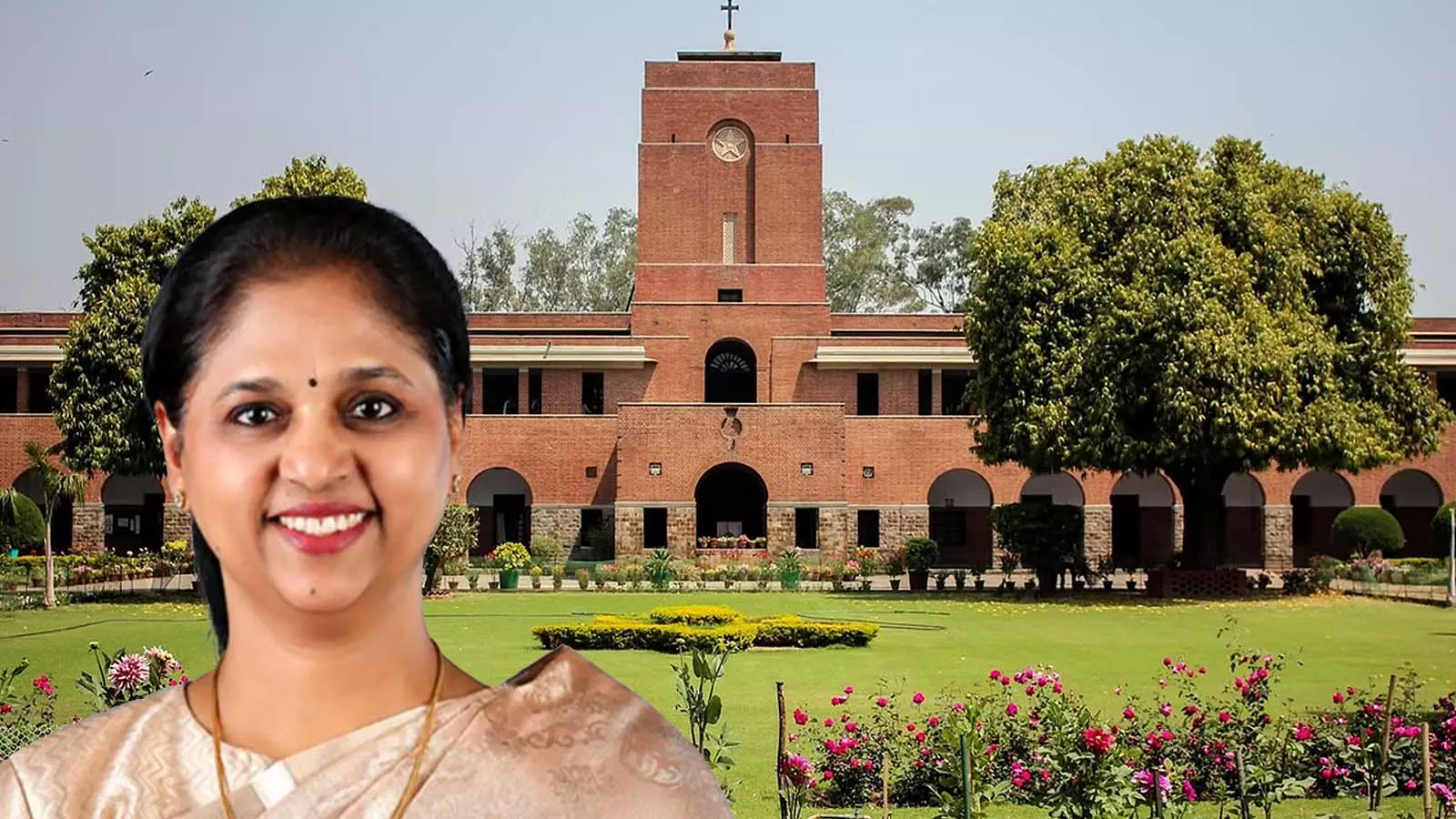
For a college, which used to write 'W' in brackets besides the names of their women students in the 70s, Delhi’s prestigious St Stephen’s seems to have come a long way today.
In a landmark move, the institution has appointed its first woman principal – Professor Susan Elias – who is all set to take charge on June 1, 2026. This is the first time a woman will lead St Stephen's in its 145-year history, signalling a new chapter for one of India’s most reputed colleges.
Professor Susan Elias, a computer scientist and academic administrator succeeds Professor John Varghese, whose continuation in office after the completion of his tenure had triggered years of conflict between the college and its varsity – Delhi University.
Founded in 1881, St Stephen's College is among the oldest higher education institutions in the national capital and was one of the original constituent colleges of the University of Delhi, when the university was established in 1922.
Ratio of 20:1
Switzerland-based Supriya Guha, a former Stephanian, who was one of the first batch of women students to be admitted in 1975, said that this appointment shows the college has come a long way.
“When I was a student, the ratio was a staggering 20 to 1. I remember out of total strength of 1,100 students, just 47 were female. Also, after a week, one girl left after her parents found out that she was the only girl in her Chemistry Honours class. Clearly, at that time, we were a male college that happened to allow women,” said Guha.
Also, she recounted how the names of the girl students were always followed by a 'W' in brackets. The girls were so few that a common joke was: "I've come for fun, the ratio is 20 to 1."
A young male teacher of philosophy once ticked off the girl students saying they should remember that this is a men’s college and they must learn to conduct themselves as such. “It was almost like it is a concession that women were allowed to join,” said Guha.
“Seeing a woman Principal today is the culmination of a long series of shifts. The number of women students and women faculty members have grown steadily over the decades," she pointed out.
Like many prestigious institutions founded in the 19th century, St Stephen’s carried a strong "gentleman’s college" identity.
Even after women were readmitted in 1975, the senior-most administrative roles remained occupied by male faculty who had joined during the all-male era. It has taken several decades for women faculty to reach the level of seniority and administrative experience required for the Principal’s post, it appears.
Historic moment
A former Stephanian, Niala Carvalho, who belonged to the 2017 batch said that she is “truly happy and proud” Professor Susan Elias has broken the glass ceiling.
“It is a historic moment for the college that will likely pave the way for fresh perspectives and leadership styles as well as greater inclusivity. It’s a welcome change given the college’s long history of male principals,” said Carvalho, an HR assistant manager at Deloitte.
Why it took 145 years?
Why did it take so long for the "glass ceiling" to break. The answer lies in its history and its constitution.
While St Stephen’s is a co-educational icon today, the college first admitted women in 1928, but only because there were no Anglican women's colleges in Delhi at the time. But it discontinued taking women after Miranda House was established in 1948.
St Stephen’s stopped admitting women entirely in 1950.
It only became co-educational again in 1975. This "stop-and-start" history meant that for a significant portion of the 20th century, the college was an all-male environment, which naturally limited the pool of women in its senior faculty and leadership pipeline.
The college is governed by a Supreme Council (a subset of the St Stephen’s College Society) and according to the college constitution, the Principal must be a member of the Church of North India (CNI) or a church in communion with it.
This dual requirement—being an eminent academic/administrator and a member of a specific religious denomination—historically narrowed the candidate pool. For decades, the college tended to look inward or toward a specific circle of traditional male leadership within the church community.
Tussle with DU
In recent years, the appointment of the Principal has been a source of heavy litigation between the college and Delhi University (DU). The college has fought to maintain its autonomy in selecting its head, while DU and the UGC (University Grants Commission) have pushed for stricter adherence to national norms.
These long-standing disputes often led to "officiating" principals or extensions for male incumbents (like Prof. John Varghese), delaying the search for a new, permanent leader.
Turning point
The selection of Prof Susan Elias reflects a new shift. By hiring an external search agency for the first time in 2025 and looking at candidates with administrative experience (like her role as Pro-Vice Chancellor at Chandigarh University), the Supreme Council has signalled a move toward professional merit over traditional "internal" succession.
Unlike many of her predecessors at Stephen’s, an institution historically associated with humanities, theology, politics, and the liberal arts, Elias is from a markedly different academic background with nearly three decades of experience in engineering education and interdisciplinary research.
Finally, as Guha puts it, "While this appointment is historic, I hope it is not merely tokenism. We must wait and see. Leadership is not defined by gender alone—women can be just as authoritarian as men. It is significant that they finally found a woman, who meets the specific Christian constitutional requirements of the college. But her true test will be how she asserts her independence. The principal's post is a powerful one and she can face political pressure, particularly given the college’s complex relationship with Delhi University. I hope she has the strength to stand up to the Governing Body."