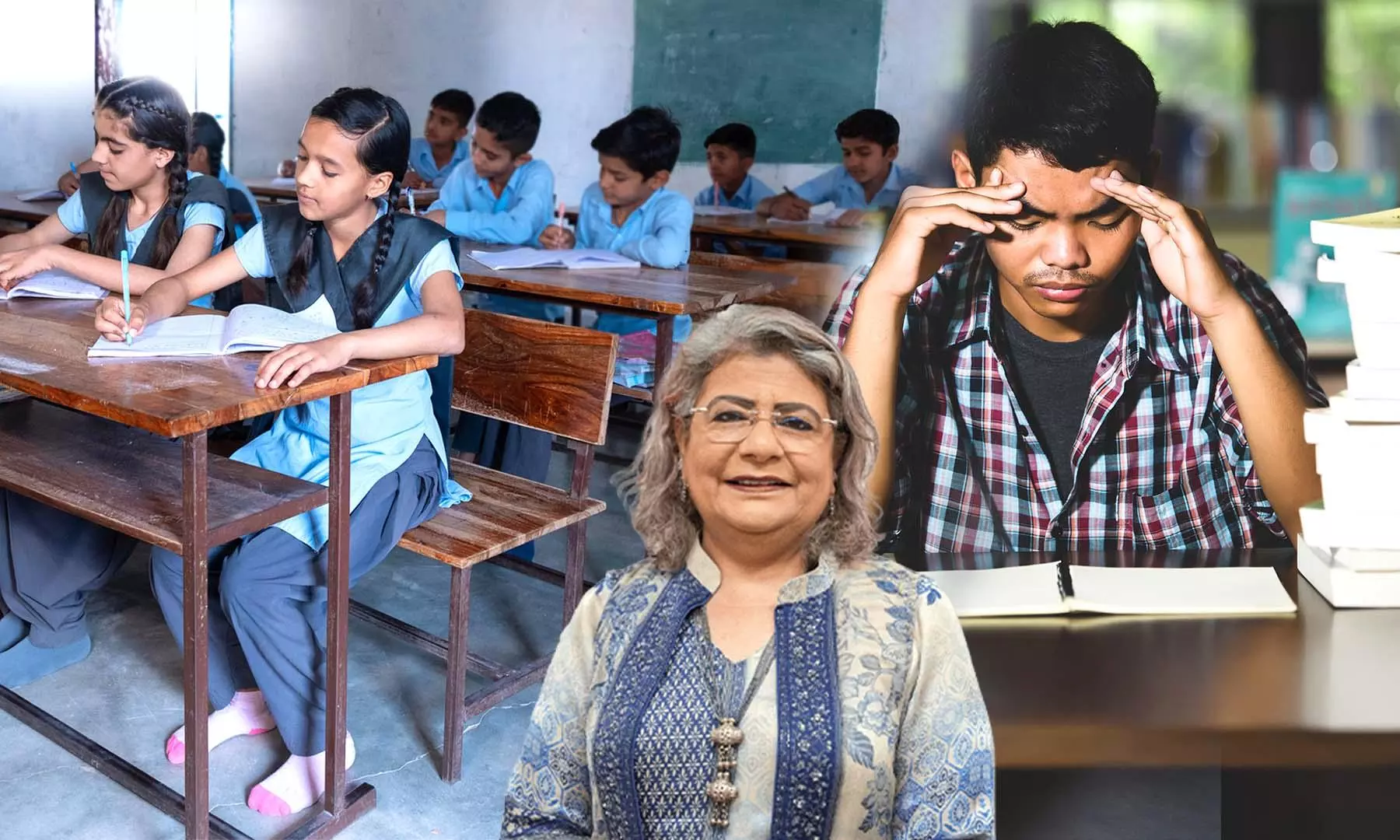
Board exam anxiety? A clinical psychologist's pointers for students, parents
Dr Roma Kumar from Ganga Ram Hospital, Delhi, tells us how students can manage exam stress, what to eat, what to do the night before, and how parents can help

As over 46 lakh students prepare for CBSE Class 10 and 12 board exams starting February 17, The Federal speaks to Dr Roma Kumar, Clinical Psychologist at Sir Ganga Ram Hospital, Delhi. Dr Kumar, who specialises in child and adolescent counselling, elaborates on how to manage anxiety, avoid burnout, and keep perspective.
Edited excerpts:
Is it normal to feel anxious about Board exams? Why do they feel “life-defining” to students?
Yes, not only is it normal, but it would be unusual not to feel anxious. A certain level of anxiety is not only normal, but it is also useful. In psychology, we call this eustress, a healthy form of stress that sharpens attention, increases motivation, and pushes us to prepare. Many students study because they care, and that care shows up as nervous energy.
In clinical practice, board exams activate what we call a threat response, not because the exam itself is dangerous, but because of the meaning attached to it. For a 15–18-year-old brain that is still developing perspective and long-term reasoning, board exams often get coded as“This decides my future.”
We have worked with high-performing students in Delhi and NCR who genuinely believed: “If I don’t get 95+, my life is over.” Not because they are dramatic, but because the ecosystem around them reinforces this narrative.
Also read: CBSE Board Exams 2026 begin Feb 17: Everything candidates need to know
In therapy sessions, we often hear:“Everyone will compare with me,” “My parents have sacrificed too much,” and “This is my only chance.”
Adolescents are especially sensitive to evaluation and social ranking. The teenage brain is wired to care deeply about status and belonging. When marks become a public scoreboard, relatives asking, WhatsApp groups buzzing, schools celebrating toppers, anxiety becomes almost inevitable.
The problem is not anxiety itself. A moderate level of stress actually sharpens focus. The problem is when anxiety turns into catastrophic thinking:
Marks = identity
Performance = worth
That’s when we start seeing panic attacks, concentration drops, appetite changes, disturbed sleeping patterns, zoning out, or psychosomatic symptoms like headaches and stomach pain in the weeks before exams. The concern is not anxiety itself, but when it crosses into this dysfunctional stress. At that point, anxiety is no longer helping performance; it’s interfering with it. That is when professional support is required. It helps you build skills, strengthen regulation, coping, and recovery under pressure.
The night before an exam: what should students do and not do?
From a psychological standpoint, the night before is about regulation, not last-minute cramming, which is anxiety-provoking, not just because of workload, but because of the message it sends your brain: “We are behind. We are unsafe. We forgot too much.”
Also read: Twice-a-year board exams for Class 10 from 2026: CBSE
This activates automatic threat thoughts: “Whatever I’ve left will come,” “I am not ready,” “I’ll blank out.” These thoughts spike cortisol, disturb sleep, and create the exact cognitive fog students are trying to avoid. The night before an exam is less about information intake and more about protecting brain function.
DOs:
1. Close your books at a fixed time (ideally 1–2 hours before sleep).
2. End study with intention. Write down:
a) What you revised
b) What you already know
c) Topics you are confident in
This signals completion to the brain. Open loops create anxiety; closure creates calm.
3. Do a light review of summaries, not new content.
4. Eat familiar, non-heavy food. Stay hydrated.
5. Prepare your bag and clothes, reduce morning decision stress.
6. Do a 5-minute breathing or grounding routine.
7. If fear thoughts show up in bed:
a) Keep a paper beside you. Write the thought down. Tell your brain: “Noted. Tomorrow.”
b) The brain relaxes when it knows a worry is stored, not ignored.
We have seen students who slept 4 hours outperform students who pulled an all-nighter because memory consolidation happens during sleep. Research suggests that your brain files information while you rest. Tell yourself: “Sleep is part of my exam strategy.” This reframes rest as performance behaviour, not laziness.
DON’Ts:
1. Start a new chapter.
2. Discuss “what you don’t know” with other friends at night.
3. Scroll Reels or exam fear videos.
4. Drink excessive caffeine.
5. Doom-think in bed.
We have heard students telling us: “I didn’t fail because I didn’t study. I failed because I panicked the night before.”
Also read: 2025-2026: CBSE announces new syllabus, grading system for Classes 10 and 12
Sleep deprivation mimics anxiety symptoms, racing heart, poor recall, irritability, which students misinterpret as “I forgot everything,” or “I got blank after seeing the question paper.”
What if a student blanks out inside the exam hall? Are there coping techniques?
Blanking out is a stress response, not a knowledge failure. When anxiety spikes, the brain temporarily shifts resources to survival mode. The prefrontal cortex, responsible for recall and reasoning, goes offline. Students describe it as: “I knew it yesterday. Inside the hall, it vanished.” The key is to signal safety back to the nervous system.
In the moment, these techniques would help:
1. Breathing: Inhale through nose → short top-up inhale → long exhale through mouth. Repeat 3–5 times. This slows the stress response almost immediately.
2. Name it to Tame it (restores control): Silently label what’s happening: “This is anxiety. Not failure. Anxiety.” Labelling emotions activates the thinking brain and reduces amygdala overdrive. In clinical settings, we call this 'affect labelling', and it measurably reduces stress intensity. It shifts the experience from “I’m doomed” → to → “I’m anxious.” That distinction matters.
3. Grounding through the senses: Press your feet firmly into the floor. Notice the texture of the desk. Read the instructions out slowly. This brings attention out of panic and back into the present.
4. Start anywhere: Answer the easiest question first. Momentum reduces fear. We have had students come back after exams saying, “The moment I wrote the first answer, my brain came back.” That is not magic; that is regulation restoring cognitive access.
How can parents help, and what should they avoid saying?
Parents often think motivation = pressure. Clinically, the opposite is true. Students perform best when they feel supported, not evaluated.
Helpful parental behaviours:
1. Normalise anxiety: “It makes sense you’re stressed.”
2. Focus on effort, not outcome.
3. Keep routines stable and predictable at home.
4. Offer practical help (food, quiet space, logistics).
5. Be emotionally available without interrogating.
Also read: 'Doubles our pressure': Principals react to CBSE's proposal to hold two 10th Board exams
Avoid saying:
a) “This is the most important exam of your life.”
b) “Other students at least study for 12 hours.”
c) “Don’t mess this up.”
d) “We’ve sacrificed so much.”
Even well-meaning statements can translate to: “If I fail, I disappoint my family.” In therapy, we have seen students cry not from fear of marks, but from fear of letting parents down. What helps most is a message like: “We care about you more than your score.” That sentence is psychologically protective.
Any message for every student reading this?
Your marks are a data point, not a destiny. We have worked with board toppers who burned out at 21 and average scorers who built deeply fulfilling careers. Board exams measure performance on specific days under specific conditions. They do not measure creativity, emotional intelligence, resilience, kindness, adaptability and most importantly long-term success. These qualities matter enormously in adult life.
Also read: How virtual world is driving India’s teenagers to anxiety and depression
An exam is important. It is not a verdict on your worth.
If you feel scared, overwhelmed, or pressured, you are not weak. You are human in a high-pressure system. Talk to someone. Regulation is a skill. Anxiety is treatable. You are not alone in this experience. Years from now, what you’ll remember is not just your percentage, but how you were treated during this time. You deserve support, sleep, and compassion while you work hard.
(This is part of The Federal’s special CBSE exams series, with more student guides and updates coming ahead of the boards.)