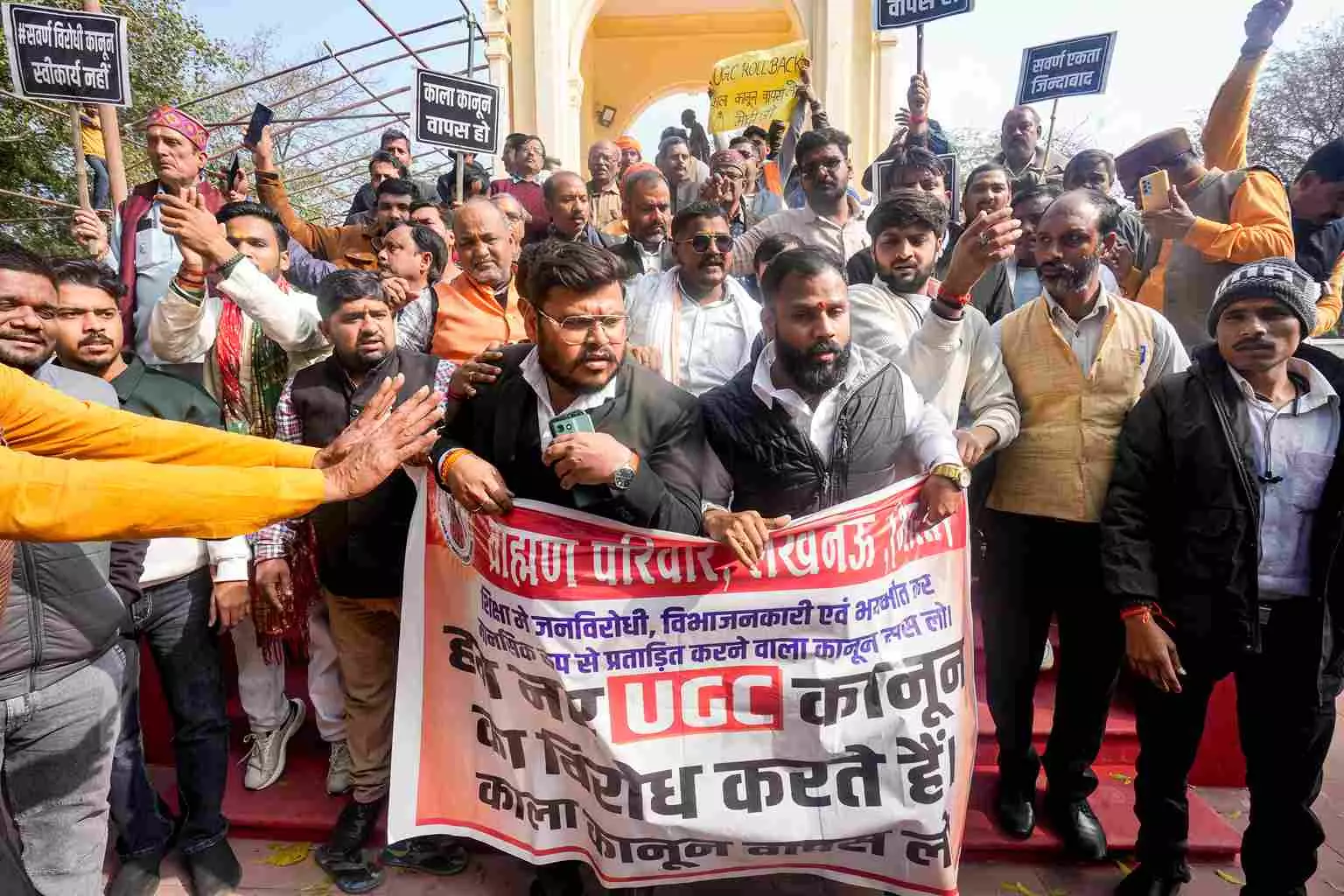
The regulations, notified earlier this month, were framed following repeated judicial observations that existing safeguards, particularly the 2012 UGC regulations, were ineffective in addressing caste-based discrimination in higher education, as seen in cases such as those of Rohith Vemula and Dr Payal Tadvi.
However, the new rules quickly became the subject of coordinated protests, social media outrage, and legal challenges, leading the Supreme Court to stay their implementation till March 19, even before detailed hearings commenced.
Strategic move?
On Thursday, the only student organisation to unequivocally welcome the stay was the Akhil Bharatiya Vidyarthi Parishad (ABVP), an organisation backed by the ruling dispensation under which the regulations were notified.
In a statement, the organisation said, “ABVP believes that the UGC and all educational institutions must preserve the intrinsic spirit of democracy, wherein every citizen enjoys equal rights, and India progresses as a society free from discrimination and rooted in equity… The decision of the Hon’ble Supreme Court bench was much needed, particularly in the present context where widespread ambiguity regarding the regulations had the potential to create discord among different social groups. ABVP firmly maintains that academic campuses should always remain spaces that are positive, inclusive, non-discriminatory, and guided by democratic values.
In a post on X, BJP MP Nishikant Dubey said, “…I once again earnestly request you to trust Modi ji; the country's laws will be governed solely under Articles 14 and 15 of the Constitution. The Supreme Court has done exactly what I said.”
Given these stands, as well as the campaign in the last week, some critics questioned whether the entire controversy was possibly engineered by the BJP. Jawaharlal Nehru University (JNU) associate professor Ajay Gudavarthy alleged that “the whole issue looks really manufactured”.
“The speed and coordination of these protests, almost overnight, suggest a deliberate political strategy. In the context of the upcoming Uttar Pradesh elections, this appears to be an attempt to polarise OBCs. I think the Supreme Court must be going through the legal proceduralities; they might put some provisions in place, and so on. But the main part is the political one,” he said.
Lack of clarity
He further questioned the lack of clarity in the regulations, alleging that it was a deliberate ploy.
“You make a blanket case of equity. What kind of complaints are admissible? What do they mean by discrimination? When you bring a law, things have to be very finite. It can't be so loosely defined; they are loosely defined because then that raises anxiety on both sides. That is the overall strategy of, I think, raising anxieties, creating conflictual situations, and then trying to draw support from both ends,” said Gudavarthy.
Academic and public intellectual Lakshman Yadav raised similar concerns.
“I had said earlier that there was not much clarity in the way the regulations were supposed to benefit SC, ST and OBCs. Today, that lack of clarity has been made the basis to put it in abeyance. So, was this planned to include these categories and claim that they are working in favour of them, but to deliberately keep it so vague that the SC put a stay on it?” he asked.
Yadav also said that the Supreme Court had backtracked on its own earlier position.
“All this started with the court, and when the court said in the case of Rohith Vemula, in the case of Payal Tadvi, that the UGC regulation of 2012 is not effective. You (SC) said to make a new regulation and make it strict so that people can get justice in caste-based discrimination. How can you change your decision today? And, today, you have implemented the guidelines of 2012 again,” he pointed out.
No logic
Lawyer and researcher Disha Wadekar, who represents the mothers of Rohith Vemula and Payal Tadvi in the Supreme Court, also questioned the logic of reverting to the 2012 regulations.
“The challenge (to the regulations) was that the upper caste should be included in the definition of caste discrimination. On this basis, the court has given the stay order. And in the meantime, the court has said till the next date of hearing, the older (2012) regulations will be in operation. But in the older regulations too, the protection was only for the Scheduled Caste and the Scheduled Tribes. Upper castes were not there. So, how does this stay on the regulations even help?” she asked.
Criticism of the stay also came from other quarters. Vanchit Bahujan Aghadi leader Prakash Ambedkar slammed the order, calling it a “judicial capitulation to casteist discourse”.
In a post on X, he said: “If the level of discourse surrounding the new UGC’s Promotion of Equity in Higher Education Institutions Regulations, 2026, was deplorable then the recent Supreme Court's stay on the new regulations represents a troubling judicial capitulation to that very discourse! The stay is against the constitutional ideas and promise of substantive equality, social justice, and democratic access to education.”
“The Supreme Court said the new regulations ‘will divide the society’! But isn’t it already? On the lines of caste!? And, this is what the regulations were! A safeguard against caste discrimination! I cannot fathom how anyone could oppose basic equity measures; the protests, itself, were a stab to the memories of Rohith Vemula, Payal Tadvi, and thousands more who faced and continue to caste discrimination in educational institutions. This is a sad day!” he added.
Left student organisation All India Students’ Association (AISA) and its parent party, the Communist Party of India (Marxist-Leninist) Liberation, said the stay amounted to a “capitulation before brahminical pressure”.
“During the hearing on the so-called ‘social counter-revolution’ of the 10 per cent EWS reservation, no stay order was granted on its implementation. Similarly, during the hearing concerning the cancellation of Jammu and Kashmir’s statehood, no stay order was issued. No stay was granted either during the hearing related to the cancellation of the SIR, which allegedly pushes significant numbers of women, marginalised communities, and Muslims out of electoral rolls. However, in the case of the UGC Equity Rules, 2026 the hearing has not even begun, yet a stay on the implementation has already been imposed,” AISA said in a statement.
CPI(ML) Liberation said it was “deeply appalled” by the stay.
“Can the rhetoric of a ‘casteless society’ deliver justice for the institutional murder of Rohith Vemula or Dr Payal Tadvi or the racist killing of Angel Chakma? Why does the CJI believe that the struggle against caste atrocities, or such legal measures born out of that struggle which strengthen the voices against caste and racial discrimination, is pushing the country backward?” it said.
Review required
Some academics also flagged the need for clearer drafting. Democratic Teachers’ Federation Secretary Abha Dev Habib said that while she did not welcome the stay, the regulations required review and broader feedback.
“When regulations are drafted too vaguely, they end up helping no one… Take the provision on forming ‘squads’, for instance. It is unclear whether these are meant for equity or for monitoring students and teachers. What does it even mean to ‘go to the spot’? Is there a ‘spot’ for discrimination in a classroom? Discrimination in education does not always take a visible or physical form, and the regulation shows very little imagination in understanding how it actually operates,” she said.
“That said, those demanding a stay are often the very people who are implicated. Any good-faith citizen should ask: What is the objection to a measure rooted in constitutional principles?” she added.