Will UGC rollback cost BJP Uttar Pradesh? Political impact decoded | AI With Sanket
UGC’s new equity rules trigger backlash from BJP’s own supporters—can the Centre tweak them without upsetting SC/ST/OBC voters?

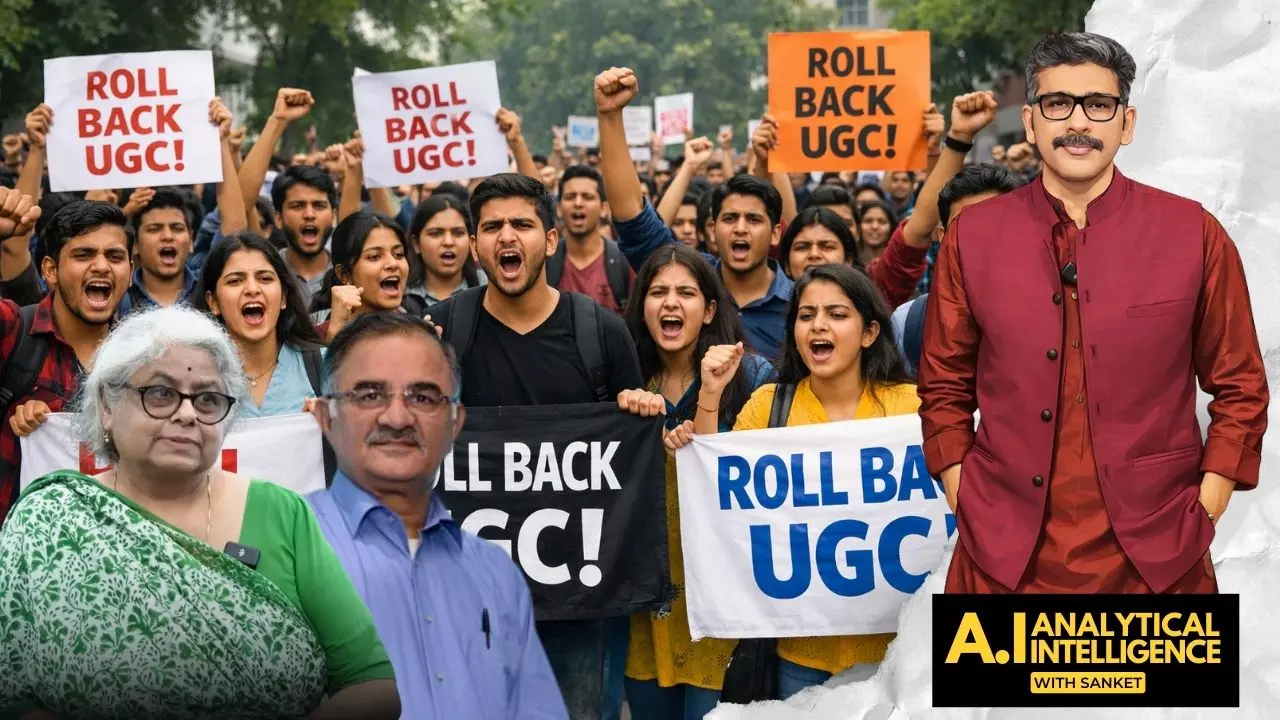
Senior journalists Aditi Phadnis and Javed Ansari weigh in on the political backlash to the UGC’s new equity guidelines, dissecting the caste dynamics, internal party tensions, and what it could mean for the BJP’s electoral future, especially in states like Uttar Pradesh.
SC pressure, policy fallout
The panel discussion began with the origin of the University Grants Commission's (UGC) new equity guidelines. Aditi Phadnis highlighted that the Supreme Court had directed the government to introduce measures preventing caste-based discrimination on campuses, particularly in light of tragic incidents like Rohith Vemula's suicide.
To comply, the UGC created regulations allowing students to raise equity concerns. But the move has triggered a backlash from upper-caste communities, who fear the guidelines will institutionalise discrimination against them. The guidelines were formulated under Jagdish Kumar, former JNU Vice Chancellor with known RSS affiliations, intensifying the political scrutiny.
Also read: Protest against UGC's new equity rules ‘manufactured’? Yogendra Yadav interview
Javed Ansari observed that the backlash comes ironically from the BJP’s traditional upper-caste base, who now feel alienated by a policy brought in by their own government.
Tightrope walk
Javed Ansari emphasised the political balancing act the BJP faces. “The Hindi heartland—UP and Bihar—is where backwards rule the roost,” he said, making it risky to alienate SC/ST/OBC voters. At the same time, upper-caste supporters, feeling betrayed, have started blaming Dharmendra Pradhan, even though such policies are cleared at the highest levels and mandated by the Supreme Court.
"This isn’t a Tughlaki farman," Ansari remarked, pointing out that ministers like Pradhan cannot unilaterally make such sweeping decisions. The resentment, he noted, is being misdirected at individuals rather than the institutional and judicial process that led to the guidelines.
Language misinterpretation
The term "particularly" used in Section 31C of the UGC guidelines—intended to protect SC, ST, OBC, and EWS students from discrimination—became a flashpoint. Aditi Phadnis stressed that nowhere does the provision say the protection is exclusive to these groups.
Still, as Ansari pointed out, many in the upper castes interpret “particularly” as “exclusively”, fuelling distrust. Despite the presence of upper-caste leadership in universities—like vice chancellors and top professors—there’s a perception that the system is now skewed against them.
Underlying caste anxieties
Aditi Phadnis noted that the protest isn’t about equity itself, but deep-seated caste insecurity among upper castes. This has re-emerged despite the BJP’s introduction of EWS reservations and continued rhetorical support from RSS chief Mohan Bhagwat, who has called caste a “curse” on Hindu society.
Also read: New UGC equity regulations spark protests: Here are the new rules explained
She recalled how in the last general elections, remarks from BJP MPs about altering the Constitution and ending reservations backfired, reducing the BJP’s seat share from 303 to 240, while the Congress rose from 45 to 91 seats.
Dangerous experiment?
Javed Ansari warned of the societal danger in politicising equity. Comparing it to the fallout from the Mandal Commission, he said this new wave of anger, if mishandled, could fracture communities and trigger irreversible damage.
He also underscored how the BJP’s ideological contradictions have been exposed. Despite the party’s stance of "social unity," the government gazette on equity guidelines has laid bare caste fault lines within the party and society.
Electoral implications in UP
With Uttar Pradesh going to polls in less than a year, both panelists saw potential for serious political repercussions. Aditi Phadnis argued that no matter what direction the BJP takes, they risk alienating either the upper castes or the backwards—a lose-lose situation.
If the guidelines are diluted to include the general category explicitly, SC/ST/OBC groups may view it as betrayal. If left unchanged, upper castes may continue to revolt.
Meanwhile, Javed Ansari explained the numerical challenge: “In pure arithmetic terms, OBCs outnumber upper castes by a huge margin.” Still, voting patterns are not monolithic, and the BJP will need to tread carefully.
He also raised the possibility that the government may try to calm things down by inserting "general category" into the guidelines—a halfway house that allows political messaging without fundamentally changing the intent.
Also read: Why some sections of society are protesting against UGC's equity rules | AI with Sanket
Aditi Phadnis added nuance to the discussion by citing an incident involving JNU Vice Chancellor Santishree Dhulipudi Pandit, who publicly credited her appointment to her gender and caste. Phadnis found it troubling that academic merit was not foregrounded.
This, she argued, underscores how caste identity remains deeply embedded in institutions, and changes like the UGC guidelines inevitably stir up systemic resistance.
A gamble
Both panelists agreed that the BJP is walking a political tightrope. Whether this move is a genuine push for social reform or a calculated electoral gamble, it carries high risks—both societal and electoral.
As the UP elections near, the ruling party will have to decide: uphold the Supreme Court-mandated guidelines and risk alienating traditional supporters, or compromise on equity and lose face with the backward classes.
Either way, as Ansari put it, "This will hurt."
The content above has been transcribed from video using a fine-tuned AI model. To ensure accuracy, quality, and editorial integrity, we employ a Human-In-The-Loop (HITL) process. While AI assists in creating the initial draft, our experienced editorial team carefully reviews, edits, and refines the content before publication. At The Federal, we combine the efficiency of AI with the expertise of human editors to deliver reliable and insightful journalism.