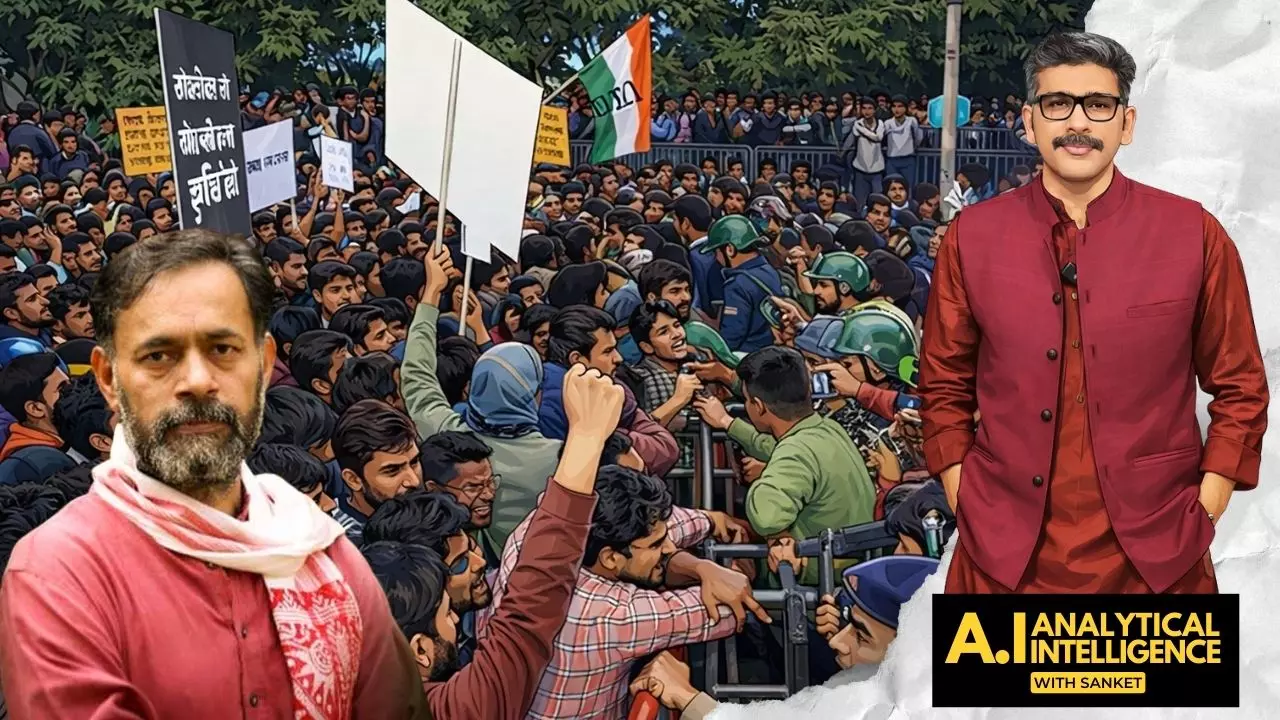
Protest against UGC's new equity rules ‘manufactured’? Yogendra Yadav interview
A former UGC member breaks down what’s new and what’s not about the equity rules and why the backlash may be designed to block implementation

The Federal spoke to Yogendra Yadav, a former UGC member, as protests and political sparring intensify over the University Grants Commission's (UGC) 2026 equity regulations. Yadav argues the public debate has missed what is actually new, why the rules were updated, and what may happen at the implementation stage.
What is the main objection being raised to the new UGC equity rules?
I think the current debate is extremely ill-informed. We have massive debates in this country where both sides are not fully informed about what they are debating.
The first misconception is that something totally new — either revolutionary good or very bad — has come into being. That is mistaken. The 2026 rule is a reformulated version of something that already existed. Equity and anti-discrimination regulations have been in place since 2012, when I was a member and was involved in framing the original rules.
The second misconception is that the government has done something major on its own. This flows from a Supreme Court case. It is not that Mr. Modi’s government suddenly developed social conscience. The Supreme Court has repeatedly said the existing regulations need improvement and must be reformulated. So this is happening at the Supreme Court’s direction.
The third misconception is that caste-discrimination provisions have been introduced for the first time. That is also wrong. The 2012 directions named SC and ST; the current directions name SC, ST, and OBC. So there is nothing fundamentally new in that sense.
What is interesting is where the criticism is coming from. Usually, criticism of education policy comes from the Opposition. But here, criticism is coming from the ideological friends and followers of the regime — so the regime is, in a sense, criticising itself. The Supreme Court says tighten the rules, the government has no option, and then you generate heat saying the public doesn’t like it. I see this as manufactured dissent to ensure the guidelines cannot be implemented.
And after comparing the earlier and current guidelines, I feel the debate doesn’t even capture the real differences. Some parts have been tightened, as the Supreme Court wanted. But in that process, some core content of anti-discrimination law has been diluted. That is what we should be debating.
Also read: New UGC equity regulations spark protests: Here are the new rules explained
What has changed from the 2012/earlier rules to the 2026 rules? What is the continuity?
The continuity is simple: the Constitution and fundamental rights prohibit discrimination based on caste, gender, ethnicity, language, place of birth, and so on. The 2012 and 2026 regulations are meant to implement a constitutional mandate.
And both regulations are not only about caste. They cover gender, physical disability, and other forms of discrimination. Caste is one part in both 2012 and 2026.
The general formulation cites all forms of discrimination. The specific mention earlier was about SC and ST; now it has been extended from SC/ST to SC/ST/OBC. But that is only one specific mention.
Please remember, provisions can be used by women, persons with disabilities, and others. If someone feels discriminated against because of religion, or because she is a girl, or because of disability, these provisions can be used. These are general rules against discrimination; only some specific provisions name certain categories.
Frankly, it is astonishing that this country is debating whether such constitutional principles should exist. The basic unease is with the Constitution’s idea of equality.
Also read: Why some sections of society are protesting against UGC's equity rules | AI with Sanket
If discrimination happens within or across categories, will it be covered?
Yes. I see no reason why not — unless someone takes a hypertechnical view.
Caste-based discrimination is caste-based discrimination. If an OBC teacher or student is accused of discriminating against an SC/ST student, that is within the idea of caste discrimination. If someone within an SC/ST group discriminates against another person within those groups, that too can be caste-based discrimination. There is no reason it should be excluded. That is why I say the debate is silly.
Also read: Padma Shri for ex-JNU VC Jagadesh Kumar reignites debate over his academic legacy
So what are the real changes introduced now?
The real changes emanate from the Supreme Court.
One, the court asked about implementation. The UGC had not checked implementation for 10-12 years. The UGC asked around 3,000 institutions, and then asked how many complaints were received. The number of complaints was far lower than the number of cells, which suggested these bodies existed largely on paper. The court was annoyed.
Two, the court asked whether UGC supervised this. The earlier regulations did not provide a mechanism for UGC oversight. That has changed.
Three, the earlier regulations made the head of the institution the final authority. The court asked: 'What if the problem is with the head?' So an appeal outside the institution had to be provided.
So the new regulations do sensible things:
UGC oversight over institutions
Appeal outside the institution to an ombudsman
Equity committee instead of a single anti-discrimination officer
Proactive measures, not just complaint-handling
All these are good steps and were driven by Supreme Court directions.
My concern is that while these mechanisms were strengthened, the regime diluted two or three things that the Supreme Court did not ask to dilute.
Has the definition of discrimination been widened or diluted?
It has not been widened. Earlier, the definition was wide and it came with examples.
Now the examples have been removed. You can say examples are not essential in law, but they matter in practice. Earlier, the regulations listed what discrimination can look like in educational institutions — things like classroom conduct, assessment, examinations, and other specific behaviours. When a law lists examples, it becomes easier for an aggrieved person to say, “This is what is happening to me”.
Now the onus shifts to the aggrieved party to fit their experience into an omnibus category. It is not impossible, but it becomes harder. So yes, institutional mechanisms have been strengthened, but the core definition has been diluted.
Will these changes actually help people facing discrimination on campus?
In the end, regulations are only as good as implementation.
The 2012 regulations were poorly implemented. Something may have been wrong in design, but more importantly, institutions did not implement them seriously.
I would have wanted the Supreme Court to revisit this, and I hope it does. The Supreme Court has kept the possibility open and told petitioners: if you are unhappy, come back. I hope the Court asks the government: we asked you to do certain things — why did you also do other things we did not ask for?
But again, the key is implementation. The controversy being generated — as if a catastrophe has happened to general category students — can function as a way to ensure the regulations are not implemented, even if they exist on paper.
How can the government stall implementation if rules are already notified?
I see two possibilities.
One, the government says: there is strong feedback, we will look into it, we will set up a committee. And then tweaks are made that dilute further. Bureaucratically, there are many ways to scuttle something.
Two, the rules remain, but no one is made to implement them — “let the law be, who asked you to enforce it?” This has happened before with earlier regulations.
Also, public discourse has shifted: earlier backlash was against affirmative action. Now there is backlash even against anti-discrimination, which is a lower threshold. That is what worries me.
Are general category or “savarna” students being targeted, as protestors claim?
If you see a smile, it is not because I take delight in anyone being persecuted. Even one person being persecuted wrongly is bad.
But this regulation has existed for 14 years. How many cases of the kind people are warning about have happened? How many instances of targeting general communities? In 14 years, show me 14 such cases. What is new here?
This is like white anxiety against anti-racial-discrimination laws in the US — an ideology of white supremacy expressing itself as anguish. Or men claiming they are victims because of anti-dowry or anti-rape laws — patriarchy expressing itself as contrived hurt.
Similarly, opposition not just to affirmative action but to anti-discrimination should be named for what it is: casteism, Brahminism, and “Manuwad” — a drive to impose caste domination.
What guardrails exist to prevent misuse or false complaints?
Every law can be misused. But compare this with stringent laws like anti-rape provisions or the SC/ST (Prevention of Atrocities) Act — where, in some situations, the onus can be very heavy on the accused.
This regulation is not like that. It is straightforward:
If you think a wrong case has been brought against you, go to the committee.
If you are not satisfied, go to the higher authority.
If you are still not satisfied, go to an ombudsman beyond the institution.
There are multiple layers of appeal. What more do you want?
So is this protest “manufactured” to avoid implementing Supreme Court-linked changes?
That is a fair summary.
And to test whether my reading is right, check the social media handles of those opposing these regulations. See what they have said about Mr. Modi, the BJP, and the RSS, and then tell me if I am wrong.
(The content above has been transcribed from video using a fine-tuned AI model. To ensure accuracy, quality, and editorial integrity, we employ a Human-In-The-Loop (HITL) process. While AI assists in creating the initial draft, our experienced editorial team carefully reviews, edits, and refines the content before publication. At The Federal, we combine the efficiency of AI with the expertise of human editors to deliver reliable and insightful journalism.)