



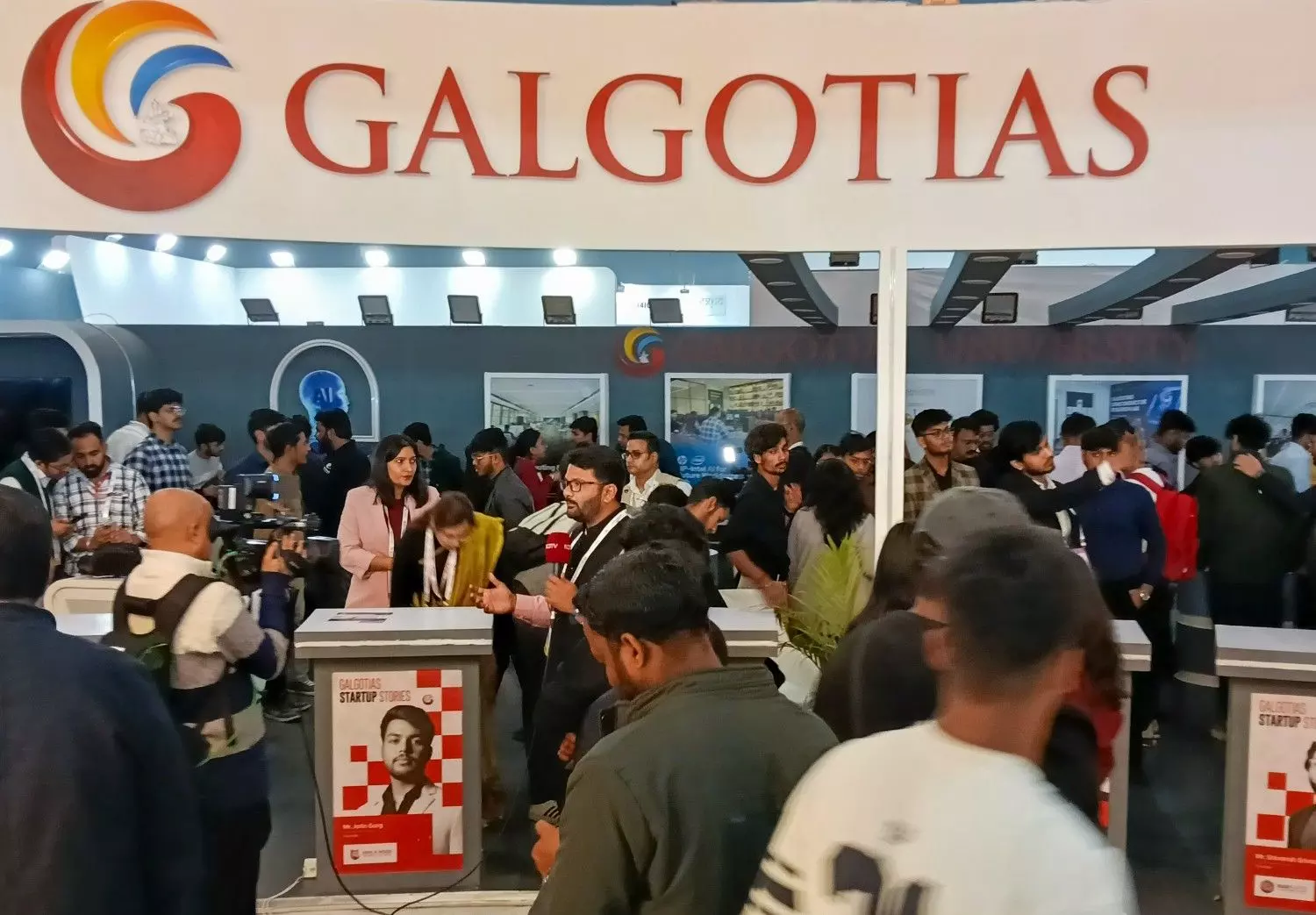
Visitors at Galgotias University's stall during the India AI Impact Summit 2026, in New Delhi, Wednesday, February 18. PTI
Five times Galgotias University was dogged by controversies
From Chinese robodog passed off as homegrown AI to paper claiming thali vibrations kill COVID-19, Galgotias has a track record of embarrassing itself in public

From a Chinese robodog passed off as a homegrown AI to a pandemic paper claiming that thali vibrations kill COVID-19, Galgotias has a track record of embarrassing itself in public.
When a communications professor at Galgotias University stepped up to a quadruped robot at the India AI Impact Summit in New Delhi last week and proudly introduced it to the nation as the university's own artificial intelligence breakthrough, she could not have known that within hours, X (formerly Twitter) would identify it as a commercially available Chinese robot costing less than Rs 3 lakh.
Also read: Galgotias’ robodog row: Blaming, philosophy, clarification, but no apology
But for those who have followed Greater Noida-based Galgotias University over the years, the episode felt less like a shocking revelation and more like a familiar pattern — a pattern of inflated claims, manufactured credibility, and spectacular, very public unravellings.
Here is a fact-checked account of five times the Galgotias University made headlines for all the wrong reasons.
Robodog that wasn't (February 2026)
At the India AI Impact Summit — inaugurated by Prime Minister Narendra Modi — Galgotias University professor Neha Singh gestured towards a four-legged robot at the varsity’s stall and described it as having been "developed by the Centre of Excellence at Galgotias University", naming it 'Orion'. Social media needed just a few hours to identify it as the Unitree Go2, a product of Chinese manufacturer Unitree Robotics, available off the shelf for roughly Rs 2-3 lakh. The university was subsequently asked to vacate its stall, and Opposition MLAs raised the matter on the floor of the Uttar Pradesh Assembly, demanding a formal probe.
Also read: Galgotias robodog row: ‘This is arrogance of an inexplicable kind’
Drone that came from Korea (February 2026)
The robodog wasn't the only exhibit that day attracting scepticism. A football-playing drone on display at the Galgotias University campus — presented as an indigenous project — was alleged by users online to closely resemble the Striker V3 ARF, a commercially available model designed by Helsel Group, a South Korean company, retailing in India for around Rs 40,000. Two alleged misrepresentations in a single day, at a national flagship event, made the story impossible to contain.
The 'Urban Maxwell' protest (2024)
In 2024, a group of Galgotias University students went viral for entirely different reasons. Participating in a political protest in New Delhi against "urban naxalism", several students were filmed unable to pronounce — or explain — the very slogan on their placards. Some read it as "urban maxwell". When reporters asked them about inheritance tax, the Congress manifesto, or the meaning of "urban naxalism", the students fumbled visibly. The clip circulated widely as a meme and raised uncomfortable questions about the quality of civic awareness being cultivated on campus.
Also read: Youth Congress stages 'shirtless protest' at AI Impact Summit
The COVID-19 thali paper (2020)
During the pandemic, Galgotias University faculty published a research paper claiming that the vibrations produced by striking a thali (metal plate used to serve food) — and ringing bells — could kill the coronavirus. The paper was widely ridiculed, with industrialist Harsh Goenka among those flagging it publicly. It drew serious scrutiny toward the university's academic standards and its peer-review process, or apparent lack thereof.
Founder's alleged loan fraud (2010-2012)
Long before the robots and the drones, the very foundations of the institution were shadowed by controversy. The university's founder, Sunil Galgotia, was accused of using forged documents to obtain a loan of Rs 120 crore. The allegations, relating to the period between 2010 and 2012, cast a long shadow over the institution's governance from its earliest years.