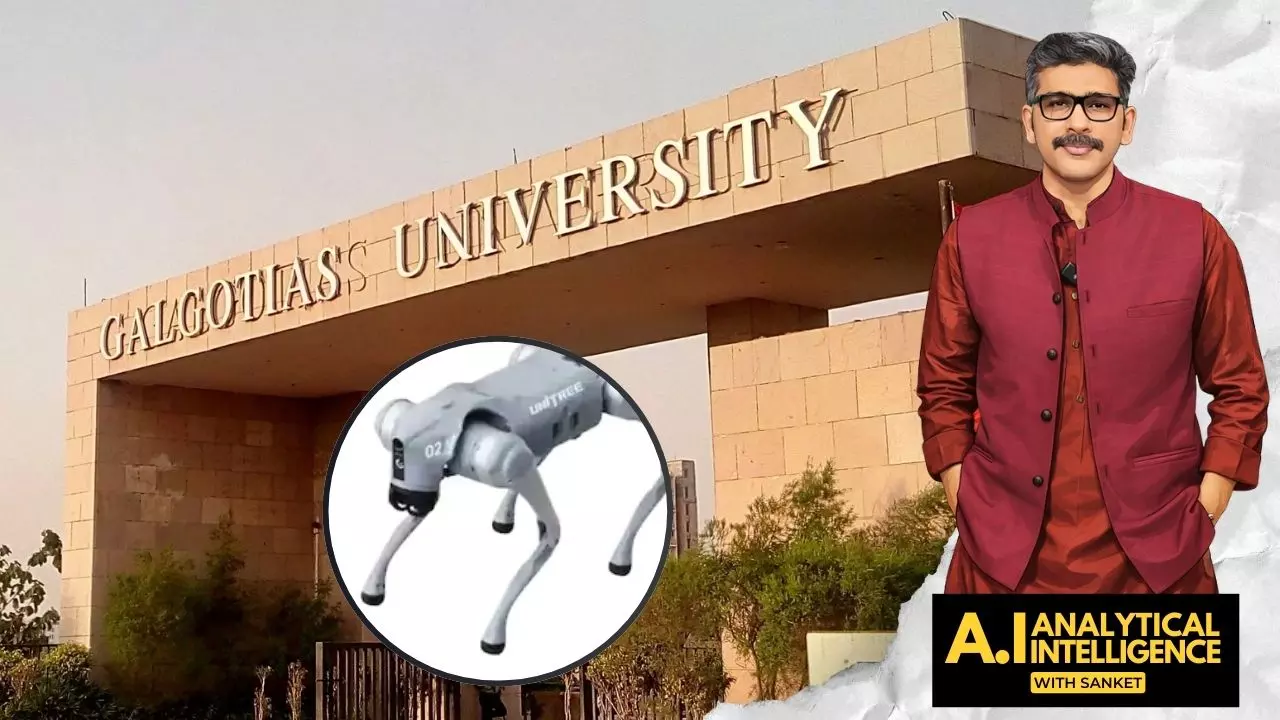
Galgotias robodog row: ‘This is arrogance of an inexplicable kind’ | AI With Sanket
Despite differences in tone, all three panellists converged on one point: the controversy must not derail India’s long-term AI aspirations, but it should trigger serious introspection on ethics, funding, regulation, and institutional accountability

A controversy has erupted over Galgotias University allegedly showcasing a Chinese-made robotdog as its own innovation at the India AI Impact Summit 2026. This has sparked questions about due diligence, innovation ethics, and whether a single exhibitor’s misstep can dent India’s broader AI ambitions.
On AI With Sanket, The Federal spoke to political analyst Sanjay Jha, Dr. Kanishk Gaur, founder of India Future Foundation, and senior Supreme Court advocate Khusbu Jain to unpack accountability, ecosystem gaps, and the future of AI innovation in India.
Serious lapse
Opening the discussion, Jha dismissed social media memes around the controversy and called it a “serious matter”. In his view, presenting an off-the-shelf product as indigenous innovation at a global AI summit was not naïveté but a reflection of deeper systemic issues. “This is not just being silly or myopic. This is arrogance of an inexplicable kind.” That was the sharp indictment from Jha.
Also read: India AI Summit: 10 things that Google’s Sundar Pichai said
“In an age when AI is far ahead of our time, when everything is subject to scrutiny, how did anyone expect this would not be exposed?” he asked. According to Jha, the incident has caused a “monumental red face” for India on an international platform.
He argued that responsibility cannot rest solely with the university. “Without due diligence, everything will be up for scrutiny. I hold the government responsible,” he said, questioning how such a product was cleared for exhibition at a government-backed global event.
Ecosystem defence
Gaur, who was present at the summit, offered a nuanced counterpoint. While agreeing that misrepresentation harms genuine innovators, he cautioned against painting the entire ecosystem with the same brush.
“I have met startups from Bihar and Jharkhand building actual robots. There is tremendous talent,” he said. According to him, the summit platform is important for fostering an innovation environment and connecting Indian startups with global delegates.
Also read: Galgotias University forced to exit AI Summit after robot dog row over misrepresentation
However, he acknowledged the ethical gap. “Until and unless you have stricter fines and penalties on AI, the copy-paste model will remain a big issue,” he said, warning against a culture of plagiarism and superficial ‘vibe coding’ replacing deep technical expertise.
Legal view
Jain urged restraint, calling it premature to declare fraud without a proper legal process. “It is at a nascent stage to make any comment as to who was right or wrong,” she said.
According to Jain, questions of misrepresentation, contract violations, copyright infringement, or even cheating must be examined through due legal channels. “Facts need to be established. There has to be due process,” she stressed.
Also read: Leaders flag AI's potential to transform education at India AI summit
She also warned against allowing a single exhibitor’s alleged lapse to eclipse the summit’s larger agenda, which included AI governance, safety, watermarking, deepfake mitigation, and global cooperation involving over 100 countries.
Vetting questions
The debate intensified around the issue of vetting. If this was a government event, what screening process was followed before allowing exhibitors to showcase products?
Gaur revealed that his own participation required a three-month vetting process and multiple rounds of interaction. “It’s not that the entire process is broken,” he said, adding that numerous global brands and credible startups were present.
Yet he admitted a structural weakness: hardware innovation may not have been scrutinised deeply enough. “Unless you have a mechanism to bring a device to a lab and test intellectual property or patents, there will always be ways to get through,” he noted.
Funding gap
Beyond the immediate controversy, the panel converged on the larger issue of India’s innovation ecosystem. Jha pointed to India’s low research and development spending — around 0.65 per cent of GDP — compared to 3 to 4 per cent in countries like China and the United States.
He also cited declining public expenditure on higher education and argued that without foundational investments in schools and universities, AI leadership would remain aspirational.
“We don’t have a single university in the top 500 in the world,” Jha said, calling it an “embarrassing fact” that needs urgent correction if India wants to lead in AI.
Role of government
The discussion also examined the government’s role in nurturing innovation. Jha maintained that governments must create digital infrastructure and fund early-stage research, as seen historically in the rise of the internet and major US tech giants.
Gaur agreed on the need for stronger public-private partnerships and venture capital support. “All we need is dry powder — funding ready to invest in the next AI breakthrough,” he said.
He added that India must move beyond “jugaad” — frugal improvisation — and build deep hardware and foundational AI capabilities. “AI can’t be built through jugaad. What someone else has built, you can’t claim as your own,” he said.
Not the norm
Jain reiterated that the incident should be treated as an exception, not the norm. “Let there be a proper legal process. If something has been done, let there be punishment,” she said, calling for this episode to serve as a lesson for institutions.
At the same time, she emphasised that trust and authenticity are central to safe AI development. “This is why we need trusted AI. That was the agenda of the summit,” she said.
The panel agreed that stronger monitoring, better evaluation mechanisms, and credible expert scrutiny — including possible “red team” evaluation structures — are essential for future events.
Bigger picture
In his closing remarks, Jha urged India to focus on core strengths rather than headline-driven ambitions. He noted that while India played a crucial role in the global IT services boom during Y2K, it has yet to create globally dominant AI consumer brands.
“We are getting carried away by hype. Play to your strengths,” he advised, arguing for world-class universities and a level playing field to unleash India’s demographic dividend.
Despite differences in tone, all three panellists converged on one point: the controversy must not derail India’s long-term AI aspirations, but it should trigger serious introspection on ethics, funding, regulation, and institutional accountability.
(The content above has been transcribed from video using a fine-tuned AI model. To ensure accuracy, quality, and editorial integrity, we employ a Human-In-The-Loop (HITL) process. While AI assists in creating the initial draft, our experienced editorial team carefully reviews, edits, and refines the content before publication. At The Federal, we combine the efficiency of AI with the expertise of human editors to deliver reliable and insightful journalism.)