



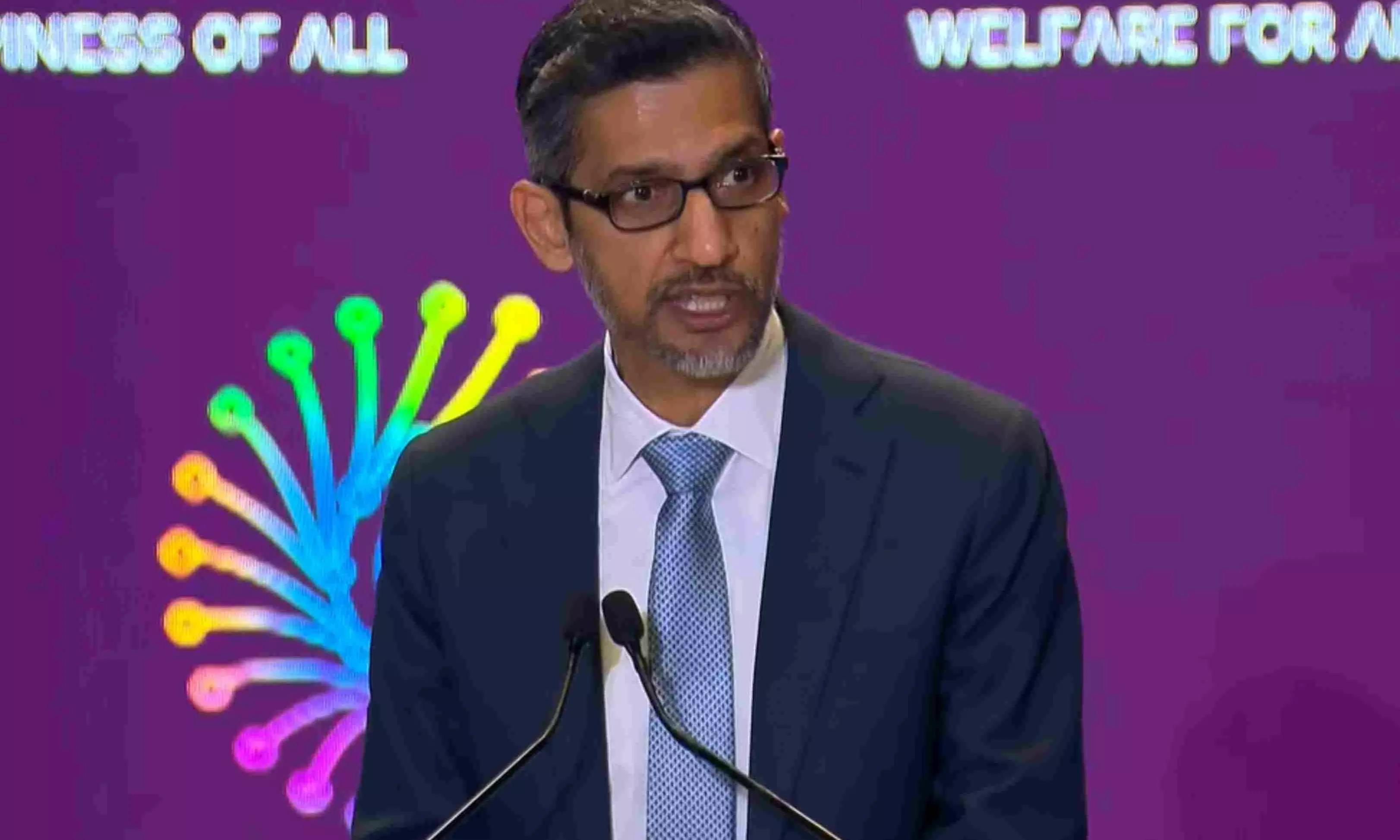
Google CEO Sundar Pichai addresses the gathering during the India AI Impact Summit 2026, in New Delhi. Photo: X |@NarendraModi/Yt via PTI
Sundar Pichai quips about driverless cars in India: 'Still working on that, Dad'
Google CEO recalls his college days in southern India, amazed at how they are building a $15B AI hub in Vizag; hails India’s "hyper progress"

Google CEO Sundar Pichai said he was deeply struck by India’s ‘pace of change’ everytime he returns to the country, and praised India’s growing role in artificial intelligence on the global stage.
He recalled his college days in southern India, while addressing the India AI Impact Summit in New Delhi with Prime Minister Narendra Modi in attendance.
“Every time I return to India, I’m amazed by the pace of change—and today is no exception,” said Pichai, who hails from Chennai, Tamil Nadu. In his student days, he used to travel by train from Chennai to IIT Kharagpur, passing through Visakhapatnam.
How Vizag has evolved
“Back then, Vizag was a quiet coastal city full of promise. Today, that same city is home to Google’s new full-stack AI hub, part of our $15 billion infrastructure investment in India,” he said.
Also read: All you need to know about Sarvam AI, the AI Summit ‘rockstar’
Pichai said Google is establishing a full-stack AI hub in Visakhapatnam in Andhra Pradesh as part of its previously announced USD 15 billion infrastructure investment in India. The facility will house gigawatt-scale compute capacity and a new international subsea cable gateway, aimed at expanding jobs and AI access across the country.
On driverless cars in India
Pichai noted that he could never have imagined Visakhapatnam evolving into a global AI center, just as he once couldn’t picture himself working on projects like space-based data centers or taking his parents on a ride in a fully autonomous car in San Francisco.
He also shared a lighthearted memory of his father, Regunatha Pichai, who once remarked that he would be “more impressed” if driverless cars could navigate India’s famously busy roads.
"Still working on that, Dad," said Pichai, who also heads Google parent Alphabet, which makes Waymo driverless taxis.
India's use of AI
Pichai praised the Indian government’s use of AI-powered forecasts that reached millions of farmers last summer, noting that this was made possible in part by Google’s NeuralGCM model.
“AI will inevitably reshape the workforce—automating certain roles, transforming others, and creating entirely new careers,” Pichai said. “Two decades ago, the idea of a professional YouTube creator didn’t exist. Today, millions of people around the world make a living that way.”
Hyper progress
Further, Pichai described AI as ushering in an era of "hyper progress", with the potential to unlock new scientific discoveries and help emerging economies bypass traditional development stages.
Also read: Feb 19 News Live: India built something no other country did: Macron at AI Summit
Pichai said no technology has made him "dream bigger" than AI, highlighting its transformative potential across science, education, and economic growth.
Subsea fibre optic cable system
He also highlighted Google’s efforts to expand digital infrastructure, announcing the construction of a vast subsea fiber optic network. This includes four new systems linking the United States and India under the recently launched America-India Connect initiative.
Google will build four new subsea fibre optic cable systems between India and the United States, positioning the project as a cornerstone of broader AI and digital infrastructure expansion, he said.
Biggest platform shift
The Google and Alphabet CEO outlined an ambitious vision for AI, calling it "the biggest platform shift of our lifetimes" and urging governments, companies and institutions to pursue the technology boldly and responsibly.
"It is the biggest platform shift of our lifetimes, we are on the cusp of hyper progress and new discoveries that can help emerging economies leapfrog legacy gaps. But that outcome is neither guaranteed nor automatic. To build AI that is truly helpful for everyone. We must pursue it boldly, approach it responsibly and work through this defining moment together," he said.
"Technology brings incredible benefits, but we must ensure everyone has access to them. We cannot allow the digital divide to become an AI divide. That means investing in compute infrastructure and connectivity," he said, citing the Vizag investment as well as those in countries like Thailand and Malaysia.
"It (AI) is the biggest platform shift of our lifetimes, we are on the cusp of hyper progress and new discoveries that can help emerging economies," he said.
AI breakthroughs
He highlighted AI breakthroughs such as AlphaFold by Google DeepMind, which he said compressed decades of protein-structure research into a publicly available database used by millions of researchers worldwide.
For five decades, predicting protein structures was a grand challenge and a blind spot that stalled drug discovery. AlphaGo programme revealed millions of intricate 3D protein structures, helping scientists understand how life's molecules interact.
This breakthrough, he said, didn't just win a Nobel Prize but it also compressed decades of research into a database that is now open to the world today.
Over 3 million researchers in more than 190 countries are using it to develop malaria vaccines, fight antibiotic resistance and much more.
Pichai said AI is being deployed across healthcare, agriculture and language inclusion initiatives, citing partnerships in El Salvador to expand access to AI-powered medical diagnosis and in India, where AI-driven monsoon forecasts were delivered to millions of farmers.
Economic impact
On the economic impact, Pichai said, "AI will undeniably reshape the workforce, automating some roles, evolving others and creating entirely new careers." He added that Google has trained 100 million people in digital skills and launched a Google AI Professional Certificate to help workers adapt to AI-driven changes.
Emphasising trust and governance, he said governments must act both as regulators and innovators to ensure AI benefits society at scale, while companies must build products that enhance knowledge, creativity and productivity.
"We have the opportunity to improve lives at a once-in-a-generation scale. I know we have the capability to do this. And looking at the leaders here today, I believe we also have the bill now. We must do the work together," Pichai said.
Pichai said AI can improve billions of lives and solve some of the hardest problems in science.
(With agency inputs)