



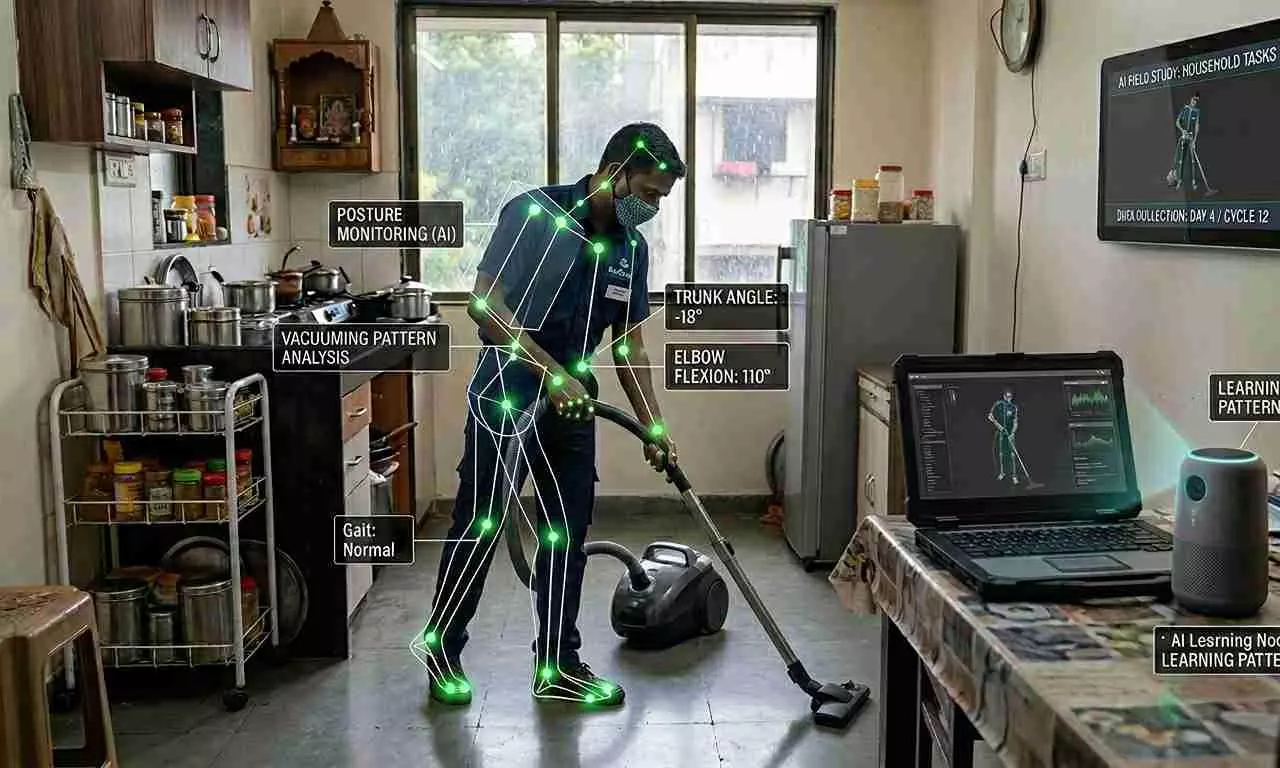
Pronto row reveals India’s growing role in training Physical AI systems
Workers are increasingly generating AI training data, even as activists warn they may be helping automate away their own jobs

The controversy around Bengaluru-based startup Pronto has once again brought attention to a growing and largely invisible industry - the use of gig workers to generate data for artificial intelligence (AI) training.
Pronto controversy
The debate began after a social media post alleged that Pronto professionals, hired on an hourly basis for domestic help, were recording videos inside customers’ homes using outward-facing body cameras. The viral post further claimed that the recordings were linked to the company investor’s “Physical AI” ambitions.
Responding to the criticism, Pronto clarified that cameras were not used by default and that only customers who had explicitly opted into the programme were part of the pilot initiative. The startup also said consent had to be reaffirmed before every booking.
Also read: Finding their own replacement? Factory workers with cameras on head trigger AI fears
But the incident sparked a wider conversation about how real-world human behaviour is increasingly being converted into AI training data.
Physical AI
This is not an isolated case. Recently, a Bengaluru vegetable vendor was seen wearing a head-mounted iPhone device while working, reportedly to collect real-world data for AI systems.
Earlier, videos from a garment factory showed workers performing tasks while wearing recording headgear.
Also read: TCS to retrain 1 lakh employees yearly to meet AI demands
At the centre of this trend is the rise of Physical AI, a branch of artificial intelligence focused on training robots and humanoid machines to perform real-world physical tasks. While generative AI systems learn from text and images online, physical AI requires something far more complex: human actions, movements, reflexes and decision-making in real environments.
Emerging hub for training data
India has quietly emerged as one of the world’s largest hubs for collecting this kind of training data.
Workers in factories, warehouses, kitchens and households are increasingly being used to generate “first-person” datasets. These recordings capture how humans stitch fabric, fold clothes, handle utensils, wash dishes, sort objects or operate machinery. Companies then use these videos to teach robots how to interact with the physical world.
Data aggregation firms such as Objectways and Egolab AI reportedly act as intermediaries, partnering with factories or gig-work platforms to collect footage and supply datasets to global AI and robotics companies.
The process
The process behind this is highly technical. AI systems first break down videos into structured maps of objects and movements. Algorithms track the exact position, velocity and orientation of items in three-dimensional space. Simultaneously, software overlays a digital skeleton onto the worker’s body, tracking movements of shoulders, elbows, wrists and even finger joints frame by frame.
Also read: Despite legal recognition, social security remains elusive for millions of gig workers
Engineers then map those human movements onto robotic systems. The AI learns by pairing each frame of a video with the action that follows it — gradually building what researchers call a “visuomotor policy”, where a camera image becomes linked to a physical action.
The trained system is eventually uploaded into robots or robotic arms, which execute movements through rapid motor commands updating hundreds of times per second.
The criticism
Despite the technological advancement, labour rights activists have raised concerns. Critics argue that underpaid workers are effectively training the very machines that may eventually replace their jobs.
Others question whether workers fully understand the commercial value of the data they are generating, with some unions now discussing ideas such as long-term data royalties or digital compensation models.
Also read: 14-hour workday in oppressive conditions: Expert shares dark truths of gig work