



Iran war effect: ATF price crosses Rs 2 lakh/kl; domestic airlines shielded, for now
Govt limits jet fuel rise to 8.5 pc for domestic carriers while foreign airlines face full surge amid war-driven spike; commercial LPG cylinder price goes up too

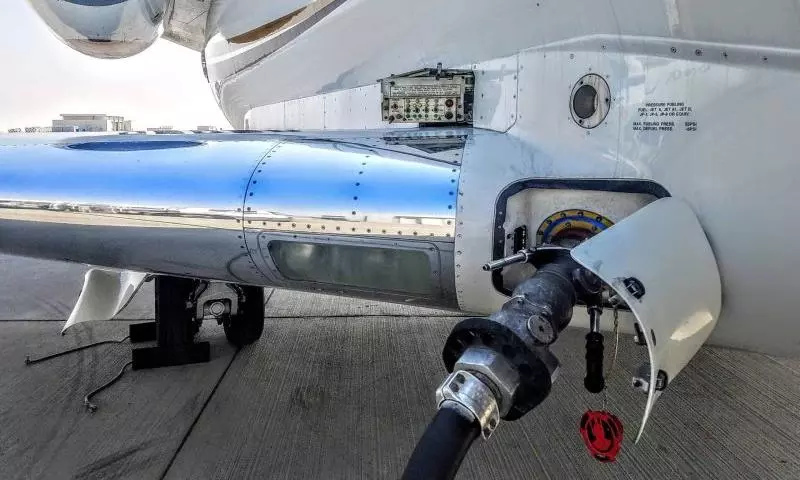
In a major impact of the West Asia war, aviation turbine fuel (ATF, jet fuel) prices more than doubled to a record Rs 2.07 lakh per kilolitre on Wednesday (April 1). However, domestic airlines—and fliers—got a breather as state-owned oil companies passed on only a fraction of the hike to airlines.
According to state-owned oil firms, ATF price was increased only by 8.5 per cent to Rs 104,927.18 per kl for domestic airlines. This was the rate in Delhi on Wednesday, a rise by Rs 8,289.04 per kilolitre (8.56 per cent) from Rs 96,638.14 per kl last month.
If that sounds steep, domestic airlines will be paying only half of what foreign airlines, as well as other carriers such as non-scheduled, ad-hoc, and charter airlines, would pay. For them, the prices have gone up by Rs 110,703.08 per kl, or 114.5 per cent, to Rs 207,341.22 per kl.
Also read: Commercial LPG prices hiked by Rs 195.5
Alongside, the rate of commercial LPG—the other petroleum product besides ATF whose pricing is deregulated—was increased by Rs 195.50 per 19-kg cylinder.
The price of select premium or branded petrol and diesel, which make up for 2 to 5 per cent of all auto fuels sold in the country, also went up by Rs 1.50 a litre to Rs 92.99 for “Extra Green” diesel and by Rs 11 to Rs 160 a litre for 100 octane petrol (XP100).
Prices of normal or unbranded petrol and diesel remain unchanged, and so do the rates of domestic cooking LPG.
Calibrated approach to help shield passengers
Civil Aviation Minister Rammohan Naidu termed the partial and staggered increase in ATF price for domestic airlines as “pragmatic and forward-looking, while ensuring that foreign routes bear the full market-aligned price”.
“This calibrated approach will help shield passengers from sharp fare increases, ease the burden on domestic airlines, and support the continued stability of the aviation sector at this crucial juncture. It will also benefit the broader economy by ensuring the smooth movement of cargo and maintaining vital air connectivity for trade and logistics,” he added.
Explaining the rationale for the jet fuel price hike, the Ministry of Petroleum and Natural Gas, in a post on X, said ATF prices in India were deregulated in 2001 and are revised on a monthly basis based on a formula of international benchmarks.
“Due to the closure of Strait of Hormuz and extraordinary situation in global energy markets, the price of ATF for domestic markets was expected to increase by more than 100 per cent on April 1,” it said.
Also read: LPG crisis, polls, SIR trigger exodus of migrant workers from cities
“In order to insulate the domestic travel costs from the substantial increase in international prices, PSU Oil Marketing Companies of the Ministry of Petroleum, in consultation with the Ministry of Civil Aviation, have passed only a partial and staggered increase of 25 per cent (only Rs 15 per litre) to the airlines. Foreign routes will pay for the full increase in ATF prices consistent with what they pay in other parts of the world.”
ATF price crosses Rs 2 lakh per kl mark for first time
The increase for domestic airlines came to only 8.56 per cent or Rs 8.3 per litre (Rs 8,289.04 per kl, or about Rs 8.3 per litre). While the ministry did not elaborate on its calculations, the quantum indicated—25 per cent or Rs 15 per litre—may be the total increase that the oil companies may have decided to pass on to domestic airlines over a certain period of time.
This is the first time ever that ATF price has crossed the Rs 2 lakh per kl mark. The previous peak was in 2022 when rates were hiked to Rs 1.1 lakh per kl as oil prices surged after Russia invaded Ukraine.
Wednesday’s hike is the second straight monthly increase in rates. Prices on March 1 were hiked by 5.7 per cent (Rs 5,244.75 per kl).
Also read: Commercial LPG supply restored to 70 per cent, says Centre, amid West Asia conflict
The rising prices will further strain airlines, which are already burning more fuel in taking longer routes for flying to Western destinations because of airspace closures due to the West Asia war. Fuel makes up for around 40 per cent of an airline’s operating cost.
Petrol, diesel prices remain unchanged
State-owned Indian Oil Corporation, Bharat Petroleum, and Hindustan Petroleum revise ATF and LPG prices on the first day of every month based on international benchmarks and the exchange rate.
Petrol and diesel prices continue to remain frozen after a Rs 2 per-litre reduction in March last year; petrol currently costs Rs 94.72 per litre in Delhi and diesel Rs 87.62.
On LPG prices, the ministry said that prices of commercial LPG cylinders, used by industries and hotels, are deregulated, market-determined and revised normally on a monthly basis. Their consumption is less than 10 per cent of the total LPG consumed in the country.
“April 1 price increase in commercial cylinder price is due to a 44 per cent surge in the Saudi Contract Price: from USD 542 per tonne in March to USD 780 per tonne for April, as 20-30 per cent of global LPG supplies are stuck in Strait of Hormuz (due to the war in Middle East),” it said.
Also read: India has 60 days of oil reserves, govt assures no fuel shortage
With today’s hike, a 19-kg commercial LPG now costs Rs 2,078.50 in Delhi. Rates were last increased by Rs 114.5 per 19-kg cylinder on March 1.
Domestic LPG rates, which were last hiked by Rs 60 per 14.2-kg cylinder on March 7, remain unchanged. It costs Rs 913 per 14.2-kg cylinder in Delhi.
Among lowest in the world
India’s domestic LPG price remains one of the lowest in the world as compared to Pakistan (Rs 1,046), Sri Lanka (Rs 1,242), and Nepal (Rs 1,208), the ministry added.
“Cumulative losses by end-May will reach approximately Rs 40,484 crore. Last year also, out of total losses of Rs 60,000 crore, Rs 30,000 crore were absorbed by oil PSUs and Rs 30,000 crore by Government of India, in order to insulate the Indian citizens from high international LPG prices,” it said.
Oil marketing companies are incurring under-recovery of Rs 380 per cylinder in keeping domestic LPG rates unchanged, it said. “With global petroleum prices up by up to 100 per cent in the last 1 month, PSU OMCs are incurring under-recoveries of Rs 24.40 per litre on petrol and Rs 104.99 a litre on diesel at RSP level as on 01.04.2026,” it said.
Also read: After the Strait of Hormuz, the world's next chokepoint could be Gate of Tears
“The recent Rs 2/litre revision applies only to premium petrol variants—XP95, Power95, Speed—high-octane performance products, whose prices are revised on fortnightly basis and whose sales by volume are 2 per cent and 5 per cent of total volume. They are purchased by motorists, at a premium, by choice.” Petrol and diesel prices remain unchanged in India even as prices all over the world have risen by 30 to 50 per cent, it added.
(With agency inputs)