US remarks on India Russian oil
US warning on India trade and Russian oil imports sparks debate | AI With Sanket
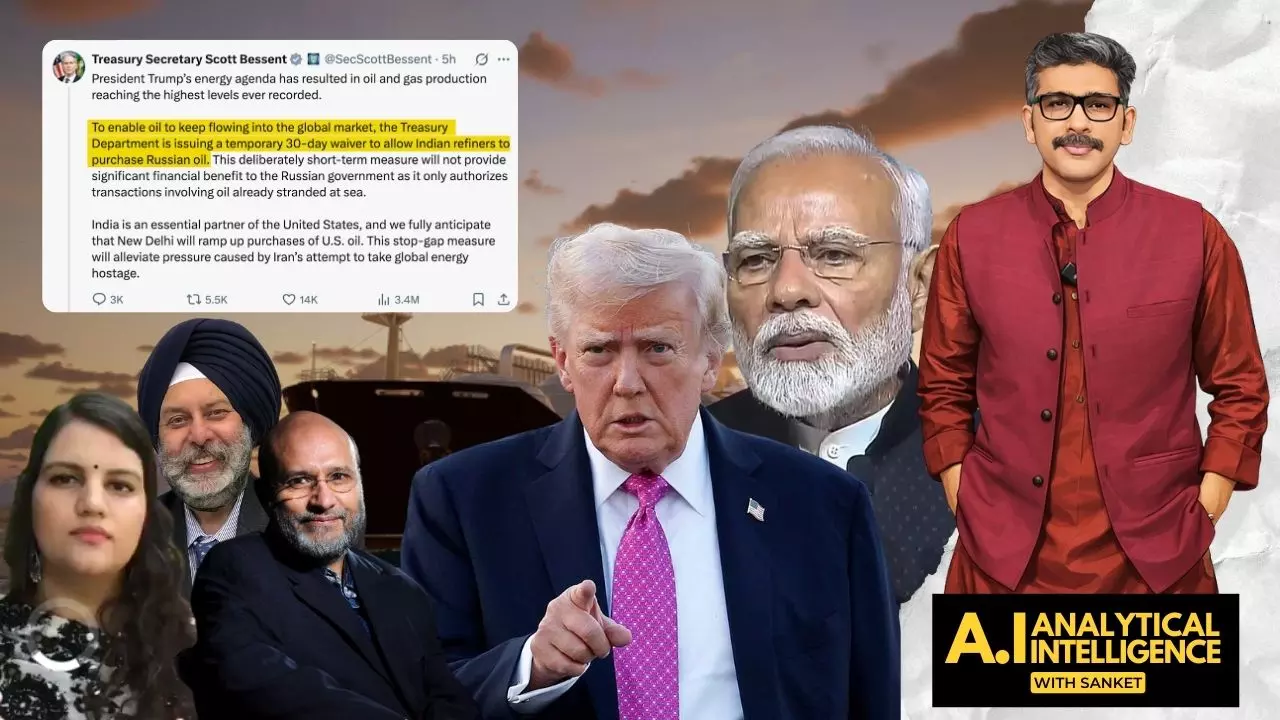
Experts debate after the US says India can buy Russian oil only 'temporarily' and warns it will not repeat the 'China mistake' that could allow India to rival America commercially

“Partnership is not permission. Who are you to give permission to India to buy oil?”
That was the sharp sentiment echoed during an intense discussion on US-India relations after Washington 'authorised' India to buy Russian oil temporarily as a measure to thwart Iran's alleged attempt to take the global energy hostage during the ongoing conflict in the Middle East. The US also said that it expected India to "ramp up purchasing" its oil.
Also read: Iran war: India evokes ESMA, ramps up LPG production
The reactions came amid broader criticism of Washington’s posture toward New Delhi, including the words uttered by a senior American official at the ongoing Raisina Dialogue in New Delhi and the rising global tensions around the Iran war, which also included the sinking of an Iranian war vessel by US submarines in India's neighbourhood.
In this episode of AI With Sanket, this writer spoke with former ambassador Manjeev Puri, economist Santosh Mehrotra, and political analyst Akriti Bhatia in a panel discussion about whether the US's recent statements and actions reflect strategic diplomacy, hegemonic pressure, or a complex balancing act vis-a-vis India.
The speakers also tried to understand whether Washington’s tone signals a deeper imbalance in the relationship and what options India has as it navigates economic growth, energy security, and geopolitical partnerships.
'US a hegemonic power'
Puri argued that the American behaviour should not surprise India since Washington has historically functioned as a hegemonic power.
“The United States is a hegemonic power,” he said, adding that hegemonic systems rarely treat partners as equals.
Also read: What is Blue Sparrow, the missile that came from 'space' to kill Khamenei?
“They see allies as those who do their bidding. They don’t really look at partners in the sense of equal partners,” he noted.
According to the veteran diplomat, India’s own strategic choice to lean closer to Washington inevitably exposes it to this dynamic. If a country chooses that route, he said, it must also expect the power imbalance that comes with it.
Puri added that the US's political environment also shapes its messaging and decisions, particularly when it comes to issues such as Russia and energy.
“Russia is a bipartisan issue in the United States, other than Donald Trump. Everybody thinks it is a big problem for the world,” he said.
Domestic calculations
Puri also pointed out that American domestic politics often influence its diplomatic communication.
He suggested that the US relies heavily on written records and official statements, which sometimes expose details that other countries might prefer to handle privately.
“In India, we have become a WhatsApp society,” he said. “But the US system works through texts and emails. The written word is extremely important.”
Also read: Middle East conflict could weaken rupee, raise inflation: Moody’s
This difference in communication style means that discussions that might once have remained behind closed doors are now appearing in official documentation.
The former ambassador stressed that these developments are part of the larger political process within the US itself.
“They are also battling at their own end domestically,” he said, referring to internal debates in Washington over foreign policy decisions.
'Bullying' concerns
Mehrotra was far more critical of Washington’s approach, describing the current US administration’s posture as “bullying”.
“The point is we have dealt with hegemony before,” Mehrotra said. “But this administration is bullying.”
He argued that India should respond with greater clarity and strategic patience, particularly in ongoing trade negotiations with the US.
According to the economist, New Delhi may have moved too quickly in agreeing to interim arrangements that appear to favour the White House.
Also read: Between fear and hope: Living through the Gulf crisis as tensions reshape daily life
“The interim agreement shows it is a one-sided deal,” he said, pointing to commitments that involve large financial obligations and tariff disparities.
He suggested India should prolong negotiations rather than rushing into agreements.
“We should string this out,” he said, adding that upcoming electoral cycles in the US could shift the balance of leverage.
The US will hold its midterm elections in November this year.
Energy pressure
Mehrotra also raised concerns about India’s energy imports, arguing that the country had already begun reducing Russian oil purchases due to external pressure.
“We were importing around one million metric tonnes. Now it is down to about 0.8 million,” he said.
While some of this decline could be attributed to private refinery decisions, Mehrotra questioned why public sector refineries appeared to follow the same trend.
He also warned that Washington’s actions demonstrate a willingness to reverse commitments.
He cited recent tensions involving Iran as an example of unpredictable US policy behaviour.
“Negotiations were going on with Iran, and then they attacked,” he said, arguing that such developments make long-term assurances uncertain.
Strategic balancing
Bhatia framed the issue in broader national security terms.
She argued that US pressure should not be seen only as an economic issue but as one affecting several aspects of India’s strategic autonomy.
Also read: As Iran war reaches India’s doorstep, should New Delhi respond to warship attack?
“National security is not just border security,” she said. “Energy security and economic security are also sovereign decisions.”
Bhatia suggested that Washington’s tone reflects a broader pattern of pressure on India regarding energy imports, defence partnerships, and geopolitical alignments.
“This kind of blatant bullying is quite outright,” she said.
She also warned that shifting diplomatic positions in West Asia could make India more vulnerable in the region.
India’s relationships with nations such as Iran and Palestine, she said, have historically been important components of its foreign policy balance.
Technology factor
Despite the criticism, Puri emphasised that the government’s strategic tilt toward the US is driven by economic considerations.
India’s rapid economic growth, he argued, requires access to advanced technology and global capital.
“For us to truly grow and build our capacities, you can’t do it without technology and money,” he said.
According to Puri, the US remains a crucial source for both.
He pointed to investments and partnerships involving major technology firms as evidence of the benefits India expects from deeper engagement with Washington.
“Look at the announcements during the AI summit — Amazon, Google, OpenAI,” he said, noting the scale of technological collaboration.
China factor
Another major driver of the US-India partnership is China.
Puri explained that many strategic thinkers in India believe closer ties with Washington are necessary to counter Beijing’s influence.
“There is a feeling in many circles in India that to stand up to China you need the US on your side,” he said.
However, this strategic logic creates its own dilemmas, particularly when Washington’s policies conflict with India’s independent interests.
Puri acknowledged that some experts still advocate maintaining greater strategic autonomy.
“We are a large country,” he said. “We should learn to stand on our own feet, no matter how long it takes.”
But others believe deeper partnerships are essential for economic and security reasons.
Political decisions
Ultimately, Puri stressed that these choices are not made by diplomats but by political leadership.
“This is not about diplomacy,” he said. “It is about foreign policy decisions taken at the highest level of government.”
The government, he explained, appears convinced that closer alignment with the US will benefit India both in the short and long term.
However, he also indicated that some form of response to Washington’s statements would likely emerge.
“There will be some kind of response,” he said. “But it will probably be a polite response.”
That approach reflects a broader strategy of maintaining partnership while avoiding open confrontation.
Pride and partnership
The discussion ultimately returned to the central controversy — the suggestion that India had been given “permission” to buy Russian oil.
For critics, that language symbolises an imbalance in the relationship.
The debate, which culminated in this author reaching the conclusion that partnership is not permission, highlighted a broader question facing India as it rises economically: how to maintain strategic autonomy while deepening partnerships with global powers.
As the panellists suggested, balancing those competing priorities will likely remain one of the country’s most complex diplomatic challenges.
The content above has been transcribed from video using a fine-tuned AI model. To ensure accuracy, quality, and editorial integrity, we employ a Human-In-The-Loop (HITL) process. While AI assists in creating the initial draft, our experienced editorial team carefully reviews, edits, and refines the content before publication. At The Federal, we combine the efficiency of AI with the expertise of human editors to deliver reliable and insightful journalism.