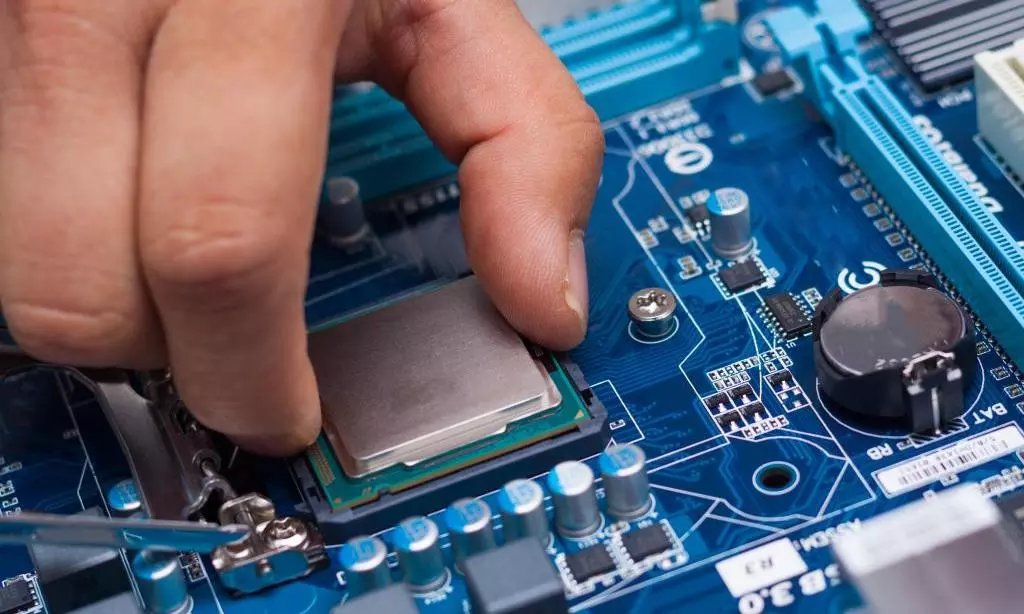
India’s uphill chip drive targets legacy tech and supply chain gaps
As global players eye resilient supply chains, India pushes mature-node fabs and packaging units, but faces steep hurdles in tech, infrastructure and execution

India is making a late but increasingly aggressive push to enter the global semiconductor manufacturing race. It's positioning itself as a “China+1” alternative as geopolitical tensions and the US–China technology split reshape global supply chains.
At the centre of the strategy is a Rs 76,000-crore semiconductor incentive programme that offers to fund up to 50 per cent of project costs, alongside a cluster of announced fabrication and packaging projects led by Tata Electronics and global partners.
The flagship proposal is Tata Electronics’ planned 28-nanometre logic fab at Dholera, Gujarat, being developed with Taiwan’s Powerchip Semiconductor Manufacturing Corp (PSMC). The project is intended to anchor a broader ecosystem that includes assembly, testing and packaging facilities—often referred to as OSAT or ATMP—such as Micron Technology’s facility in Sanand and packaging ventures involving Tata-PSMC and CG Power with Japan’s Renesas.
'The moment may lie in legacy chips'
Together, these projects mark India’s most serious attempt yet to move beyond chip design and electronics assembly into semiconductor manufacturing itself. Policymakers argue that India’s large and fast-growing electronics market, combined with geopolitical supply-chain diversification, gives the country a narrow window to attract investment that might otherwise flow to Taiwan, South Korea, the United States or China.
Also Read: Gold’s glittering 2025 run sets the stage for more gains in 2026
Analysts, however, caution that India’s ambitions must be viewed in context. Stephen Ezell, thevice president for global innovation policy at the Washington-based Information Technology & Innovation Foundation (ITIF), has argued that India’s opportunity lies first in mature technologies rather than cutting-edge manufacturing.
In a February 2024 readiness assessment, Ezell wrote that “India has the potential to play a much more significant role in global semiconductor value chains, provided the government upholds its investment policies, maintains a conducive regulatory and business environment, and avoids measures that create unpredictability.”
Scale over sophistication
Ezell’s report adds that India’s most realistic near-term gains are likely to be in back-end manufacturing and older process nodes. “In the next five years, India has the potential to expand its presence in the semiconductor assembly, test, and packaging (ATP) segment to as many as five facilities and to attract fabs producing legacy semiconductors at 28 nm or above,” the assessment states.
That assessment broadly mirrors the profile of India’s announced projects. While advanced logic manufacturing at nodes below 14 nm remains dominated by a handful of firms—most notably Taiwan Semiconductor Manufacturing Company—India’s plans focus on mature-node logic and back-end manufacturing, which are critical for supply-chain resilience but account for a smaller share of industry value.
Also Read: Gold, silver prices hit new highs on weak dollar, Fed rate cut hopes
A November 2025 research paper by Nishith Desai Associates underscores both the scale of the opportunity and the constraints India faces. The paper notes that “the global semiconductor market is expected to reach $1 trillion by 2030, with India’s market projected to reach $100–110 billion.”
Chip fabs strain resources
At the same time, it highlights the formidable barriers to entry. Semiconductor fabrication, the paper notes, requires “massive investments in highly complex, multi-step processes that occur in ultra-clean environments, requiring billions of dollars in capital for specialised equipment, advanced machinery, and the construction of massive facilities.”
Those demands create practical constraints that go beyond capital. Fabrication plants are among the most water and power-intensive industrial facilities in the world, raising questions about sustainability in drought-prone regions in India. They also depend on uninterrupted electricity, ultra-pure water, specialised gases and imported manufacturing tools—many of which are controlled by a small group of global suppliers.
Also Read: India-New Zealand free trade agreement: Here are the highlights
India’s dependence on foreign technology remains acute, particularly for advanced lithography equipment and process know-how. While officials have spoken publicly about ambitions to move toward more advanced nodes over time, analysts say access to sub-14-nm manufacturing remains constrained by technology controls, intellectual property regimes and the sheer complexity of scaling cutting-edge fabs.
Partial wins in value chain
The Nishith Desai paper also emphasises that semiconductor manufacturing is not a single activity but part of a deeply interdependent global value chain. No country, it argues, can realistically be self-reliant across all stages, especially for advanced nodes, making partnerships and policy stability critical.
From a strategic standpoint, proponents argue that even partial success can deliver long-term benefits. Writing for Carnegie India in August 2025, Konark Bhandari argued that domestic manufacturing capability can generate important spillovers for the wider economy. “A robust manufacturing base ensures that the knowledge gained from ‘learning by doing’ is transferred to domestic firms as well,” he wrote.
Also Read: Indian-origin Amazon veteran Anand Varadarajan named Starbucks CTO
That logic underpins New Delhi’s emphasis on OSAT and mature-node fabrication as stepping stones rather than end goals. India already accounts for a significant share of the global semiconductor design workforce, and policymakers see manufacturing as a way to connect design talent with production experience over time.
Still, investors and analysts stress that execution will matter more than announcements. Semiconductor firms are highly sensitive to regulatory uncertainty, infrastructure reliability and policy reversals. As Ezell’s assessment notes, multinational manufacturers prioritise stability and predictability when committing billions of dollars to long-lived assets.