



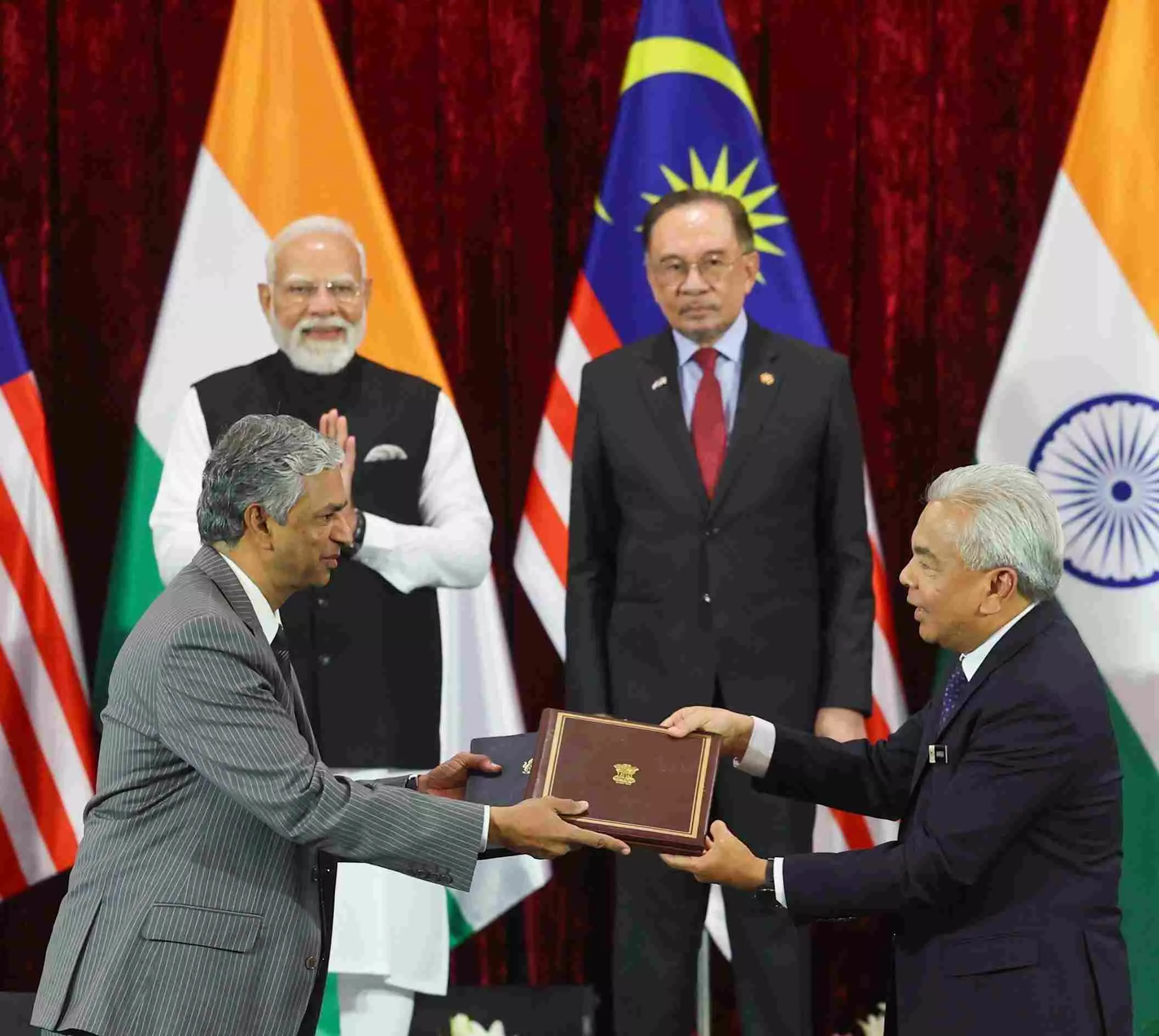
Prime Minister Narendra Modi stands with Malaysian Prime Minister Anwar Ibrahim during the exchange of MoUs, in Kuala Lumpur, Malaysia. Photo: PMO via PTI
India, Malaysia deepen economic ties with focus on semiconductors, energy, digital sector
Joint statement during Modi’s Malaysia visit outlines cooperation on trade facilitation, semiconductors, renewable energy and digital payments

India and Malaysia on Sunday (February 9) reaffirmed their commitment to deepening a wide-ranging Comprehensive Strategic Partnership, as Prime Minister Narendra Modi concluded a two-day official visit to Malaysia at the invitation of Malaysian Prime Minister Anwar Ibrahim.
In a joint statement issued at the end of the visit, the two sides said the engagement reflected the “deep-rooted friendship and enduring people-to-people ties” between the countries, grounded in civilisational links and shared democratic values. The leaders reiterated their resolve to further consolidate the Comprehensive Strategic Partnership, which was formally established in August 2024.
The discussions, described as “extensive and productive” and held in a “warm and cordial atmosphere”, covered political engagement, defence and security cooperation, maritime collaboration, trade and investment, digital economy, science and technology, energy, agriculture, health, education, culture, tourism and regional and global issues of mutual interest.
Several bilateral documents were also exchanged to strengthen institutional cooperation.
Political cooperation
On political cooperation, both sides agreed that regular high-level dialogue and exchanges have strengthened coordination on bilateral and multilateral issues. Platforms such as the Foreign Office Consultations and Joint Commission Meetings were identified as key mechanisms underpinning ties.
Also read: India seen as trusted trade partner: PM Modi in Malaysia after US, EU deals
The leaders also encouraged closer parliamentary cooperation, taking note of recent exchanges involving parliamentary delegations from both countries. On trade and investment, the joint statement noted Malaysia’s recognition of India as a “vital global economic partner” and welcomed the growth in bilateral trade.
Trade facilitation
The two prime ministers agreed to enhance trade facilitation and explore new opportunities in areas such as semiconductors, the digital economy and industrial collaboration.
The leaders emphasised the importance of the Malaysia-India Comprehensive Economic Cooperation Agreement (MICECA) and the ASEAN-India Trade in Goods Agreement (AITIGA). They welcomed the ongoing review of AITIGA to make it “mutually beneficial, trade facilitative and relevant to current global trading practices”, while encouraging greater utilisation of MICECA.
Both sides welcomed growing bilateral investments and identified priority sectors including infrastructure, energy — including renewable energy — advanced manufacturing, semiconductors, healthcare, fintech, startups, artificial intelligence, hospitality and green technologies.
Prime Minister Modi highlighted India’s position as a key investment destination for Malaysian companies, while Prime Minister Anwar welcomed the role of Indian firms in generating high-skilled jobs in Malaysia.
Also read: PM Modi begins 2-day Malaysia visit to boost strategic and defence ties
The leaders also welcomed the 10th meeting of the India-Malaysia CEO Forum held in Kuala Lumpur on February 7 and expressed hope that it would continue to complement government-level efforts. They appreciated ongoing collaboration between the Reserve Bank of India and Bank Negara Malaysia to promote local currency settlement in bilateral trade, encouraging greater use of the Indian rupee and Malaysian ringgit.
Food security and agri-commodity cooperation featured prominently, with both sides agreeing to deepen collaboration to ensure stable and resilient supply chains. Malaysia reiterated its commitment to remain a reliable supplier of sustainable palm oil, while both countries agreed to work together on value-chain development and timely resolution of market-access issues.
In the digital domain
In the digital domain, the leaders welcomed the formalisation of the Malaysia–India Digital Council, calling it a key platform to advance cooperation in fintech, e-governance, cybersecurity, artificial intelligence and digital public infrastructure. They also welcomed collaboration between NPCI International and PayNet Malaysia to establish bilateral payment linkages, which they said would provide “seamless, low-cost” payment solutions for tourists, students and small businesses.
Semiconductors and energy
Energy and semiconductors emerged as strategic areas of cooperation.
The leaders noted the role of PETRONAS and Gentari in India’s renewable energy and green hydrogen sectors and highlighted opportunities for collaboration in large-scale solar energy projects. They also underscored the importance of strengthening the semiconductor value chain, citing ongoing cooperation between academic and industry bodies in both countries.
Defence and security
On defence and security, the leaders expressed satisfaction with the growing scope of cooperation, including regular exercises, training and defence industry collaboration. They welcomed progress under the Malaysia-India Defence Cooperation Committee and reaffirmed cooperation within the ASEAN Defence Ministers’ Meeting Plus framework.
Both sides “unequivocally and strongly condemned terrorism in all its forms”, calling for zero tolerance and enhanced international cooperation, including through the UN and FATF.
The joint statement also highlighted cooperation in education, skill development, healthcare, traditional medicine, culture, tourism and sustainable development, including biodiversity conservation and disaster management. Both leaders reaffirmed support for stronger multi-lateral cooperation, reforms of international institutions and a free, open and rules-based Indo-Pacific.