IndiGo crisis: When competition watchdog stops barking, it spells trouble
CCI is legally empowered to prevent private monopolies or market concentration from emerging, yet did little to rein in IndiGo; last of 2-part series

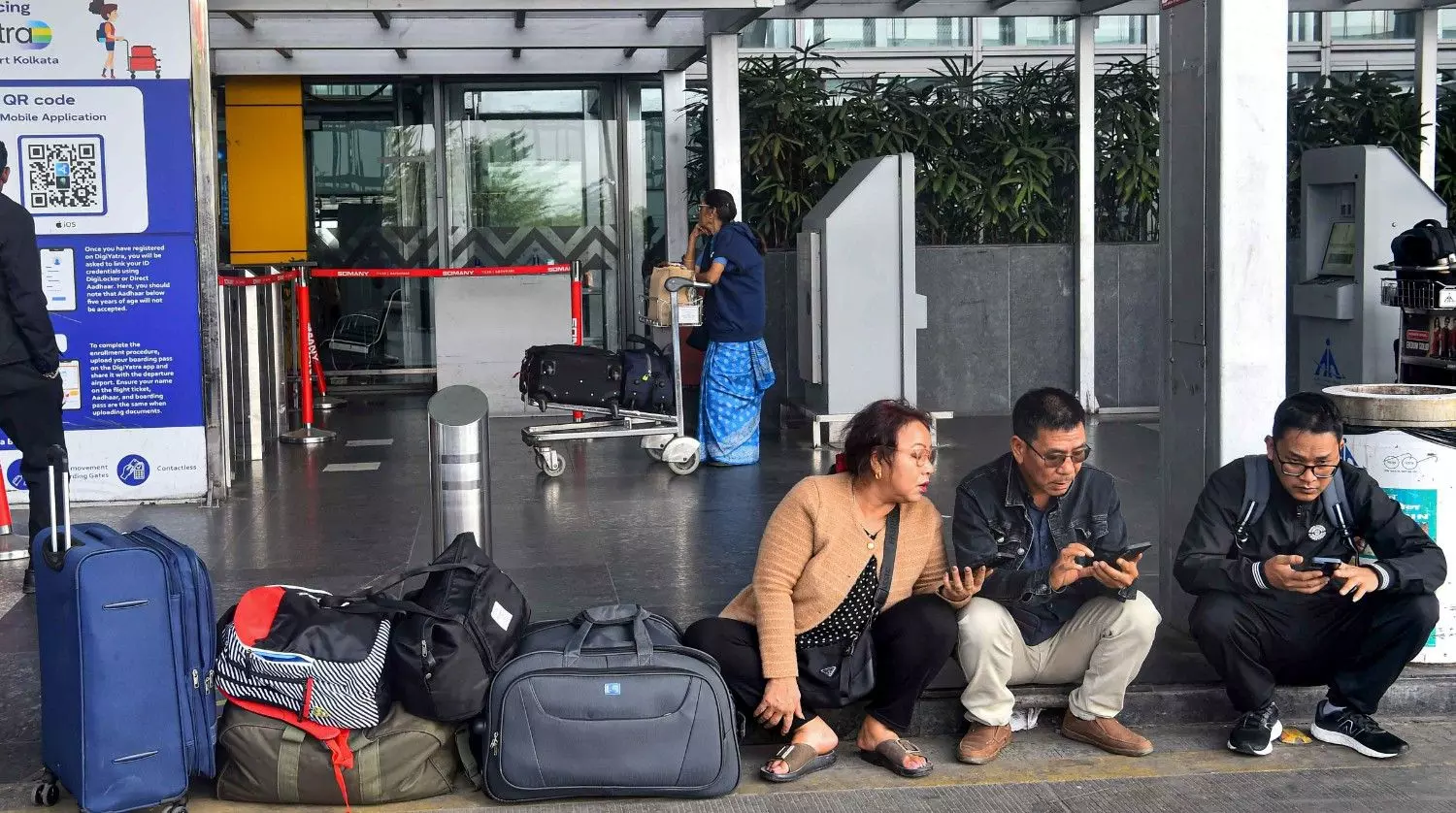
Passengers look at their mobile phones as they wait amid IndiGo flight disruptions, at Netaji Subhash Chandra Bose International Airport in Kolkata, Saturday, December 6. PTI
Part I had looked at the failures of civil aviation regulator DGCA; Part II examines how the CCI has failed to check growing market concentration, potentially allowing far bigger risks to the economy.
In the wake of the IndiGo fiasco, it is possible to argue that no one was preventing any other airline from entering the market and competing. Akasa Air, launched in 2022, is a good example. But that is no excuse for the Competition Commission of India (CCI) to stop barking as two airlines, the IndiGo and Air India group, raised their market share to 91.2 per cent in domestic air passengers in 2025.
Part 1: IndiGo’s extreme market muscle makes it too big to fail or regulate
As a watchdog, the CCI is sufficiently empowered under the Competition Act of 2002 to prevent private monopolies or market concentration from emerging on its own (suo motu power).
The very first paragraph of the Competition Act of 2002 says about the “duties, powers and functions” of the CCI. It reads: “…it shall be the duty of the Commission to eliminate practices having adverse effect on competition, promote and sustain competition, protect the interests of consumers and ensure freedom of trade carried on by other participants, in markets in India”.
Also read: IndiGo crisis: Could the chaos have been prevented? | Ex-AirAsia CFO explains
A Ministry of Corporate Affairs’ review of the Competition Law of 2002, released in 2019, said the law envisaged the CCI to act as “a market regulator for preventing and regulating anticompetitive practices in the country and to carry on the advisory and advocacy functions in its role as a regulator”.
Indeed, the Competition Act of 2002 empowers the CCI (i) to initiate “own its own” (or “suo motu”) inquiry into “anti-competitive agreements” (Sections 3, 19 and 26), “abuse of dominant position” (Section 4) and also (ii) make references – that is, call out monopoly or its abuse through “advisory and advocacy” – to the government (section 21A).
CCI: Tough on foreign firms’ abuse of dominant position
The CCI does all of these and is no pushover when it comes to big foreign firms. Some instances for illustration:
(a) On November 18, 2024, it fined Meta with Rs 213.14 crore for “abusing its dominant position” – in the case relating to WhatsApp's 2021 privacy policy which allowed it to collect user data and share with other Meta companies.
(b) On October 20, 2022, it fined Google with Rs 1,337.76 crore “for abusing its dominant position” in multiple markets in the Android mobile device ecosystem, issued cease and desist order and directed to modify its conduct within a defined timeline.
Also read: IndiGo flight cancellations ‘credit negative’, says Moody’s; slams planning lapses
(c) Amazon has been in the CCI’s crosshairs since 2020 for abusing its dominant position. In 2021, the CCI imposed a penalty of Rs 202 crore on it for allegedly not disclosing some details about its deal with the Future Group in 2019 and put the deal on hold.
CCI: Free pass to domestic market concentration
But when it comes to domestic giants, it develops cold feet.
Over the past decade, it has routinely allowed big domestic private monopolies to flourish by greenlighting mergers, acquisitions and government contracts for airports, ports, mining, thermal plants, renewable energy, real estate, cement, steel etc. unquestioned.
These are too well known to warrant a listing.
Here is one instance of how absurd the CCI can get when it deals with the so-called “national champions”.
In June 2017, it dismissed Airtel’s complaint against Reliance Jio’s predatory pricing – free call and data for 200 days and then dirt-cheap rates for several years to capture the market and eliminate competitors. The CCI argued that Jio wasn’t “a dominant enterprise” in 2016 (when it was launched).
Also read: IndiGo refunds touch Rs 827 crore
Well, Jio is now the dominant player and the once vibrant telecom sector is a duopoly (Jio and Airtel), like the airlines.
Telecom regulator TRAI’s data of December 3, 2025, shows Jio’s mobile subscriber base grew to 41.2 per cent and that of Airtel was 33.5 per cent of the total by the end of September 2025 – taking the total to 75 per cent.
That isn’t always the case though.
For example, in 2011, it found the real estate major DLF guilty of anti-competitive practices and fined Rs 630 crore. In 2021, it found more such abuse and pronounced the DLF guilty again, although it didn’t impose fresh fines because of the earlier Rs 630 crore penalty.
In 2013, it imposed a penalty of Rs 1,773.05 crore on Coal India for abusing its dominant position.
But it hasn’t acted against any of the “national champions” former RBI Governor Viral Acharya had listed for “dismantling” in his 2023 paper (mentioned in Part I).
What if a private player with extreme market concentration decides to do an IndiGo act for whatever reason? The impact of a partial or full shutdown of telecom, airports, ports, energy etc. for a week would be far more devastating than that of the airline.
Competition law review finds flaws with CCI
In 2002, the Monopolies and Restrictive Trade Practices Act (MRTP) of 1969 was replaced with the Competition Act in view of the changes the 1991 liberalisation (in industry, trade and capital market) had brought. The Ministry of Corporate Affairs (MCA) constituted a committee to review the functioning of this law, the report of which was submitted in 2019.
The review concluded that “the CCI continues to operate mostly in an adversarial adjudication mode with a limited proactive role in the form of suo motu proceedings and reference functions” due to some legacy issues with the law.
Among others, it recommended:
• Amending the law to provide for a governing body to strengthen the CCI’s accountability.
• CCI must deal with alleged anticompetitive conduct “on the basis of its own surveillance”, “must independently review all information on merits without requiring the Informant’s presence”, “must be the regulator for competition matters for markets in India”.
• A ‘green channel’ for automatic approval of the CCI for merger and acquisition.
• The engagement between the CCI and sectoral regulators “must be more structured, meaningful and effective” and it “must build capacity in the ecosystem for competition assessment of state interventions”.
Many of these were incorporated too in the Competition (Amendment) Act of 2023, including ‘green channel’ approval for up to Rs 2,000 crore for mergers and acquisitions.
But there is no sign as yet of the CCI actually doing what the law envisaged – that is, “a market regulator for preventing and regulating anticompetitive practices in the country and to carry on the advisory and advocacy functions in its role as a regulator”.