IndiGo’s extreme market muscle makes it too big to fail or regulate
DGCA watched silently as IndiGo’s passenger share doubled from 32 pc in 2014 to 65 pc in 2025, failing in its duty to rein it in: Part 1 of a 2-part series

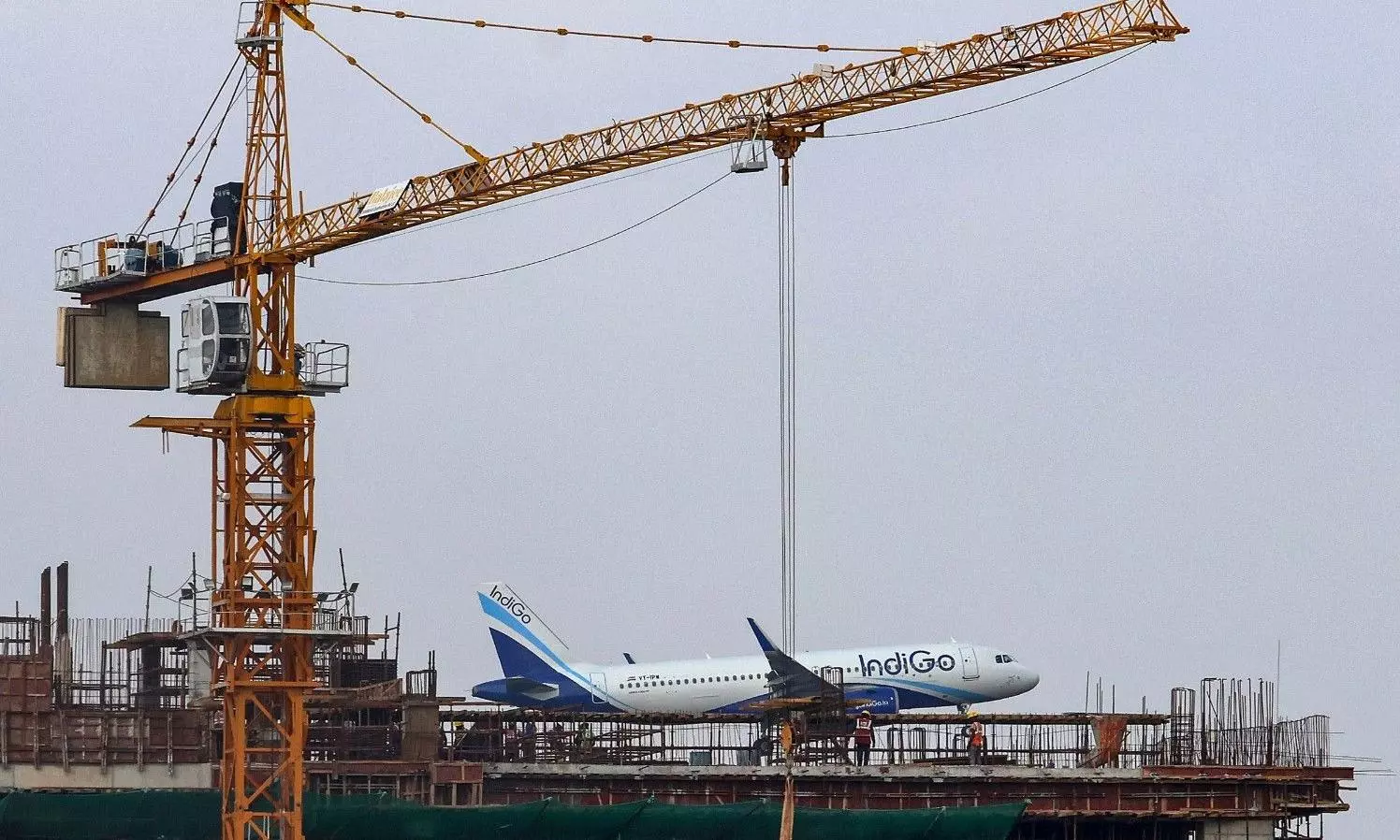
The massive disruptions in the air traffic caused by IndiGo for over a week could have been easily avoided had the extreme market concentration it enjoys now been checked in time. According to the Directorate General of Civil Aviation (DGCA), IndiGo flew 65 per cent of air passengers during January-September 2025, more than double of 32 per cent in 2014.
The second major player, Air India group (Vistara merged into it in November 2024 and its subsidiary Air India Express) flew another 26.8 per cent of air passengers during the same period (January-September 2025). The two together flew 91.2 per cent of total domestic air passengers in 2025.
Also read: How will DGCA’s 5 pc fleet-cut order to IndiGo impact fliers, flight sectors?
Aviation analysts now point out that IndiGo is the sole or unique airline on 60.4 per cent of the domestic routes – up from 22.3 per cent a decade ago – and in 21 per cent of other routes it has only one competitor.
Though the Aviation Ministry and DGCA are primarily responsible for the IndiGo fiasco, it also marks the failure of the other big regulator, the Competition Commission of India.
This extreme market concentration – which kills competition, fair play and makes an economy vulnerable to massive disruptions – is unheard of in the world of aviation.
No such monopoly in US or Europe
In sharp contrast to India, top airlines in the US and Europe have significantly less market shares.
In the US, the top three airlines Delta Air Lines, United Airlines and American Airlines together had a market share (domestic passenger traffic) of 62 per cent (21, 21 and 20 pc, respectively) in 2024. Another eight had market shares ranging from 2 to 13 per cent (Statista).
Also read: How IndiGo crisis exposes India’s fragile skies
In Europe, the top six airlines (in passengers enplaned) in 2024 had a combined share of 28.4 per cent – nowhere close to IndiGo’s in India. None had a double-digit market share; the top two were Ryanair (7.9 per cent) and Lufthansa (5.3 per cent).
The red flag should have gone up more than a decade ago, much before IndiGo’s market share zoomed to 32 per cent in 2014.
Many raised red flags in the recent past.
Warnings ignored
In August, a Parliamentary standing committee specifically directed the DGCA to “rigorously monitor and enforce compliance with the updated FDTL (Flight Duty Time Limitation) regulations for all flight crews, ensuring that operators do not circumvent these vital safety measures”.
The FDTL – stipulating more weekly rest (minimum from 36 to 48 hours) and less night landings (maximum two against 4-5 earlier) for pilots – is at the heart of the current IndiGo-inflicted crisis.
Also read: Indigo pilot’s emotional apology wins hearts amid nationwide flight chaos
The panel also drew attention to system failings, flagging “critical” issues like “specific operational risks”, which it said, pointed to “a dangerous gap between de jure compliance and de facto safety reality” and “a long-standing and systemic inertia”.
There were others too.
In July 2024, the Herfindahl-Hirschman Index (HHI), a measure of market concentration, had marked market concentrations reaching new highs in 2024 in airlines and other sectors like telecom, cement, steel and tyres.
Rahul Gandhi's warning
In November 2024, Leader of Opposition in Lok Sabha Rahul Gandhi wrote in a national daily, warning against growing private monopolies. Titled “A new deal for Indian business”, it said a “new breed of monopolists” (“oligarchic groups”) was controlling governing institutions and regulators and, because of this, a large number of businesses had been decimated, making it difficult to generate jobs. He pleaded with the citizens to “choose freedom over fear”.
In March 2023, former Reserve Bank of India (RBI) Deputy Governor Viral Acharya had sought “dismantling (of) the largest conglomerates” in India – in the context of artificially created inflation then, thereby killing competition through rising market power in the retail, resources and telecom sectors.
Also read: Govt to curtail IndiGo’s winter schedule amid mass flight cancellations
He also pointed out that the tariff walls India erected after 2014 were shielding domestic market leaders (“national champions”) from foreign competition. He had warned: “Creating national champions, which is considered by many as the industrial policy of ‘new India’, appears to be feeding directly into keeping prices at a high level.”
The “national champions” is an unstated model evident in India after 2014, in which a select few businesses are not only given a free pass but also actively supported to grow and grab markets.
Too big a player
The IndiGo has not only grown too big to fail but also too big to regulate – as is evident in the manner the DGCA bent backwards and relaxed the FDTL norms, despite the airline defying its orders for nearly two years (other airlines didn’t see such disruptions).
In November 2024, Rahul Gandhi said a “new breed of monopolists” was controlling governing institutions and regulators and, because of this, a large number of businesses had been decimated, making it difficult to generate jobs.
It went on to ask, on December 5, the DGCA for time till February 10, 2026, to stabilise its operations.
But February 10 is more than three months from the day it started grounding flights (December 2-3 ), nearly two years after the revised FDTL was issued in January 2024 and over four months after the deadline for the final implementation ended on November 1, 2025.
The DGCA had issued the last FDTL on January 8, 2024 – a revised one of the earlier one of April 2019.
With plenty of time in hand, the IndiGo went for mass flight cancellations from December 1 – one month after the deadline was over – when the DGCA sought enforcement of the FDTL.
No redress for passengers
Last Monday (December 8), the Supreme Court refused to intervene in the matter, stating that the Centre had taken appropriate steps. IndiGo faces no penalty yet.
The DGCA, however, showed no such leniency on Air India on which it had imposed a fine of Rs 80 lakh way back in March 2024 on the same FDTL issue!
Although the Civil Aviation Ministry and DGCA are primarily responsible for the IndiGo fiasco, it also marks the failure of the other big regulator, the Competition Commission of India (CCI), set up in 2003 under the Competition Act of 2002 to prevent private monopolies from emerging and abusing their dominant positions to the detriment of other enterprises and the economy as a whole.
The CCI has turned mute spectator as private monopolies zoomed across sectors – from airport to port, thermal power, renewable energy, cement, telecom, tyre, and mining sectors in the past decade.
Coming soon: Part II | When market watchdog stops barking, it spells trouble