




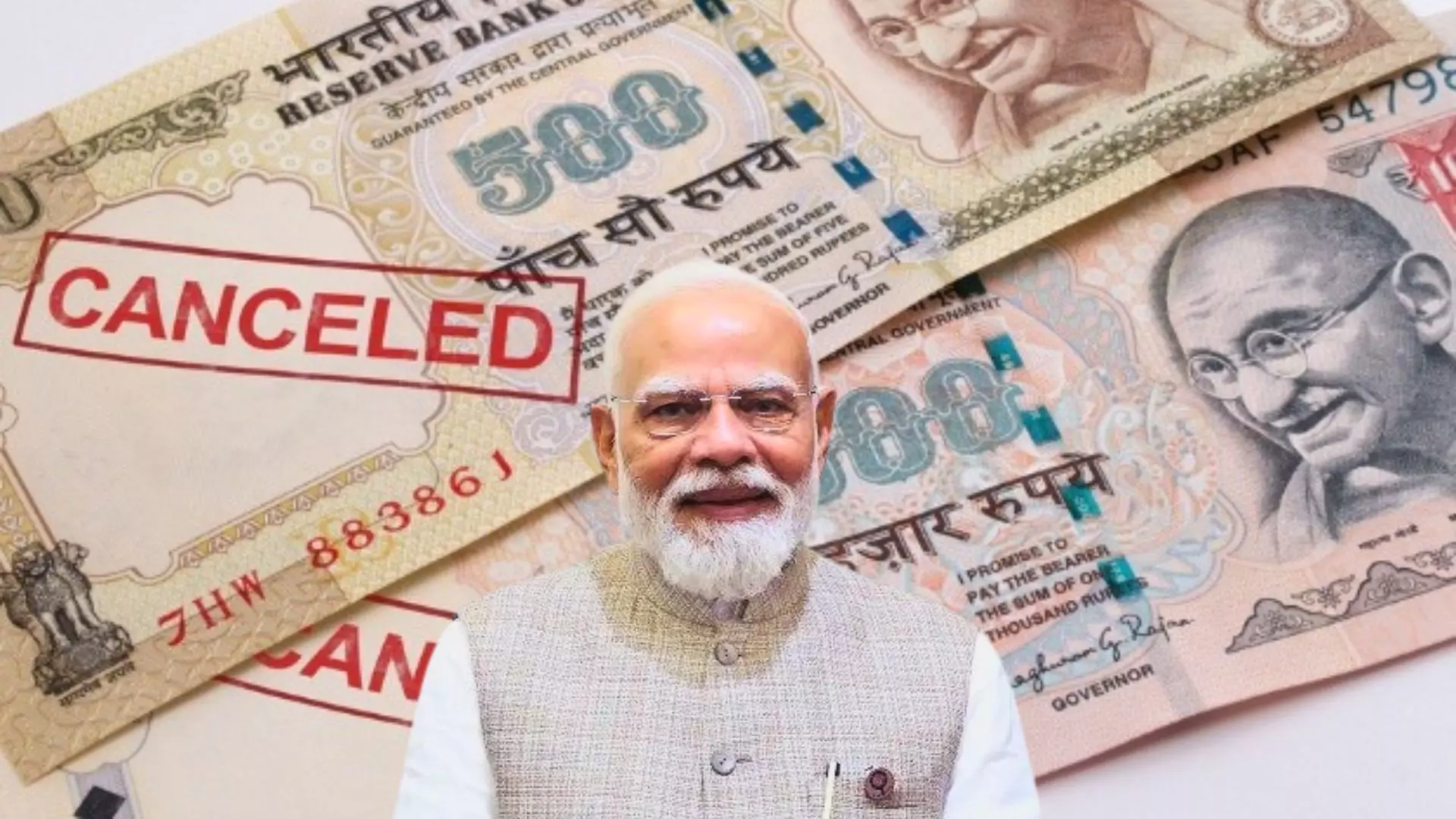
Five promises of demonetisation: 10 years later, what is the score?
Did India eliminate black money, counterfeit currency and terror financing, or accelerate digital payments? An evidence-based audit examines the five promises

On November 8, 2016, Prime Minister Narendra Modi announced one of the most consequential economic decisions in independent India’s history: The withdrawal of the legal tender status of old Rs-500 and Rs-1,000 currency notes. The move was presented as a major strike against black money, counterfeit currency, terrorist financing, and the informal economy. It also promised to expand the tax base and accelerate digital payments, making India a less-cash economy.
The government subsequently outlined five specific objectives for demonetisation. Ten years later, how much of that promise has translated into measurable results? An examination of available evidence across all five objectives offers a picture that is more complicated than either political claims or government advertisements suggest.
1. Elimination of black money
The biggest promise of demonetisation was to eliminate black money. The government’s expectation was that a significant amount of undeclared cash would become worthless because its holders would be unable to exchange or deposit it through the banking system.
However, according to the Reserve Bank of India’s (RBI) Annual Report for 2017–18, approximately Rs 15.31 lakh crore of the Rs 15.42 lakh crore in demonetised currency returned to the banking system. This represented approximately 99.3 per cent of the withdrawn currency.
Also read: Demonetisation to Yes Bank: RBI's top 10 controversies in Modi regime
In other words, only a very small proportion of the demonetised currency did not return to the banking system. The government had expected a much larger amount of undeclared cash to be extinguished, but that did not happen.
The return of currency, however, does not automatically establish that all the money was legitimate. Deposits could be examined, suspicious transactions investigated and tax evasion detected. But the central question remains: How much of previously undisclosed wealth was actually identified, taxed or destroyed because of demonetisation?
Black wealth is also not limited to cash. Real estate, gold, benami properties, and overseas assets are other avenues through which undisclosed wealth can be held. These forms of wealth were never dependent on cash alone.
The evidence, therefore, suggests that demonetisation did not eliminate black money. It brought almost all the withdrawn currency back into the banking system, creating opportunities for scrutiny. But bringing money into banks and eliminating black wealth are two very different outcomes.
2. Elimination of counterfeit currency
The second promise was to eliminate counterfeit Indian currency. By invalidating the old Rs-500 and Rs-1,000 notes, the government aimed to disrupt the circulation of fake currency and undermine the networks producing and distributing it.
But have counterfeit notes disappeared? The latest RBI figures cited in the audit show that 2,29,746 counterfeit notes were detected in the banking system in financial year 2025–26, compared with 2,17,396 in the previous financial year. This represents an increase of approximately 5.7 per cent.
More significantly, counterfeit Rs-500 notes increased by 20.5 per cent, reaching 1,41,907 detected notes.
Also read: UPI volume jumps 32 pc on Diwali to 916.9 million
These figures relate to counterfeit notes detected by banks and the RBI. They do not include counterfeit currency seized by the police and other enforcement agencies.
Demonetisation may have temporarily disrupted existing counterfeit currency networks by invalidating the old notes. However, counterfeit currency has not disappeared. The available evidence does not support the claim that the problem was permanently eliminated.
3. Eliminating terror financing
Perhaps the most important national security objective of demonetisation was to strike at the roots of terror financing. The government’s argument was that terrorist organisations relied on counterfeit currency, illegal cash and hawala networks to finance their activities.
In July 2017, the Ministry of Home Affairs reported that demonetisation had significantly affected several theatres of violence and disrupted hawala operators. This was the immediate impact reported by the government following the currency withdrawal.
However, an immediate disruption is not necessarily a permanent solution. In its 2024 mutual evaluation, the Financial Action Task Force (FATF) recognised India’s broader efforts to strengthen its anti-money-laundering and counter-terrorist-financing framework.
Also read: Will India become world’s largest economy by 2100? Jeffrey Sachs’ prediction explained
That assessment, however, examined India’s wider institutional and enforcement system. It did not establish that demonetisation itself had permanently dismantled terrorist financing networks.
Terror financing can operate through several channels, including illicit business proceeds, informal financial networks and cross-border funding. Eliminating one source of cash does not automatically eliminate all these channels.
Demonetisation may have temporarily disrupted some funding networks, as the government reported. But the available evidence does not establish that it permanently struck at the root of terrorist financing.
4. Economic formalisation
Another major objective was to formalise India’s economy, expand the tax base and support employment. The underlying argument was straightforward: When more money enters the banking system, transactions become more traceable and tax authorities gain greater visibility into economic activity.
However, depositing money in a bank is not the same as formalising an economy. Genuine formalisation involves more businesses becoming registered, more workers receiving social security, better employment conditions, higher productivity and sustained tax compliance.
Indeed, there has been progress in India’s tax system. According to the Economic Survey 2025–26, the share of direct taxes in total major tax collections increased from an average of 51.9 per cent in the pre-pandemic period to 58.8 per cent in financial year 2024–25.
But can this improvement be credited to demonetisation? Not conclusively. The Goods and Services Tax (GST), improvements in tax administration, economic growth, digital reporting and several other reforms have also contributed to the expansion of the tax base.
Also read: Rs 1 lakh cr a day: Record UPI volumes mask uneven growth in digital payment ecosystem
The International Monetary Fund’s (IMF) 2018 assessment also noted that demonetisation’s impact on economic growth was more severe and longer-lasting than initially anticipated, with a disproportionate impact on the informal sector.
The IMF estimated that growth had slowed by approximately 180 basis points between the announcement and May 2017. It also noted that the impact of demonetisation and uncertainty related to the implementation of GST overlapped.
This is significant because small businesses, daily-wage workers and cash-dependent enterprises were among the most exposed to the disruption.
The real question, therefore, is not how much cash entered banks in 2016, but how much lasting formalisation, additional employment and tax compliance can actually be attributed to demonetisation. The available evidence does not provide a clear, isolated answer.
5. Shift from cash to digital payments
The most visible transformation associated with India’s changing payment ecosystem has been the expansion of the Unified Payments Interface (UPI).
According to government figures based on National Payments Corporation of India (NPCI) data, UPI processed approximately 24,162 crore transactions worth Rs 314 lakh crore in financial year 2025–26. This is a dramatic increase from approximately two crore transactions in financial year 2016–17.
The expansion represents an extraordinary transformation in India’s payment ecosystem. However, one important fact must not be overlooked: UPI was launched on April 11, 2016, several months before demonetisation.
Its subsequent expansion was driven by multiple developments, including affordable smartphones, inexpensive mobile internet, QR-code infrastructure, fintech innovation, improved banking access and government initiatives.
Also read: Jobs, skills, AI access will shape next phase of India's growth: World Bank
Demonetisation certainly created an immediate incentive to explore digital alternatives when cash became difficult to obtain. But it cannot take sole credit for the UPI revolution.
There is another important indicator to consider: the amount of physical currency in circulation. According to the RBI’s Annual Report for 2025–26, the value of banknotes in circulation stood at approximately Rs 41.24 lakh crore on March 31, 2026.
The RBI’s latest household payment survey also indicates a continued strong preference for cash. This suggests that while India has unquestionably become more digital, it has not moved away from physical currency to the extent that the idea of a less-cash economy might suggest.
Digital payments have expanded dramatically, but cash remains deeply embedded in everyday economic activity.
The final score
Ten years after demonetisation, the five promises present a mixed picture.
On black money, approximately 99.3 per cent of the demonetised currency returned to the banking system. The exercise created opportunities for scrutiny, but there is no evidence that it eliminated black wealth.
On counterfeit currency, the problem persists, with the latest RBI figures showing an increase in detected counterfeit notes.
On terror financing, the government reported immediate disruption, but the permanent dismantling of terrorist financing networks has not been established.
Also read: India’s growth story strong, but rising costs, market volatility niggling concerns
On economic formalisation, tax administration and digital visibility have improved. However, the specific long-term contribution of demonetisation remains difficult to isolate from other economic and policy developments.
On digital payments, India has witnessed an extraordinary transformation. But that success has been driven by several developments, including a UPI system launched before demonetisation.
The larger lesson is that economic and national security problems cannot be solved by withdrawing currency alone. They require sustained institutional reforms, effective enforcement, financial intelligence, stronger governance and long-term policy execution.
Watch the video to know more.