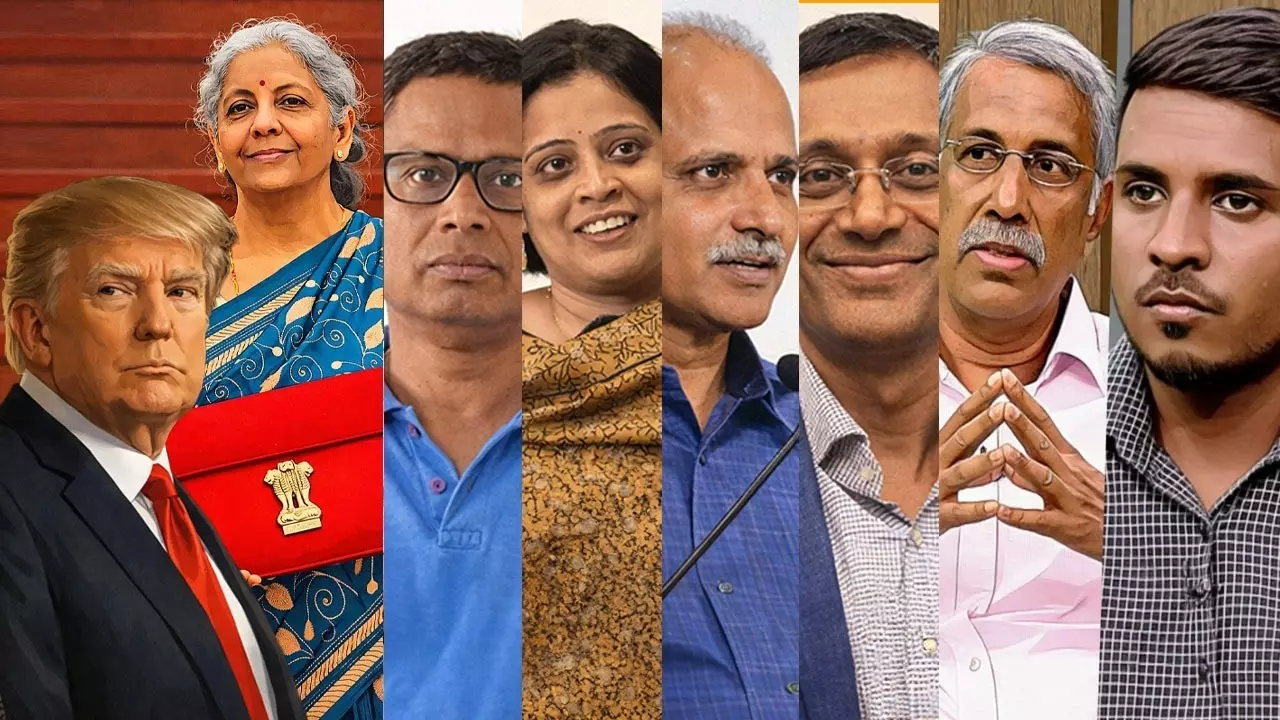
Budget 2026: What to expect from FM Sitharaman | Experts explain
While the Economic Survey projects a stable growth trajectory, The Federal's Editor-in-Chief S. Srinivasan said India would need sustained growth of 8 per cent to 10 per cent to reach its development goals

India heads into the Union Budget season with macroeconomic indicators showing relative resilience. The economy is expected to grow about 7.3 per cent in FY26, while retail inflation has fallen well below the Reserve Bank of India’s (RBI) tolerance band. Yet economists and policy analysts warn that these figures mask persistent structural weaknesses, particularly weak private investment, stagnant real wages and fragile consumption, that Budget 2026 will need to confront.
Also read: Did Budget 2025 keep its promises? Here is a progress report
Speaking at a pre-Budget panel discussion hosted by The Federal, economist and columnist TK Arun said the government’s reliance on tax cuts to stimulate consumption has delivered limited results because investment, not demand, remains the binding constraint on growth.
He noted that India’s demand elasticity of growth is low, citing estimates by the National Institute of Public Finance and Policy (NIPFP).
Reviving private investment
“To expect tax cuts alone to revive growth without reviving investment was unrealistic,” Arun said. Gross fixed capital formation has remained below 30 per cent of GDP for most of the past decade, compared with the 35 per cent required for sustained medium-term growth, he added. With private sector capacity utilisation stuck below 75 per cent, firms have little incentive to add capacity.
Also read: Will Budget 2026-27 give new and old tax regimes a makeover?
Arun argued that infrastructure remains the only viable channel for reviving private investment and called for sector-specific public-private partnership policies. He also cautioned against aggressive fiscal tightening, saying growth should be allowed to drive consolidation rather than sharp expenditure cuts.
Implementation gaps
S. Srinivasan, Editor-in-Chief of The Federal, said GST rationalisation and income tax changes have failed to generate the expected boost to consumption or revenues. While the Economic Survey projects a stable growth trajectory, Srinivasan said India would need sustained growth of 8 per cent to 10 per cent to reach its development goals. “The disconnect lies between projections and outcomes on the ground,” he said, pointing to implementation gaps.
Also read: Why Economic Survey talks about obesity, mobile addiction? AI With Sanket
On the demand side, Vidya Mahambare, Professor of Economics at Great Lakes Institute of Management, Chennai, said temporary tax reliefs do not materially raise consumption unless households see durable increases in income. Real wage growth, she noted, has been close to zero in recent years. Since only a small proportion of Indians pay direct income tax, the transmission of tax cuts to aggregate demand is inherently limited.
“Without growth in real wages and income stability, consumption will remain weak regardless of headline inflation,” Mahambare said.
Corporate tax cuts
The panel debated why corporate tax cuts and incentive schemes such as the Production-Linked Incentive programme have not triggered a broad investment cycle.
Ampa Palaniappan, President of Ampa Group and Vice-President of the South Indian Chamber of Commerce and Industry, said investment decisions operate on longer time horizons and argued that lower interest rates, the proposed India-EU free trade agreement and regulatory improvements could support capital formation over the next five years.
However, The Federal’s Business Editor Prasanna Mohanty said data does not support expectations of an imminent revival. He cited weak real wage growth, slowing job creation and reports showing repeated withdrawal of private investment proposals. “Without income growth, consumption cannot revive, and without consumption, capacity utilisation will remain low,” Mohanty said.
Fiscal strategy
The discussion also addressed fiscal strategy. While acknowledging progress in reducing the fiscal deficit from pandemic-era peaks, panellists broadly agreed that further consolidation should not come at the expense of growth. Mohanty cited post-pandemic research by the International Monetary Fund suggesting that countries exceeding traditional deficit thresholds have often performed better when spending is growth-enhancing.
Geopolitical risks were another focus. Arun said rising global uncertainty and weakening multilateral trade and security frameworks require India to increase spending on defence, research and strategic preparedness. He argued that fiscal resources could be freed by rationalising subsidies and refocusing central government spending on constitutionally mandated responsibilities, leaving welfare delivery largely to states.