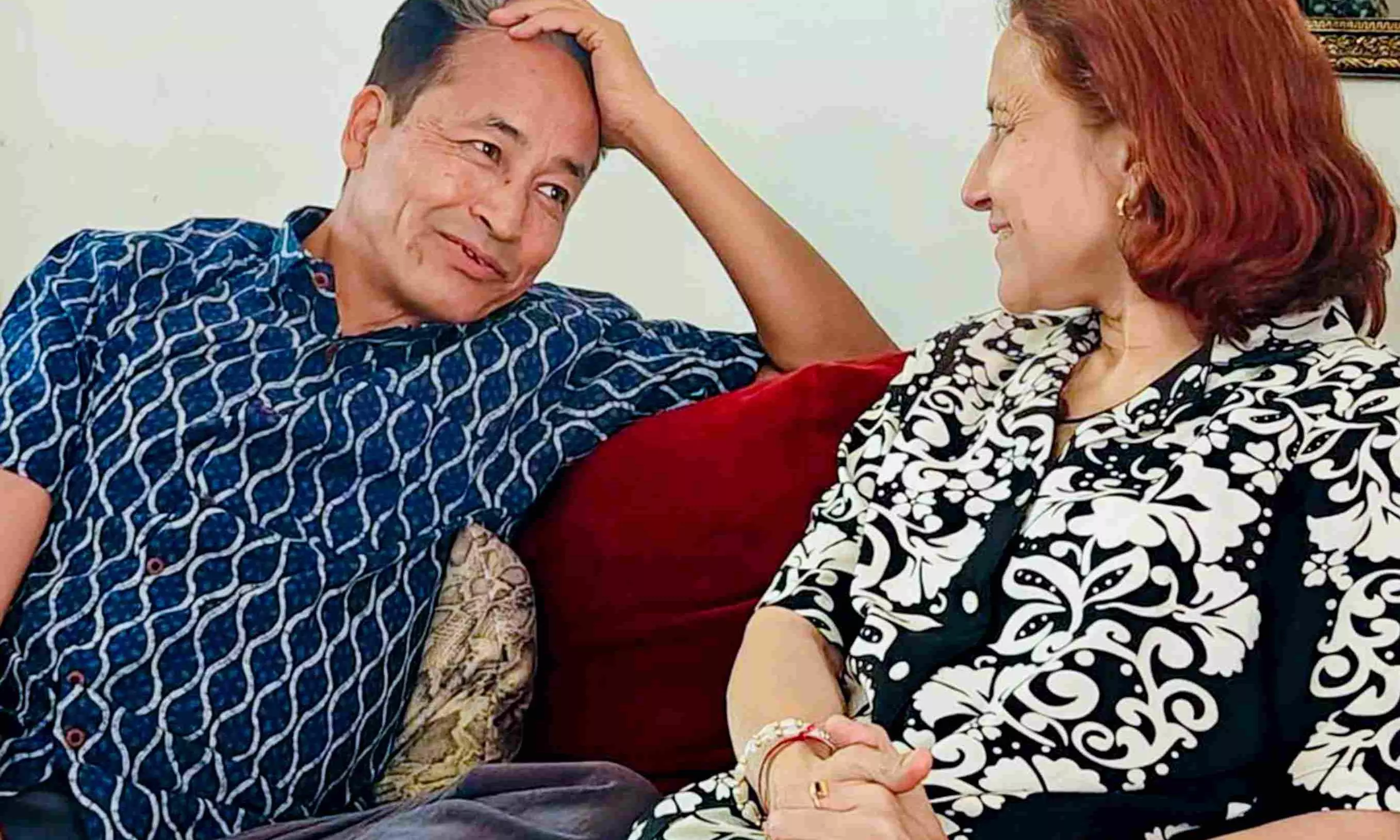
Climate activist Sonam Wangchuk with spouse Gitanjali J Angmo at a hospital for a medical check-up after his release from Jodhpur Central Jail following the revocation of his detention under the NSA on Saturday, March 14, 2026. Photo: X|@GitanjaliAngmo via PTI
What is really behind govt's change of heart on Sonam Wangchuk?
As Iran-Israel conflict reshapes global alliances and a new LG takes charge in Leh, New Delhi moves to quiet internal dissent on the sensitive Chinese border

Ladakh activist Sonam Wangchuk has finally been set free from Jodhpur Jail. This has come as a big surprise to many as the Union government decided to revoke National Security Act (NSA) slapped on him for allegedly inciting treacherous trouble in the Ladakh capital of Leh last September.
But what prompted the government to suddenly have a change of heart and show mercy to Wangchuk after about six months of his detention, under the dreaded law in a Rajasthan jail, so far off from Ladakh, remains a moot point.
Reasons for release
The general impression touted by the media is that the government has relented to release Wangchuk because the Supreme Court hearing a petition filed by his wife against the arrest had red flagged the government’s case for his detention.
Another hearing was billed in the top court for Tuesday, March 17, and, thus, just days before facing the court once again the government decided to release Wangchuk in order to escape a possible reprimand by the Supreme Court for the rather unjustified arrest.
Also read: ‘Big victory’, says Leh Apex Body as leaders welcome Wangchuk’s release
But the sheer timing of the government step points to the possibility of other reasons having played a likely role in Wangchuk’s unexpected though may be genuinely deserved release.
New LG in Leh
A new Lieutenant Governor (LG) has taken over in Leh to run the nearly seven-year-old Union Territory. Soon after the Delhi’s notification of revocation of NSA against Wangchuk, the LG Vinai Saxena took to social media to welcome the reprieve given to Wangchuk by the Centre. Saxena virtually extended an olive branch to the climate activist Wangchuk through a tweet from his official handle on Saturday, March 14.
Saxena’s ascent to the top post of the border province, after he served as LG in Delhi for several years, has come at a time when nearly half of the Union Territory now under his reins is restive. This is largely because of the US-Israel war against Iran.
The Kargil region of the UT is overwhelmingly inhabited by Shia Muslims, who have been disappointed by India’s deepening ties with Israel and the US amidst or even since before the US-Israeli attack on Iran and now also Lebanon.
Iran war fallout
There have been huge demonstrations in Kargil in the wake of assassination of Iran’s Supreme leader Ayatollah Seyyed Ali Khamanei on February 28 and demonstrators have been critical of the absence of condolences from Prime Minister Narendra Modi over the Ayatollah’s death.
The Iran war came at a time when the other Buddhist half of the province had already been averse to the Centre because of Wangchuk’s last year’s agitation for climate and tribal rights of the Ladakhi people. These include grazing rights of the flocks herded by Ladakh’s shepherds in parts of areas which troops from the neighbouring China have started claiming to be theirs.
Also read: Sonam Wangchuk to be released as govt revokes detention under NSA
Wangchuk has been raising this until his arrest last year even as government tried to underplay Chinese incursions into the grassy meadows that have for long been frequented by sheep raring communities of Ladakh.
China factor
Wangchuk was once stopped by Indian forces when he and his cohorts tried to lead shepherds and their flock to the areas forbidden by the Chinese for the grazing of Ladakhi animals. Informed sources say that this tiff proved to be costly for Wangchuk and he was eventually arrested under NSA. But with time, India’s position seems to be taking a turn away from China; and it is getting more favourably tilted towards the US.
The war in Iran appears to be playing a role in this as China has been backing Tehran. This may well further accentuate the Chinese threat for India. And, thus, the government may not like anymore to muffle the voice of an academic-turned-activist like Wangchuk in Ladakh bordering China.
Significantly, the US President Donald Trump is expected to visit Beijing for three days at the end of this month. It makes the government's move to release Wangchuk look even more strategically timed, as the Indo-China border issue and India’s worries about this are felt rather than being conveniently forgotten.
Wangchuk and his recent plight at least remind about the issue though may be in subtle way.